
Voyager 2 instruments preserve sole direct science in interstellar space
This digest was compiled by AI from multiple sources — links to the originals are below.
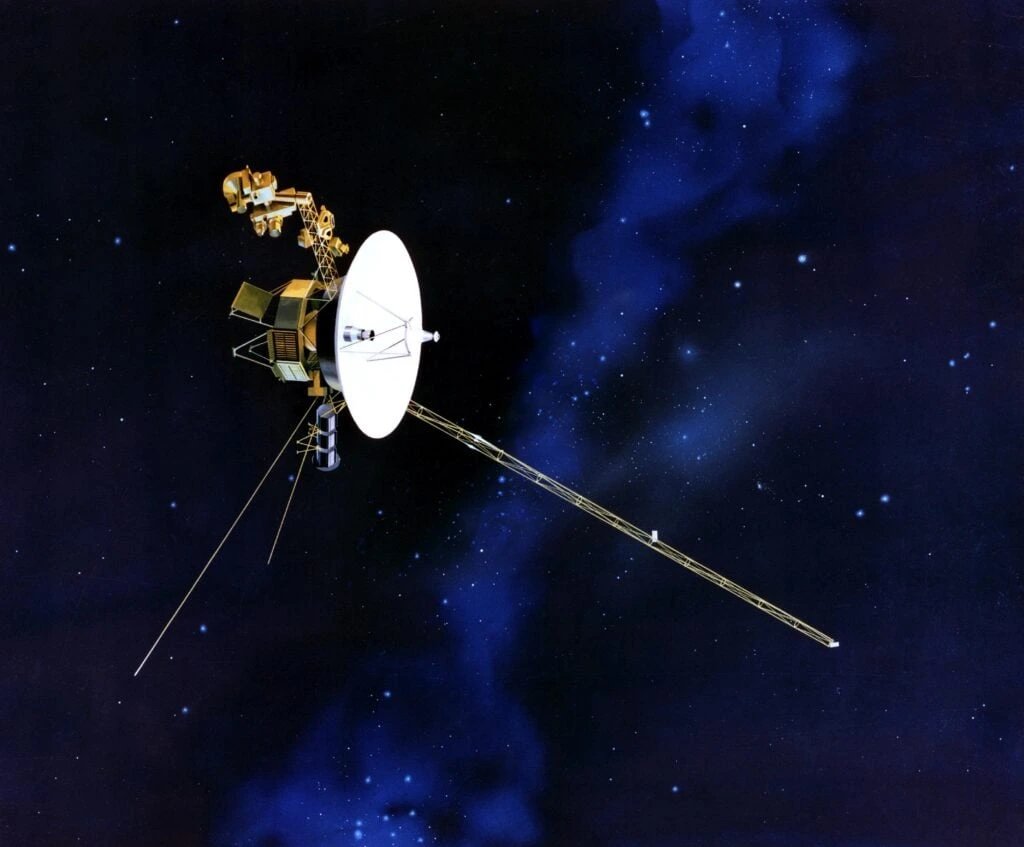
NASA's July 2026 power reconfiguration on Voyager 2 keeps all three remaining science instruments operating for at least an extra year. The spacecraft is one of only two working probes beyond the heliopause, with no approved successor to take over their measurements. The saved power preserves humanity's only direct scientific presence in interstellar space.
Key Facts
- NASA announced on 4 August that the Big Bang power operation on Voyager 2 should keep all three remaining science instruments operating for at least an extra year.
- Voyager 1 and Voyager 2 are the only working probes beyond the heliopause, and no approved successor is being built to take over their measurements.
- Voyager 2's three active instruments are the cosmic ray subsystem, magnetometer, and plasma wave subsystem.
- Voyager 1, after another shutdown in April 2026, continues with its magnetometer and plasma wave subsystem.
The Big Bang Power Operation
NASA announced on 4 August that engineers had successfully freed power on Voyager 2 through an operation nicknamed the Big Bang. Several powered devices were turned off together and replaced with lower-power alternatives, without allowing the spacecraft to become too cold to work. The agency says the saving should keep all three remaining science instruments operating for at least an extra year.
The Three Surviving Instruments
Voyager 2 launched with ten science instruments, but cameras, spectrometers and other systems built for planetary encounters were retired after their work ended. The three still operating are the cosmic ray subsystem, magnetometer and plasma wave subsystem, all identified as active on Voyager 2 by NASA's current instrument list. The magnetometer measures the strength and direction of the local magnetic field, which helps organise how charged particles move. The plasma wave subsystem listens for electrical oscillations, allowing researchers to infer local electron density from their frequency. The cosmic ray subsystem detects high-energy particles and measures their energy and composition, sampling a particle environment no longer enclosed by most of the Sun's shielding influence.
No Successor Mission
Voyager 1 and Voyager 2 are the only working probes beyond the heliopause, the boundary between the heliosphere shaped by the solar wind and the surrounding interstellar medium. No approved successor is being built to take over their measurements. The saved watts preserve humanity's only direct, working scientific presence in interstellar space at a time when there is no funded handover mission waiting behind Voyager.
1 source
Time · lag behind first