
University of Queensland develops cyborg cockroach for disaster first aid
This digest was compiled by AI from multiple sources — links to the originals are below.
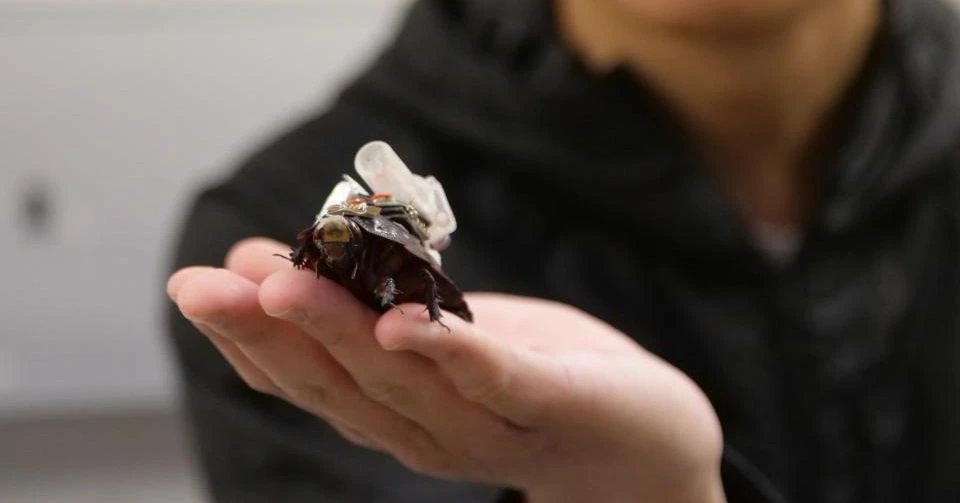
Researchers at the University of Queensland and the University of New South Wales have developed a cyborg cockroach, the Paraborg, capable of searching for disaster victims and administering first aid. The team remotely steers the insect via electrodes in its antennae and cerci, with one variant carrying a camera and another an automatic injection mechanism. The system is designed to buy rescuers time in collapsed structures where conventional robots cannot reach.
Key Facts
- The Paraborg is based on the giant burrowing cockroach of northern Queensland, which reaches 87 millimeters in length and 40 grams in weight.
- Two Paraborg variants were built: one with a camera to film victims and one with an automatic injection mechanism to administer medication.
- Researchers steer the cockroach by applying electrical stimuli of 10–40 hertz to electrodes in its antennae and cerci; frequencies above 50 hertz lose effectiveness over time.
- The injection mechanism uses a spring-loaded syringe triggered by a chemical reaction between citric acid and baking soda that generates carbon dioxide.
- The study was published in the journal Advanced Science.
The Paraborg Design
The Paraborg is built on the giant burrowing cockroach native to northern Queensland, which can grow to 87 millimeters and weigh up to 40 grams. The team developed two versions: one equipped with a camera to film the condition of disaster victims, and another with an automatic injection mechanism to administer medication. Cockroaches can carry up to 1.5 times their body weight, and the injection-equipped version added about 15 millimeters in height and 17 grams in weight without significantly impairing movement. Electrodes and microchips were attached under anesthesia, and the insects lived normally once the equipment was removed.
Remote Steering Mechanism
Researchers control the cockroach's direction and walking speed by applying electrical stimuli to electrodes embedded in its antennae and cerci. Stimulating each antenna independently steers the insect, while stimulating both cerci controls its pace. The team used frequencies between 10 and 40 hertz after finding that anything over 50 hertz became ineffective over time.
Injection Mechanism
The injection mechanism is a small device that deploys a syringe using a spring system. The spring triggers a process that breaks the seal between a chamber containing citric acid and another containing baking soda. The resulting chemical reaction creates enough carbon dioxide to push the plunger on the syringe and administer medication.
1 source
Time · lag behind first