
Betelgeuse's northeast hotspot persisted from 2015 to 2023, outlasting convective models
This digest was compiled by AI from multiple sources — links to the originals are below.
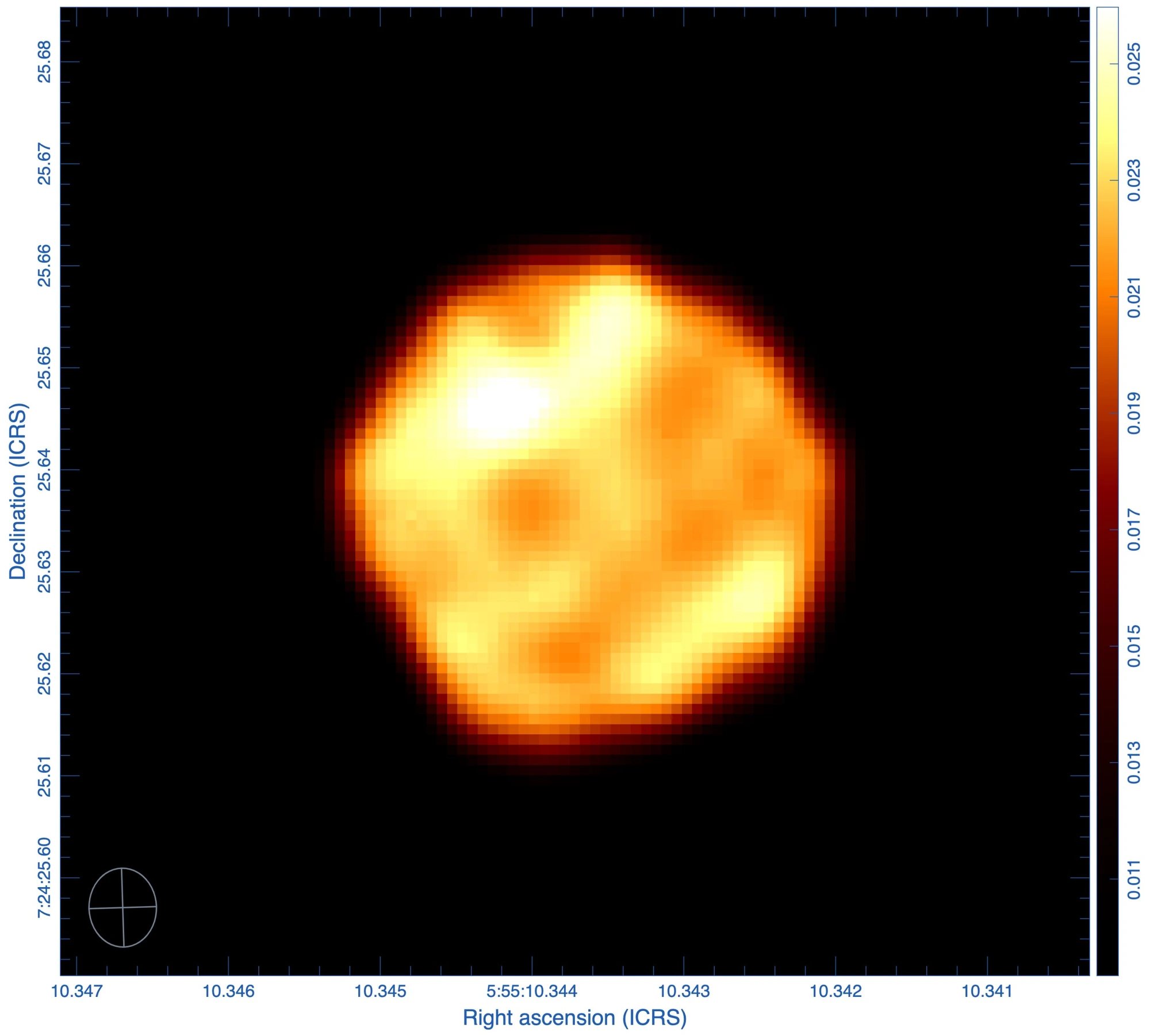
A bright patch on Betelgeuse's northeastern limb remained at nearly the same location and intensity in ALMA images taken in 2015 and 2023. The persistence outlasts lifetimes current models assign to the star's largest convective structures. The finding comes from new work led by Bill Dent of ESO, described by the ALMA Observatory and detailed in an arXiv preprint.
Key Facts
- The northeastern hotspot on Betelgeuse appeared at nearly the same location and intensity in ALMA images from 2015 and 2023.
- The 2023 observations used ALMA's longest baseline configuration, achieving a resolution of about 7 milliarcseconds.
- The hotspot is up to about 800 K hotter than the surrounding gas, against an average temperature of about 2300 K in the lower atmosphere.
- ALMA measurements show variations in Betelgeuse's apparent radius of up to about 6 percent.
- The work is led by Bill Dent of ESO and is in press at Astronomy & Astrophysics.
The Persistent Hotspot
A bright patch on the northeastern limb of Betelgeuse sat in nearly the same place, at nearly the same intensity, in ALMA images taken more than seven years apart — 2015 and 2023. The persistence outlasts the lifetimes current models assign to the star's largest convective structures. The 2023 observations used ALMA's longest baseline configuration, reaching a resolution of roughly 7 milliarcseconds — fine enough to break the star's disc into patches rather than treat it as a single smeared point of light. Betelgeuse lies about 600 light-years away and carries a radius roughly 800 times the Sun's.
Temperature Map and Convection
What ALMA resolves at millimetre wavelengths is not the optical photosphere but the lower atmosphere just above it — the layer where the star's outward flow of material is still being assembled. Across that layer the average temperature comes in around 2300 K. The observations show hotter regions toward the northeast and the southwest, and the brightest of them, the northeastern spot, runs up to about 800 K hotter than the gas around it. Betelgeuse is a red supergiant, and the standard picture of its outer envelope is convection on a monstrous scale: a small number of enormous rising cells, each comparable in size to a substantial fraction of the visible disc, carrying heat up from the interior, spreading, cooling, and sinking again. Models of these giant convective structures give them lifetimes — and those lifetimes are the number the new observations run against.
Radius Variations and Comparison
There is a second measurement folded into the same data: the star's apparent radius is not fixed, with ALMA finding variations of up to about 6 percent depending on where and when you measure the edge. A star whose boundary moves by that much is not a sphere with a surface so much as a swollen, ragged atmosphere with a statistical outline. The 2015 comparison is what turns a snapshot into an argument: ALMA had observed Betelgeuse in a similar 0.9-millimetre configuration roughly seven years before the 2023 long-baseline run, and the northeastern hotspot appears in both epochs at nearly the same location on the disc, with similar intensity. The conservative reading of two epochs is a lower bound: the feature has persisted for at least seven years.
1 source
Time · lag behind first