
Saturn's 1992 gravity shove triggered 450P/LONEOS comet activity, study finds
This digest was compiled by AI from multiple sources — links to the originals are below.
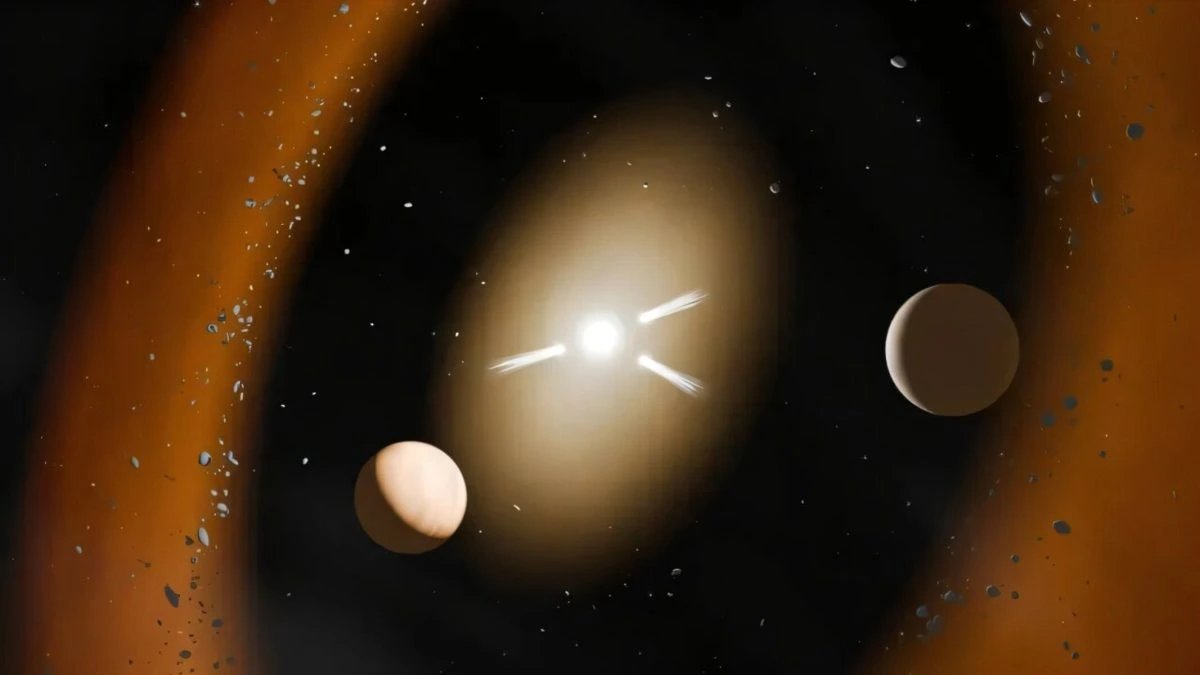
Astronomers have linked a 1992 close pass by Saturn to the recent comet-like activity of icy body 450P/LONEOS. Observations from Gemini North and the James Webb Space Telescope show a faint coma and dust production emerging more than two decades after the encounter. The findings, published in The Planetary Science Journal, trace the object's transition from Centaur to Jupiter-family comet.
Key Facts
- 450P/LONEOS passed within about 4.6 million kilometres of Saturn in 1992, and Saturn's gravity pulled its orbit markedly inward.
- Gemini North began following 450P/LONEOS as it returned towards the Sun, and a faint coma appeared with rising dust production.
- The James Webb Space Telescope detected carbon dioxide, dust and solid water ice in the coma, but no water vapour or carbon monoxide.
- The study, published in The Planetary Science Journal, combines observations from 2019 through 2024 and was led by Charles Schambeau of the University of Central Florida.
The Saturn Encounter
In 1992, the icy body now called 450P/LONEOS came within about 4.6 million kilometres of Saturn. Saturn's gravity pulled its orbit markedly inward, but the close pass lasted only hours and produced no instant plume. Heat takes time to move through a porous, insulating nucleus, so the effect of the encounter was delayed. More than two decades later, Gemini North began following the object as it returned towards the Sun.
Coma Composition
The James Webb Space Telescope read the coma in infrared light and found carbon dioxide, dust and solid water ice. No water vapour or carbon monoxide was detected, but a subtle spectral feature may reveal crystalline water ice. Crystalline water ice is a sign that some material has been heated or physically processed. Together, the observations and orbital modelling show a Centaur receiving a gravitational shove, experiencing stronger sunlight, and displaying gas-and-dust activity associated with a comet.
Centaur to Comet Transition
Centaurs are small bodies whose orbits run among the giant planets, broadly between Jupiter and Neptune. Many are thought to have been scattered inward from the trans-Neptunian region after forming in the cold outer Solar System. 450P/LONEOS was discovered in 2004 by the Lowell Observatory Near-Earth Object Search and initially received the designation P/2004 A1. Because its activity was recovered on a later return, it now has the numbered periodic-comet name 450P. Astronomers are watching the beginning of a physical and dynamical transition that may eventually place it among the Jupiter-family comets.
1 source
Time · lag behind first