
Interstellar comet 3I/ATLAS carries water 30 times richer in deuterium than solar system comets
This digest was compiled by AI from multiple sources — links to the originals are below.
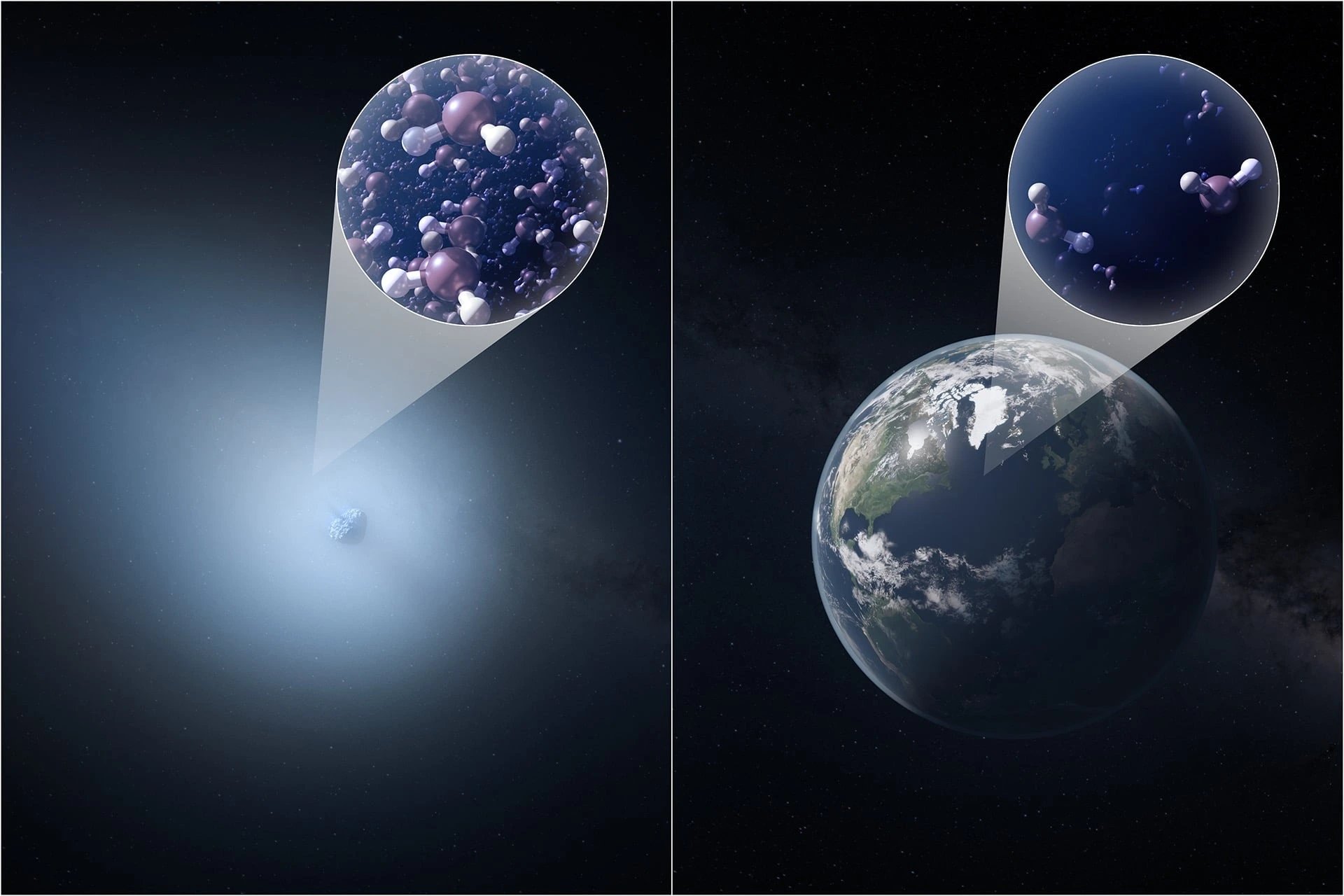
Astronomers analyzing interstellar comet 3I/ATLAS found its water enriched in deuterium by more than 30 times compared with typical solar system comets. The James Webb Space Telescope independently measured the deuterium-to-hydrogen ratio at 0.98 percent. The finding points to ice formed below 30 kelvin in another star system.
Key Facts
- The water in interstellar comet 3I/ATLAS is enriched in deuterium by more than 30 times compared with the typical value for solar system comets.
- The James Webb Space Telescope measured the deuterium-to-hydrogen ratio in 3I/ATLAS at 0.98 plus or minus 0.06 percent.
- 3I/ATLAS was reported by the NASA-funded ATLAS survey telescope at Rio Hurtado, Chile, on 1 July 2025.
- The comet reached perihelion on 29 October 2025 at about 1.36 astronomical units from the Sun, just inside Mars's orbit.
- 3I/ATLAS is only the third confirmed interstellar object, after 1I/'Oumuamua and 2I/Borisov.
Chemical Fingerprint
The strongest clue to the comet's origin was not simply water, but the balance between two kinds of hydrogen inside it. A 2026 Nature Astronomy analysis found that the water in 3I/ATLAS was enriched in deuterium, or heavy hydrogen, by more than 30 times compared with the typical value for solar system comets. Later observations with the James Webb Space Telescope independently measured the ratio at 0.98 plus or minus 0.06 percent. That chemical imbalance points to ice formed at temperatures below roughly 30 kelvin, then spared enough warmth and mixing to preserve its original isotope record.
Discovery and Orbit
The NASA-funded ATLAS survey telescope at Rio Hurtado in Chile reported the object on 1 July 2025. Astronomers quickly established that its orbit was hyperbolic: it was moving too fast to be bound to the Sun in a repeating ellipse. As NASA's 3I/ATLAS overview explains, it was only the third confirmed object known to arrive from interstellar space, after 1I/'Oumuamua and 2I/Borisov. Unlike the apparently inactive 'Oumuamua, 3I/ATLAS developed a bright gaseous coma, making it the second interstellar visitor with clearly resolved outgassing after Borisov. The comet reached perihelion on 29 October 2025 at about 1.36 astronomical units from the Sun, just inside Mars's orbit, and never threatened Earth.
Isotope Ratio Meaning
Ordinary hydrogen has one proton in its nucleus, while deuterium has one proton plus a neutron, making the atom about twice as massive. Astronomers compare the number of deuterium atoms with the number of hydrogen atoms and report the deuterium-to-hydrogen, or D/H, ratio. The headline figure describes that ratio inside the water; it does not mean the comet contains 30 times as much total water, nor that one molecule in 30 is pure heavy water. A synthesis of solar system comet measurements places ordinary cometary water around a D/H value of 0.029 percent on average, with object-to-object variation.
1 source
Time · lag behind first