
Webb detects carbon in Jupiter-mass exoplanet orbiting pulsar 2,050 light-years away
This digest was compiled by AI from multiple sources — links to the originals are below.
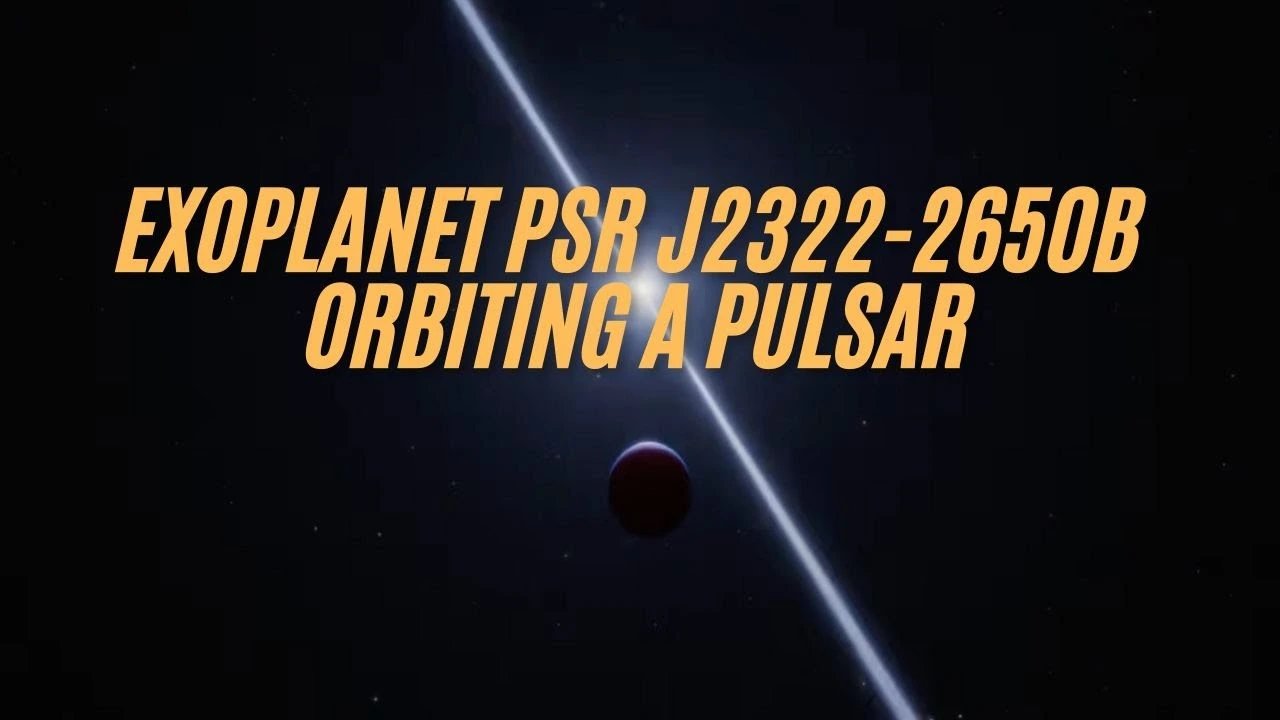
The James Webb Space Telescope detected molecular carbon in the infrared spectrum of PSR J2322-2650b, a Jupiter-mass companion orbiting a millisecond pulsar every 7.8 hours. The atmosphere appears helium-dominated with carbon clouds, and tidal forces distort the planet into a lemon-like shape. The system lies about 2,050 light-years from Earth, not the previously reported 750 light-years.
Key Facts
- Webb detected C2 and C3 carbon bands in the infrared spectrum of PSR J2322-2650b.
- The companion orbits the pulsar every 7.8 hours and has roughly the mass of Jupiter.
- No measurable signatures of water, methane, or carbon dioxide were found.
- The system's distance is about 2,050 light-years, based on a 2024 MeerKAT timing study and updated radio timing.
- The pulsar spins once every 3.5 milliseconds and contributes little infrared light in Webb's NIRSpec band.
Atmospheric Composition
Webb's NIRSpec instrument detected molecular carbon in the infrared spectrum of PSR J2322-2650b. The data show no measurable signatures of water, methane, or carbon dioxide. A helium-dominated atmosphere with carbon clouds fits the observed spectrum. Carbon physics allows diamonds to form deeper inside the planet.
Distance Revision
The widely repeated distance of 750 light-years comes from the 2017 discovery paper, which used a parallax of 4.4 ± 1.2 milliarcseconds. A 2024 MeerKAT timing study reported roughly 0.8 kiloparsecs, much closer to an earlier dispersion-measure estimate. The Webb analysis adopted 630 parsecs, about 2,050 light-years, based on new radio timing. Distance matters because converting measured flux into emitted power requires a distance and an assumed radius.
Observational Advantage
The host pulsar has about the mass of the Sun compressed into an object the size of a city. It spins once every 3.5 milliseconds and sweeps radio pulses across Earth. The pulsar contributes little infrared light in Webb's NIRSpec band, allowing a cleaner measurement of the companion. Webb followed the companion's own emission through an entire orbit while the host was effectively invisible to the instrument.
1 source
Time · lag behind first