
Jupiter's north pole holds nine cyclones, not one storm, Juno data show
This digest was compiled by AI from multiple sources — links to the originals are below.
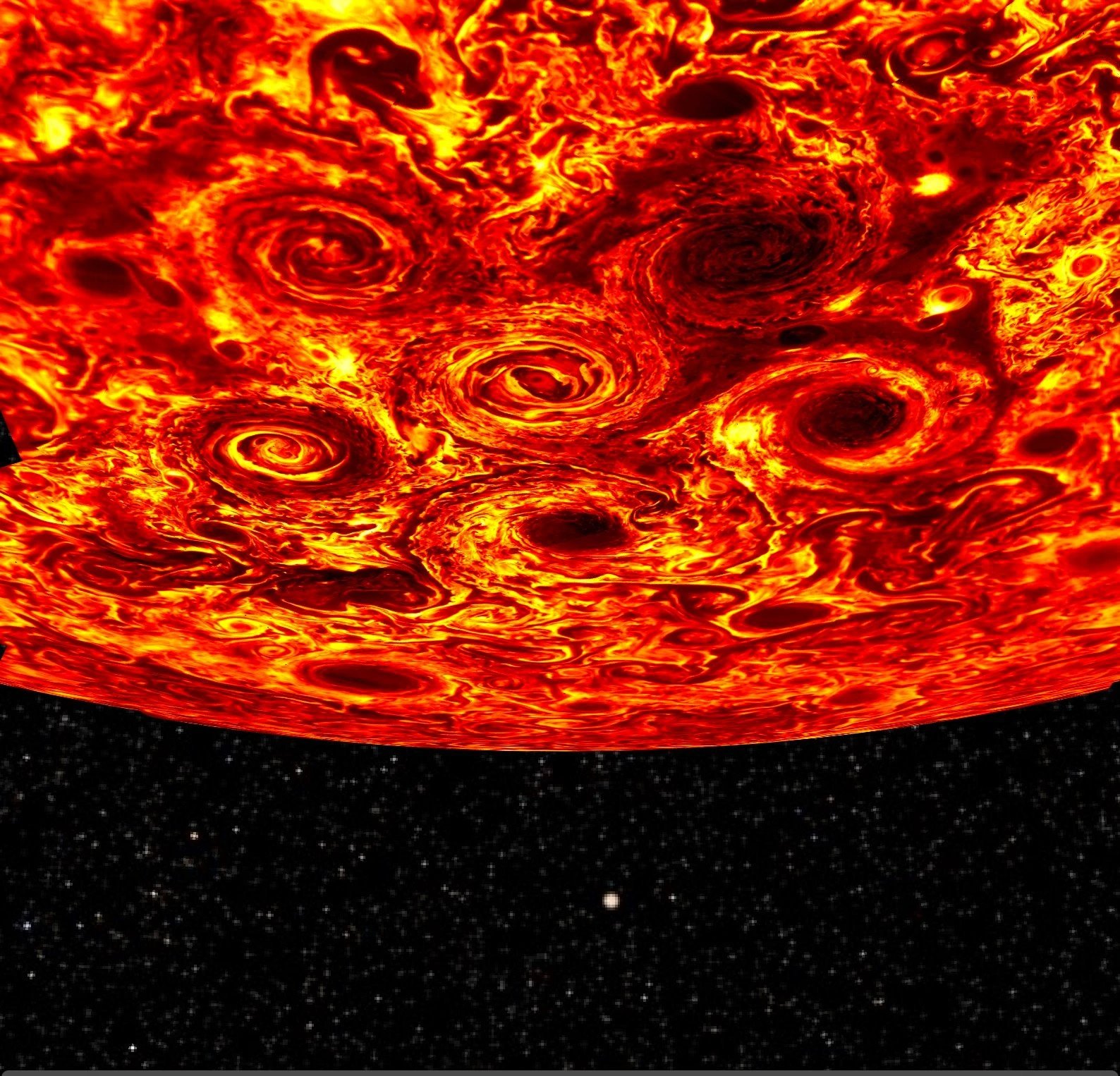
Jupiter's north pole contains a central cyclone surrounded by eight others, each 4,000 to 4,600 kilometers wide with winds up to 350 kilometers per hour. NASA's Juno spacecraft revealed the pattern after entering orbit in July 2016, providing the first direct polar views. The nine cyclones drift slowly westward while maintaining their ring formation.
Key Facts
- Jupiter's north pole has one central cyclone and eight circumpolar cyclones, each 4,000 to 4,600 kilometers wide.
- Winds in some polar storms reach 350 kilometers per hour.
- NASA's Juno spacecraft entered Jupiter orbit in July 2016 and provided the first direct polar observations.
- The eight outer cyclones lie at roughly 84 degrees north latitude and drift slowly westward.
Polar Cyclone Structure
Jupiter's north pole contains nine distinct cyclone cores: one near the pole and eight in a surrounding ring. The outer cyclones are roughly 4,000 to 4,600 kilometers across, with some spanning more than the distance from London to Baghdad. Winds can reach about 350 kilometers per hour, and the spiral arms of neighboring storms brush against one another. Despite the crowding, the cyclone cores do not merge into a single polar vortex.
Juno Observations
NASA's Juno spacecraft entered orbit in July 2016 and followed elongated paths over Jupiter's north and south poles. The visible-light JunoCam instrument supplied detailed cloud images, while the Jovian Infrared Auroral Mapper detected thermal radiation even in darkness. A 2018 Nature paper described one polar cyclone and eight circumpolar cyclones in the north, and a central cyclone with five companions in the south. In an April 2025 presentation, mission scientist Yohai Kaspi compared the storm interactions to masses bouncing against springs.
Storm Dynamics
Each storm wanders around a preferred position while the whole group slowly drifts westward. The spring-like behavior emerges because a displaced cyclone changes atmospheric forces, creating a tendency to move back. The eight outer cyclones lie at roughly 84 degrees north latitude, forming an approximate octagon from storm positions rather than cloud boundaries.
1 source
Time · lag behind first