Jupiter was twice its current radius 3.8 million years after solar system formed
This digest was compiled by AI from multiple sources — links to the originals are below.
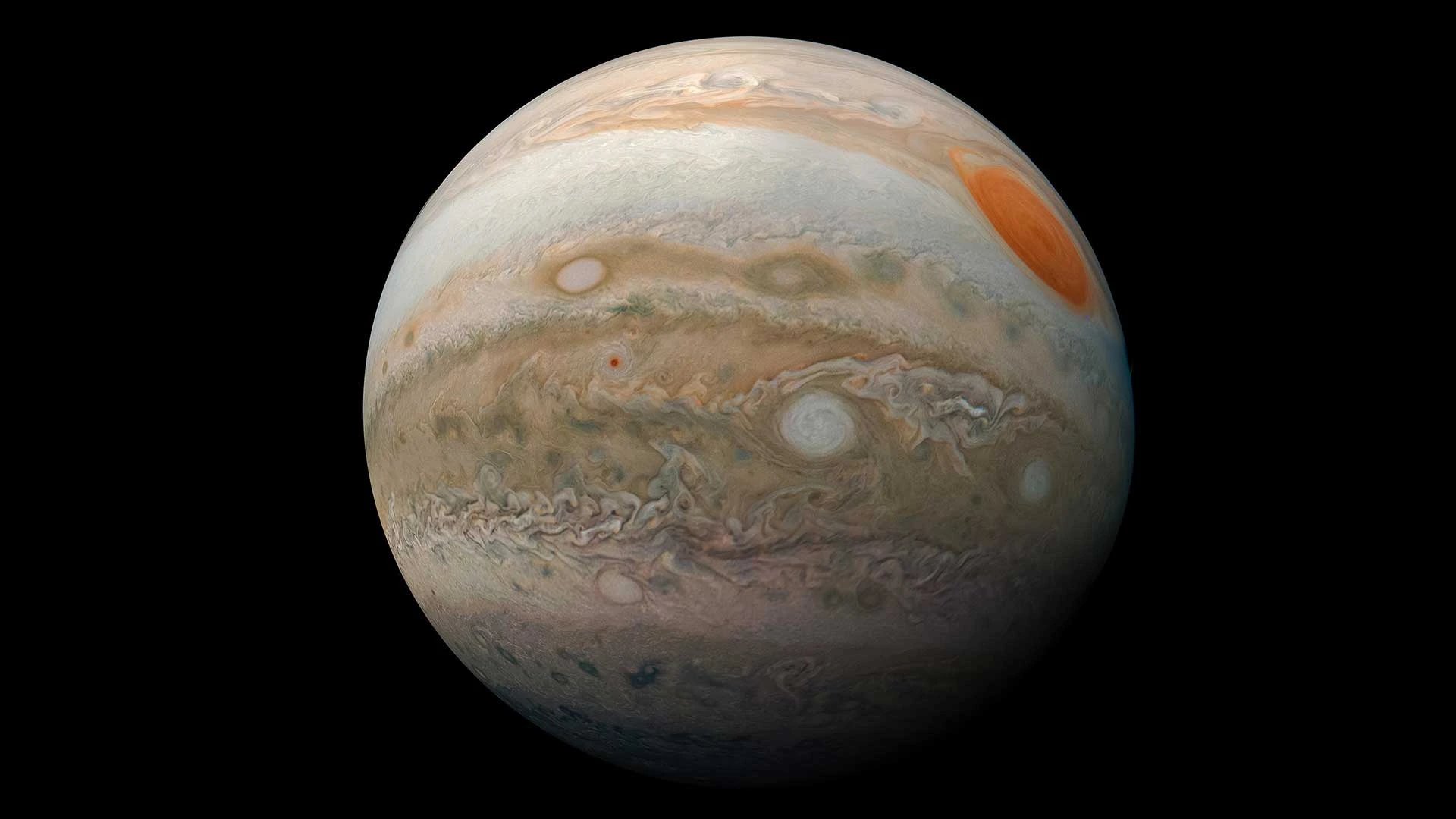
Jupiter was between 2.0 and 2.56 times its present radius 3.8 million years after the solar system's first solids formed, according to a 2025 Nature Astronomy study by Caltech scientists Konstantin Batygin and Fred C. Adams. The reconstruction is based on orbital tilts of the small moons Amalthea and Thebe. The study also implies a surface magnetic field near 21 millitesla, about 50 times today's value.
Key Facts
- Jupiter was between 2.0 and 2.56 times its present radius 3.8 million years after the first solar-system solids formed, according to a 2025 Nature Astronomy study.
- The study implies a characteristic surface magnetic field near 21 millitesla, roughly 50 times today's value.
- Amalthea has an orbital inclination of about 0.36 degrees and Thebe about 1.09 degrees relative to Jupiter's equatorial plane.
- Amalthea orbits Jupiter at about 181,400 kilometres with a mean radius of roughly 84 kilometres, while Thebe has a mean radius near 49 kilometres.
- The study was conducted by Caltech planetary scientists Konstantin Batygin and Fred C. Adams.
Orbital Tilts as Evidence
Amalthea and Thebe travel on orbits tilted slightly away from Jupiter's equatorial plane, with angles of about 0.36 degrees and 1.09 degrees respectively. Batygin and Adams treated those tilts as surviving traces of resonances that swept across the moons after the gas around young Jupiter disappeared. A resonance occurs when orbital frequencies enter a simple numerical relationship, and under the right conditions a passing resonance can change an orbit's inclination. The researchers numerically followed several relevant second-order inclination resonances and found that Amalthea's present inclination was consistent with a resonance crossing as Io migrated outward. Thebe's larger tilt could be reproduced through a sequence involving the 6:4, 5:3 and 4:2 resonances.
Model-Based Reconstruction
The reconstruction placed Jupiter at between about 2.0 and 2.56 times its present radius 3.8 million years after the first solar-system solids formed. A separate dynamo scaling then implied a characteristic surface magnetic field near 21 millitesla, roughly 50 times today's value. These are model-based inferences, not direct measurements of an ancient planet. Understanding the result means following a chain that runs from two small moons, through Io's orbital migration and the edge of a vanished disk, to Jupiter's contraction and magnetic interior.
Limits of the Method
Collisions, tides and long-term orbital evolution complicate any ancient signal, so the exercise did not turn either moon into a perfect recorder. It did, however, narrow the range of plausible places from which Io began its post-nebular migration. Amalthea and Thebe are small, dark and irregular, and each helps supply material to Jupiter's faint gossamer rings. In this case, their value lies in geometry: a fraction of a degree retained across billions of years can carry information about a much larger moon's movement at an epoch no spacecraft could observe.
1 source
Jupiter was twice its current radius 3.8 million years after solar system formed