
NASA JPL tests 120 kW electric thruster, 25 times Psyche mission power
This digest was compiled by AI from multiple sources — links to the originals are below.
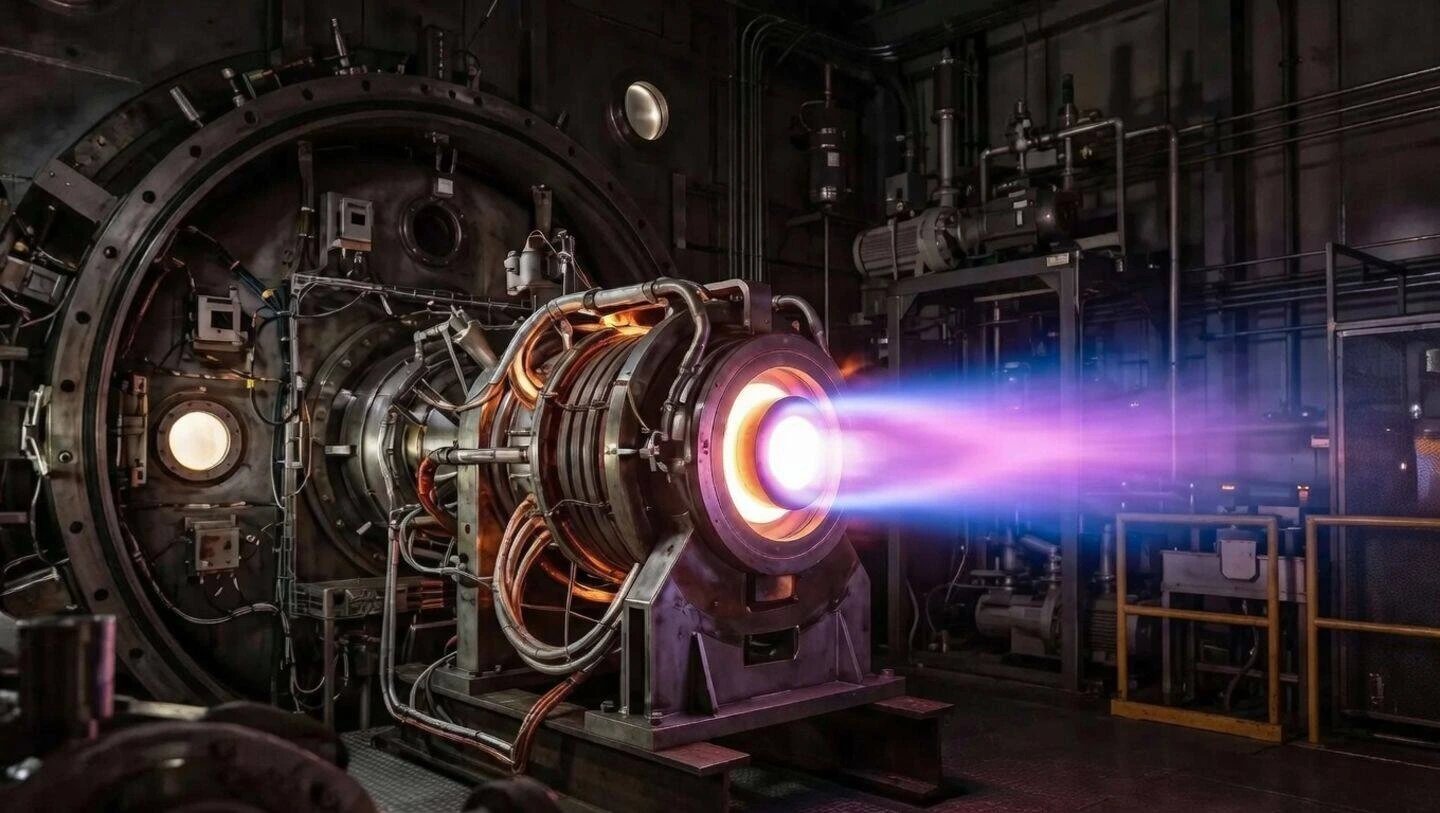
NASA's Jet Propulsion Laboratory operated a prototype electric thruster at 120 kilowatts on 24 February 2026, more than 25 times the power of the thrusters on the Psyche asteroid mission. The test occurred inside an eight-metre vacuum chamber at JPL, with the central tungsten electrode reaching over 2,800 degrees Celsius. The laboratory result opens a route to higher-power electric propulsion, though flight qualification and mission performance remain to be demonstrated.
Key Facts
- The prototype drew 120 kilowatts of electrical power at its highest setting during the 24 February 2026 test.
- NASA's Psyche mission Hall-effect thrusters draw about 4.5 kilowatts, making the JPL test more than 25 times higher in power.
- JPL engineers aim to test a single thruster at between 500 kilowatts and one megawatt, roughly 222 times Psyche's benchmark.
- The central tungsten electrode glowed white at more than 2,800 degrees Celsius inside the eight-metre vacuum chamber.
- JPL did not publish measured thrust, efficiency, or specific impulse at 120 kilowatts in the 28 April announcement.
The Laboratory Test
On 24 February 2026, a new electric thruster came to life five times inside an eight-metre vacuum chamber at NASA's Jet Propulsion Laboratory. Its central tungsten electrode glowed white at more than 2,800 degrees Celsius, and a red plume spread from the mouth of the machine. At its highest setting, the prototype drew 120 kilowatts of electrical power. The JPL announcement issued on 28 April described an initial laboratory test, not an endurance run, a flight qualification or a measured journey to Mars.
Power Versus Thrust
A kilowatt measures how quickly electrical energy enters the propulsion system, while thrust measures force. Two engines can draw the same power while producing different combinations of thrust and exhaust velocity, depending on their efficiency, propellant and design. JPL did not publish a complete performance table with the April release, nor the prototype's measured thrust, efficiency or specific impulse at 120 kilowatts. A higher-power electric thruster does not by itself produce a particular Mars travel time; mission duration depends on vehicle mass, total thrust, propellant loading, exhaust velocity, duty cycle, departure orbit, arrival requirements and the mass of the power system.
Psyche Benchmark
NASA's Psyche mission is cruising towards a metal-rich asteroid with the highest-power electric thrusters currently operating on one of the agency's spacecraft. The active Hall-effect thruster draws about 4.5 kilowatts at the reference level behind JPL's comparison. Psyche carries four Hall-effect thrusters, arranged in two pairs, but operates only one at a time. JPL's engineers now want to test a single thruster at between 500 kilowatts and one megawatt, roughly 222 times Psyche's 4.5-kilowatt benchmark and 8.3 times the February test.
1 source
Time · lag behind first