
LUX-ZEPLIN detector records single dark matter candidate event in South Dakota
This digest was compiled by AI from multiple sources — links to the originals are below.
The LUX-ZEPLIN experiment at the Sanford Underground Research Facility in South Dakota recorded a single data point that could be the first direct detection of a dark matter particle. Researchers are unable to explain the unusual energy signature, which they believe may be the most convincing physical evidence of dark matter to date. The finding was reported in a Lawrence Berkeley National Laboratory preprint that has not yet been peer reviewed.
Key Facts
- The LUX-ZEPLIN experiment contains 10 tonnes of liquid xenon and is located at the Sanford Underground Research Facility in South Dakota.
- The detector seeks evidence of WIMPs by looking for flashes created when such a particle collides with the nucleus of a xenon atom.
- Dark matter makes up about 85 percent of the matter in the universe, according to Wired.
- The finding was reported in a Lawrence Berkeley National Laboratory preprint that has not been peer reviewed.
The Detection Event
More than a kilometer underground, in what used to be a gold mine, inside a tank filled with tons of liquid xenon, a particle struck the nucleus of an atom. The tiny collision left an unusual energy signature that researchers are still unable to explain. The scientists behind the experiment believe this could be the most convincing physical evidence of dark matter to date. The LUX-ZEPLIN experiment at the Sanford Underground Research Facility contains 10 tonnes of liquid xenon. It seeks evidence of a candidate particle called a WIMP by looking for flashes created when such a particle collides with the nucleus of just one xenon atom.
Dark Matter Context
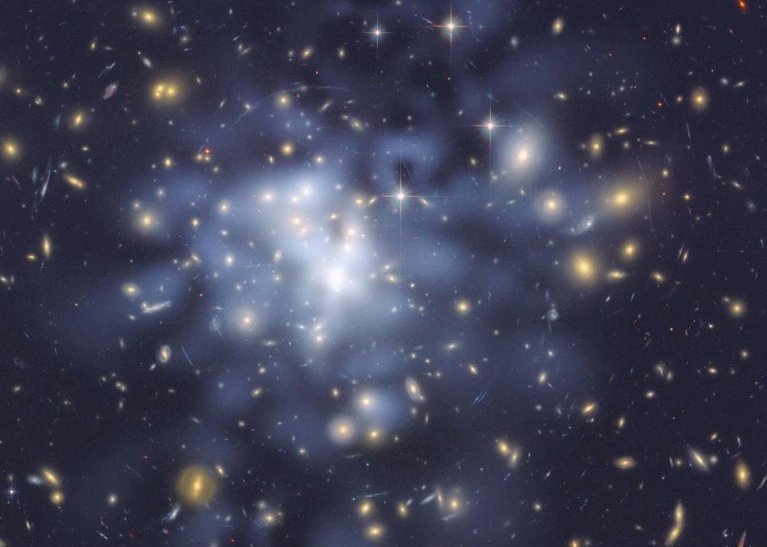
Dark matter is one of the most important and elusive substances in astrophysics. Though it makes up about 85 percent of the matter in the universe, we cannot observe it directly because it does not interact with light or much else. Most of the evidence for its existence comes from its gravitational effects, the mass of dark matter having tugged on the atoms of the early universe to form stars, galaxies, and the vast web of intergalactic structures visible today. Scientists do not know what dark matter is made of, whether it is a single type of particle or an entire set of particles that interact with one another in ways not yet understood. One of the most widely studied theories on dark matter has dubbed its components WIMPs, short for Weakly Interacting Massive Particles, meaning the particles have a mass and thus a gravitational pull but otherwise interact weakly with conventional matter.
Scientific Validation
If the finding can be backed up with more data, it could mean that the material that seems to make up most of the mass of the Universe has finally been discovered. The result was reported in a Lawrence Berkeley National Laboratory preprint that has not been peer reviewed.
2 sources
Time · lag behind first