
LUX-ZEPLIN detector records possible dark matter signal in South Dakota
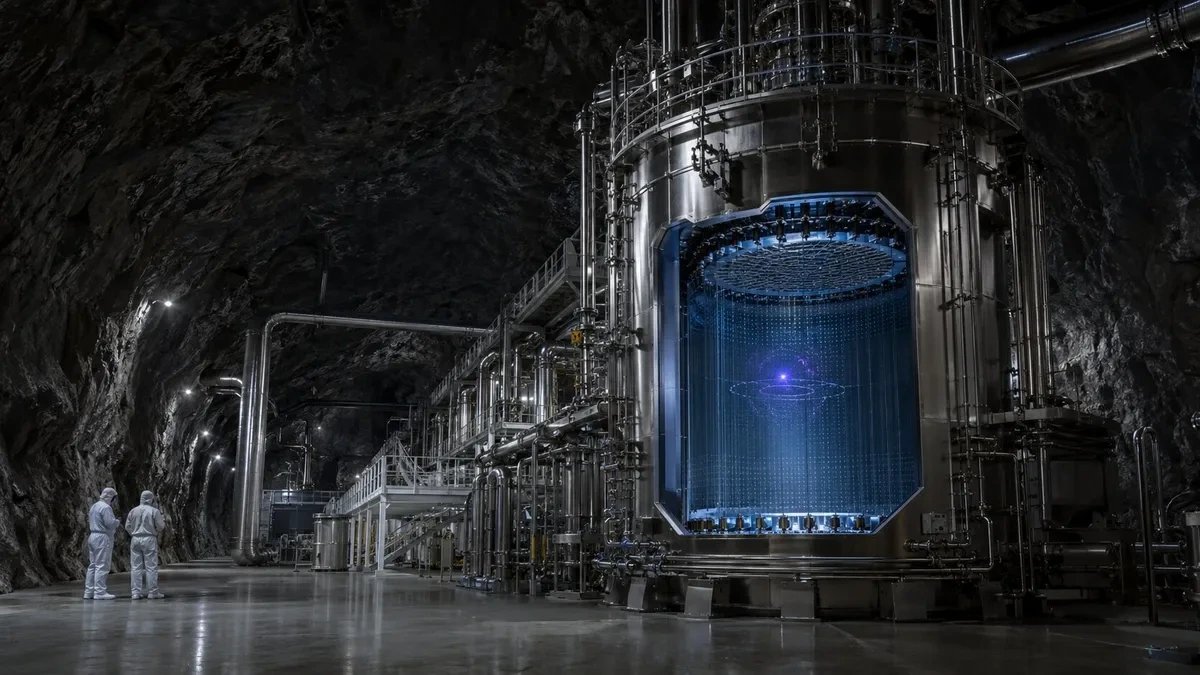
This digest was compiled by AI from multiple sources — links to the originals are below.
The LUX-ZEPLIN experiment in South Dakota recorded a single particle interaction consistent with a WIMP, a leading dark matter candidate. Researchers will now examine whether the signal stems from background radiation or known particles. The event, if confirmed, would mark one of the first direct observations of dark matter.
Key Facts
- The LUX-ZEPLIN detector is located about 1.6 kilometers underground in a former gold mine in South Dakota and uses approximately 10 tons of liquid xenon.
- The detector recorded a single particle interaction that produced a faint ultraviolet flash and a nuclear recoil in a xenon atom.
- Dark matter is estimated to constitute 85 percent of the universe's total mass but does not emit or reflect light.
- Research team leader Sam Eriksen stated that such events are extremely rare and that the detector's sensitivity makes even a single unusual contact highly valuable.
The LUX-ZEPLIN Experiment
The possible signal was recorded by the LUX-ZEPLIN (LZ) experiment in a former gold mine in South Dakota, about 1.6 kilometers underground. The system uses approximately 10 tons of liquid xenon and is shielded from cosmic rays by its underground location. The detector is housed at the Sanford Underground Research Facility in South Dakota.
The Candidate Signal
The detector observed an interaction between a xenon atom and an unidentified particle, producing a faint ultraviolet flash and a nuclear recoil. According to scientists, the event appears consistent with the expected behavior of a weakly interacting massive particle, or WIMP. The signal cannot be explained by any known background source, according to the research team. Research team leader Sam Eriksen emphasized that such events are extremely rare and that the detector's sensitivity makes even a single unusual contact highly valuable.
Verification and Implications
Researchers will now examine whether the signal originates from background radiation or other known particles. If confirmed, the event could become one of the first direct observations of dark matter in the history of physics. Dark matter does not emit or reflect light, so it cannot be seen directly with telescopes, but its gravitational effect on galaxies is considered the strongest evidence of its existence. Dark matter is estimated to make up 85 percent of the universe's total mass and is not composed of known atomic particles such as protons or neutrons.
2 sources
Time · lag behind first