
Astronomers confirm IC 1101 as largest known galaxy, 1.7 million light-years across
This digest was compiled by AI from multiple sources — links to the originals are below.
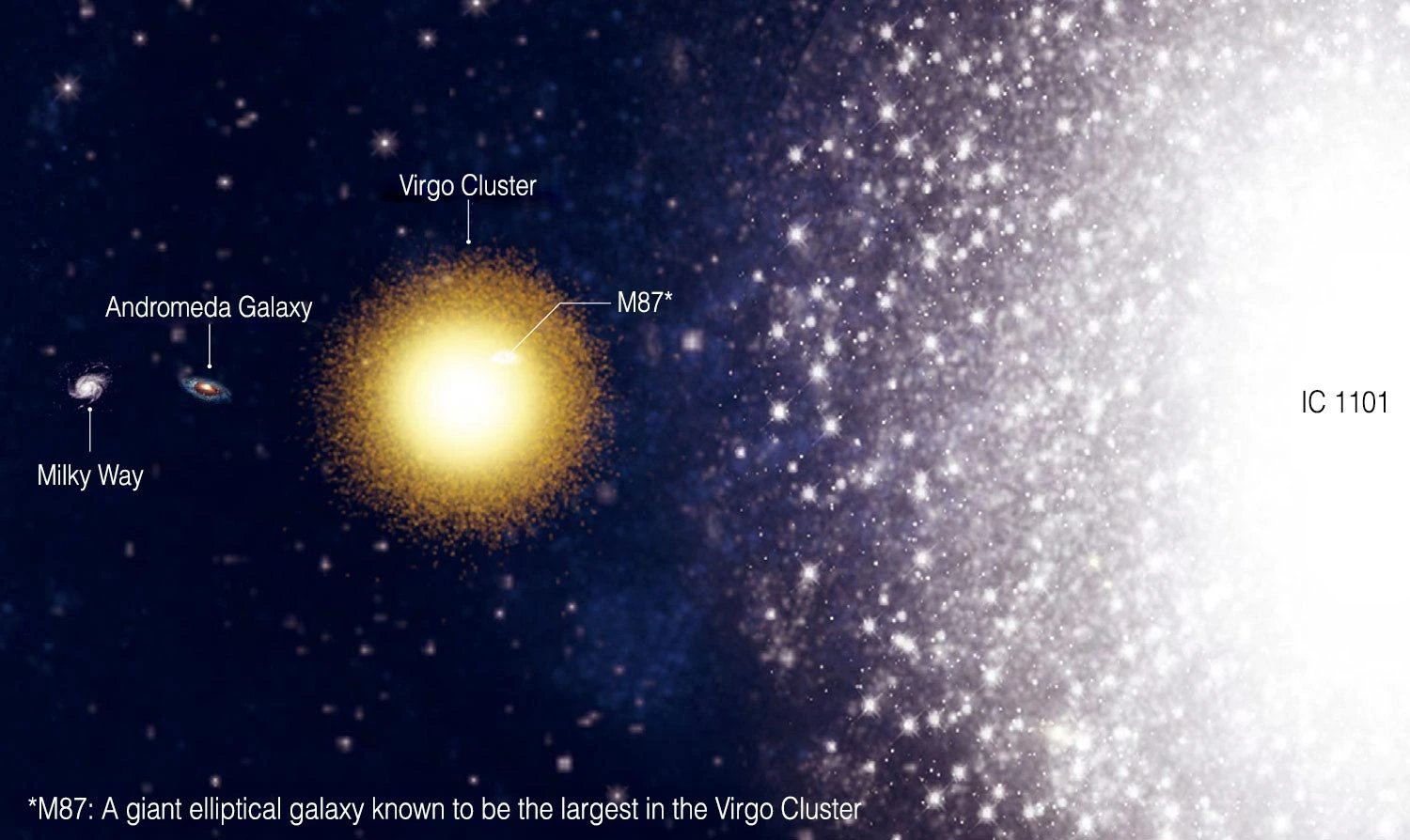
Astronomers have determined that galaxy IC 1101 is the largest known, spanning nearly 1.7 million light-years, based on deep images from the Isaac Newton Telescope. The finding, submitted to arXiv.org on July 16, shows it contains about 3.4 trillion solar masses and is still growing through galactic cannibalism. The galaxy, located over a billion light-years away in the Abell 2029 cluster, dwarfs the Milky Way at over 17 times its width.
Deep Imaging
Researchers used the deepest images ever taken of IC 1101, captured in 2022 by the Isaac Newton Telescope at Roque de los Muchachos Observatory on La Palma. The images, with long exposure times, revealed the galaxy’s faint edge, allowing astrophysicist Carlos Marrero de la Rosa of the Instituto de Astrofísica de Canarias and colleagues to estimate its diameter at 520 kiloparsecs, or nearly 1.7 million light-years. That is wider than 17 Milky Ways placed side by side. The galaxy’s total stellar mass is about 3.4 trillion solar masses, according to the study submitted to arXiv.org on July 16.
Galactic Cannibalism
IC 1101 is still growing, with taillike features extending from its edges that researchers attribute to mergers with smaller galaxies. ‘It’s still accreting things … It has not finished,’ Marrero de la Rosa said. The galaxy resides in the core of the Abell 2029 galaxy cluster, over a billion light-years from Earth, where it dominates as the most luminous member. Its growth through repeated mergers exemplifies ‘galactic cannibalism,’ a process that drives the evolution of brightest cluster galaxies.
Previous Estimates
Earlier studies had indicated that IC 1101 was massive but failed to precisely pinpoint the transition between the galaxy and the surrounding cluster material. The new analysis, by reaching the faintest extensions, provides the most accurate measurement to date. Pinning down the full extent of such enormous galaxies remains challenging, researchers note, as diffuse stellar halos make boundaries ambiguous.
1 source
Time · lag behind first