
Astronomers detect possible atmosphere on 500-km icy body beyond Neptune
This digest was compiled by AI from multiple sources — links to the originals are below.
Astronomers reported on 4 May 2026 that the 500-km trans-Neptunian object (612533) 2002 XV93 appears to possess an atmosphere, based on a stellar occultation observed from Japan on 10 January 2024. The inferred surface pressure of 100–200 nanobars is far higher than expected for such a small body, and models suggest the gas would escape in under 1,000 years without replenishment. The finding leaves astronomers with two open questions: confirming the interpretation and explaining the atmosphere's presence.
Key Facts
- The object (612533) 2002 XV93 is about 500 km across and orbits beyond Neptune.
- The occultation was observed from three sites in Japan on 10 January 2024: Kyoto, Kiso Observatory, and Fukushima.
- The inferred surface pressure is between 100 and 200 nanobars, roughly 5–10 million times thinner than Earth's sea-level pressure.
- Models indicate the atmosphere would escape in less than 1,000 years without replenishment.
- The study was published in Nature Astronomy on 4 May 2026 by Ko Arimatsu and colleagues.
Stellar Occultation Evidence
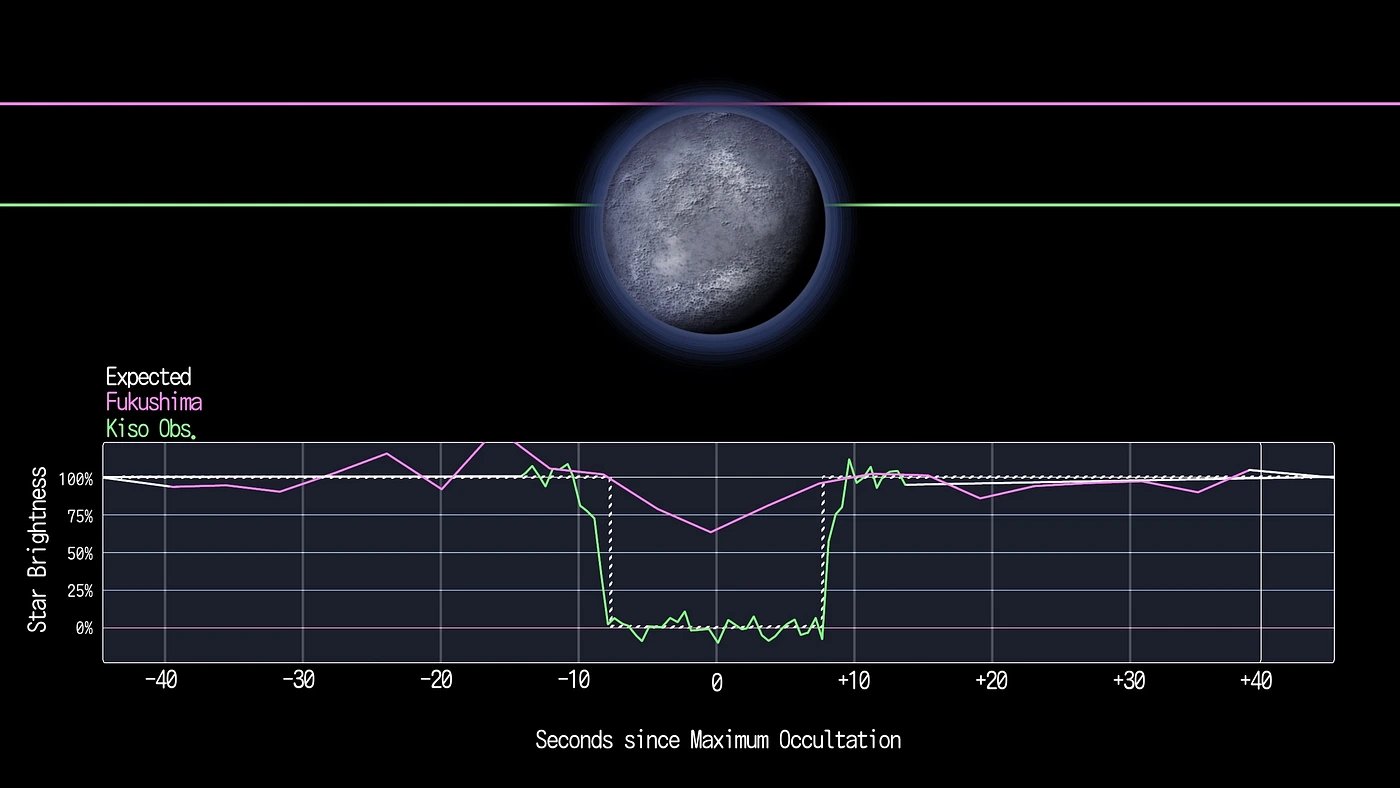
No telescope directly resolved an atmospheric rim around 2002 XV93; the evidence comes from a stellar occultation on 10 January 2024. Professional and amateur astronomers organized a campaign at Kyoto, Kiso Observatory, and a site in Fukushima to record the event. Kyoto and Kiso recorded passages behind the main body, while Fukushima's light curve showed a possible gradual drop without a clear solid-body occultation. The combined profiles favor a refracting layer around the object, consistent with attenuation by an atmosphere.
Atmospheric Pressure and Escape
A nanobar is one-billionth of a bar, so the proposed atmosphere is about 5 million to 10 million times thinner than Earth's air at sea level. Even Pluto's atmosphere, with an average surface pressure near 10 microbars, is roughly 50 to 100 times denser than the inferred layer on 2002 XV93. Without replenishment, the atmosphere should escape in less than 1,000 years, an instant in Solar System history. The observation therefore presents two mysteries: confirming the interpretation of the starlight and explaining why the gas is present now.
1 source
Time · lag behind first