
Webb detects Neptune auroras and finds upper atmosphere 400K cooler than Voyager 2 measured
This digest was compiled by AI from multiple sources — links to the originals are below.
The James Webb Space Telescope detected the first definitive auroras on Neptune and measured an upper atmosphere temperature of about 358 kelvin, roughly 400 kelvin cooler than Voyager 2's 1989 estimate. The findings, announced by NASA on 26 March 2025, reveal a temperature gap that remains unexplained.
Key Facts
- Webb observed Neptune on 22 June 2023 using its Near-Infrared Spectrograph (NIRSpec).
- The telescope identified clear emission from H3+, a molecule that serves as an established tracer of auroral activity on Jupiter, Saturn, and Uranus.
- Webb measured an upper atmosphere temperature of about 358 kelvin, compared with Voyager 2's estimate of around 750 kelvin in 1989.
- Neptune's magnetic field is tilted by about 47 degrees relative to its rotation axis and is offset from the planet's centre.
- The strongest H3+ enhancements appeared around southern mid-latitudes rather than over the geographic pole.
Auroral Detection
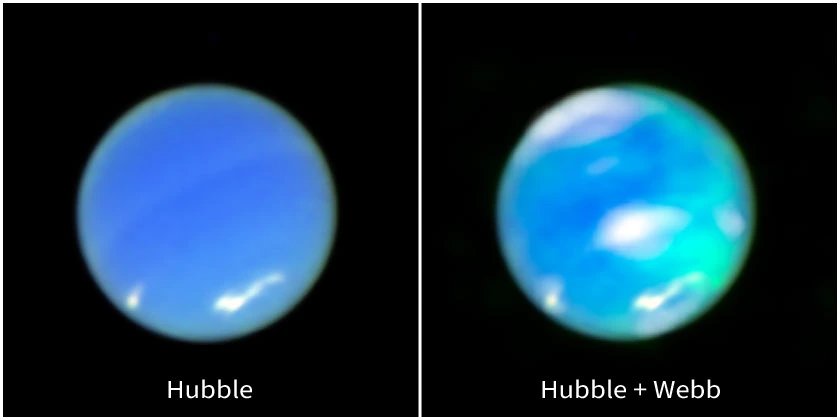
Webb observed Neptune on 22 June 2023 with its Near-Infrared Spectrograph, NIRSpec. The instrument separated light by wavelength across different points on the disc, revealing clear emission from H3+. H3+ forms when energetic particles ionise molecular hydrogen, and on Jupiter, Saturn, and Uranus it is an established tracer of auroral activity. Voyager 2 had detected radio emissions and suggestive ultraviolet observations, but not the decisive H3+ signature. The cyan patches in NASA's published Webb composite map the infrared emission layered over images of Neptune, making the signal legible.
Temperature Discrepancy
Webb measured an upper atmosphere temperature of about 358 kelvin, while Voyager 2's best estimate in 1989 was around 750 kelvin. Even after allowing for different instruments and atmospheric layers, the gap remained too large to dismiss as a change of thermometer. Scientists have two widely separated snapshots made in different ways, not a continuous 34-year cooling record. The thin gas high above Neptune's clouds was several hundred degrees cooler in 2023 than it appeared to be in 1989, and no complete explanation exists.
Magnetic Geometry
Neptune's magnetic field is tilted by about 47 degrees relative to its rotation axis and is offset from the planet's centre. Webb's strongest H3+ enhancements appeared around southern mid-latitudes, rather than forming a familiar cap over the geographic pole. That location fits a world whose magnetic axis swings through space at an extreme angle as Neptune rotates every 16 hours or so.
1 source
Time · lag behind first