
NASA launches $4.3 billion Roman Space Telescope to map dark energy
This digest was compiled by AI from multiple sources — links to the originals are below.
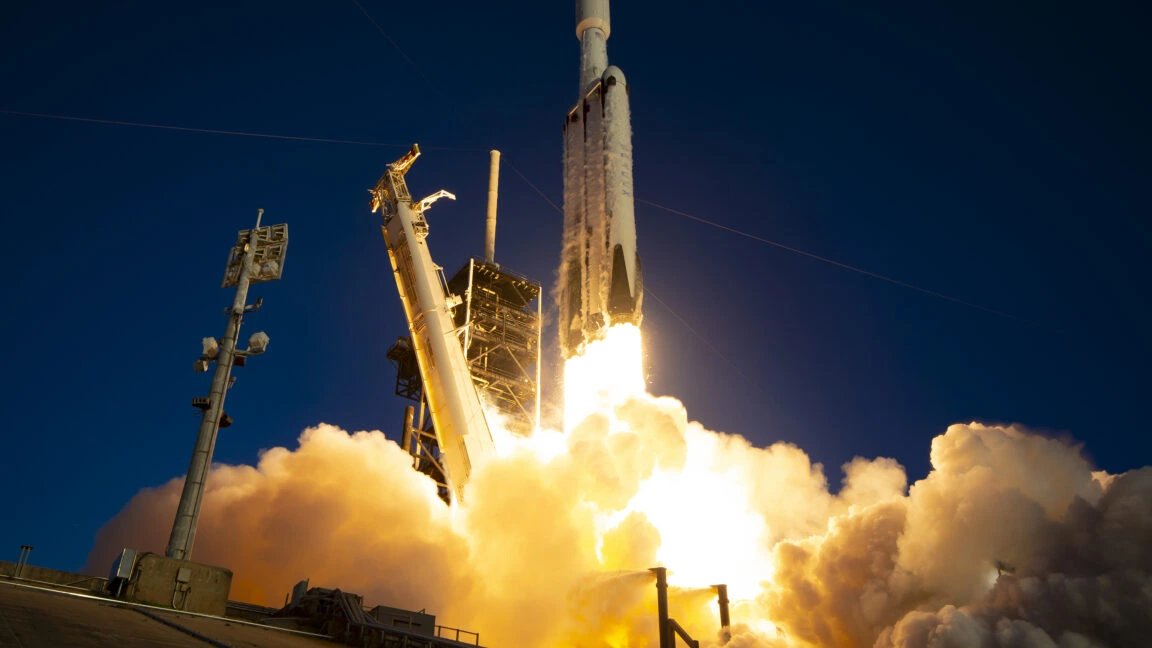
NASA's $4.3 billion Nancy Grace Roman Space Telescope launched Sunday from Kennedy Space Center aboard a SpaceX Falcon Heavy rocket. The observatory will operate from the Sun-Earth L2 Lagrange point, nearly a million miles from Earth, to study dark energy and exoplanets. Liftoff occurred at 7:25 am EDT, with the telescope deployed on a trajectory four times farther than the Moon.
Key Facts
- The Roman Space Telescope carries a 300-megapixel camera and a 2.4-meter mirror repurposed from a National Reconnaissance Office spy satellite.
- The Falcon Heavy rocket generated 5 million pounds of thrust at liftoff, according to NASA launch director Denton Gibson.
- Roman will take about three months to reach its operational orbit around the Sun-Earth L2 Lagrange point.
- NASA Administrator Jared Isaacman said the mission was delivered ahead of schedule and on budget.
Launch and Deployment
A SpaceX Falcon Heavy rocket lifted off at 7:25 am EDT (11:25 UTC) Sunday from Launch Complex 39A at NASA's Kennedy Space Center in Florida. The rocket's two reusable side boosters separated and returned to Cape Canaveral after sending Roman toward deep space. Fully fueled, the observatory weighed about 20,000 pounds (9 metric tons) and filled the Falcon Heavy's payload fairing. Roman was deployed on a course to take it four times farther from Earth than the Moon.
Mission Capabilities
Roman's field of view is 100 times wider than the Hubble Space Telescope, allowing it to survey large areas of the sky. The telescope will complement the James Webb Space Telescope, which launched in 2021 as NASA's first astrophysics mission of the century. A single Roman survey image would require over half a million 4K TVs to display fully, according to NASA. Ground teams will activate and calibrate the observatory during its three-month transit to the L2 point.
Program Milestones
Roman arrived at the launch pad nine months before NASA's commitment to launch by May 2027. NASA Administrator Jared Isaacman praised the mission as a success story delivered ahead of schedule and on budget. Scientists aim to have the first science images ready for publication by the end of the year.
1 source
Time · lag behind first