
NASA's Roman Space Telescope to Launch August 30 to Map Dark Universe
This digest was compiled by AI from multiple sources — links to the originals are below.
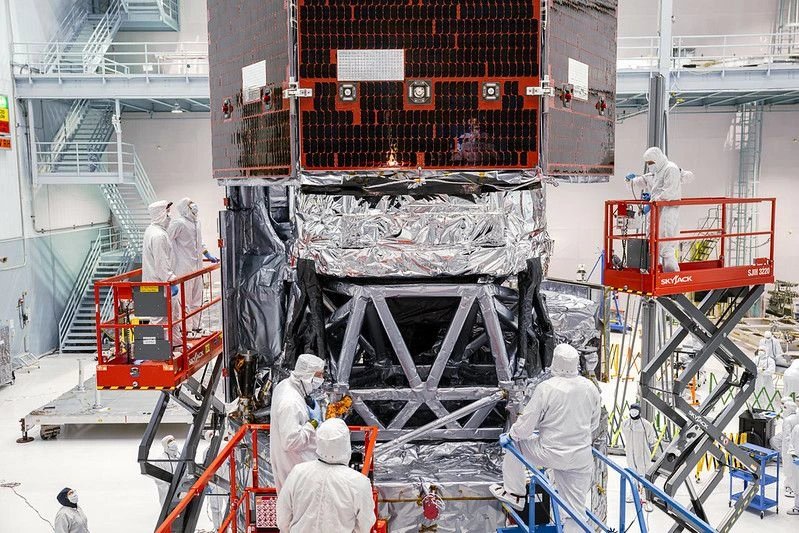
NASA's Nancy Grace Roman Space Telescope is scheduled to launch as soon as August 30 from Kennedy Space Center in Florida. The telescope will map expansive swaths of space during its five-year primary mission to study dark matter and dark energy. Roman is expected to discover up to 200,000 new exoplanets, a major leap from the roughly 6,300 confirmed today.
Key Facts
- The Nancy Grace Roman Space Telescope is scheduled to launch as soon as August 30 from NASA's Kennedy Space Center in Florida.
- Roman will have the resolution of the Hubble Space Telescope and a field of view about 100 times larger.
- During its five-year primary mission, Roman is expected to discover as many as 200,000 new exoplanets.
- Roman will orbit Lagrange Point 2, nearly a million miles from Earth, alongside the James Webb Space Telescope.
Mission Objectives
Roman will map expansive swaths of space to develop a comprehensive picture of galaxies and dark matter. The telescope will trace astrophysical structures by measuring subtle distortions of light caused by gravity, a technique that will help scientists study how dark energy drives cosmic evolution. Julie McEnery, NASA's senior project scientist for Roman, described the observatory as 'intrinsically a discovery machine.'
Exoplanet Discovery
Roman's sharp, wide view is expected to capture as many as 200,000 new planets, compared to roughly 6,300 confirmed exoplanets known today. Most of these worlds will be detected as they block some of the light from their host stars, while about 1,000 will be found through gravitational microlensing. McEnery said the most exciting science from Roman 'may well be something that we can't even imagine now.'
2 sources
Time · lag behind first