
NASA's Roman Space Telescope launches to map dark matter and dark energy
This digest was compiled by AI from multiple sources — links to the originals are below.
NASA's Nancy Grace Roman Space Telescope launched on 30 August aboard a SpaceX rocket. The telescope will travel 1.5 million kilometres to study dark matter, dark energy, and distant planets. Its 2.4-metre mirror was originally built for terrestrial surveillance and transferred to NASA in 2012.
Key Facts
- The Roman Space Telescope launched on 30 August aboard a SpaceX rocket.
- The telescope will travel 1.5 million kilometres from Earth.
- Its 2.4-metre primary mirror was built for terrestrial surveillance and transferred to NASA in 2012.
- The Wide Field Instrument is a 300-megapixel infrared camera that captures a sky area 100 times larger than Hubble in a single exposure.
Mission Overview
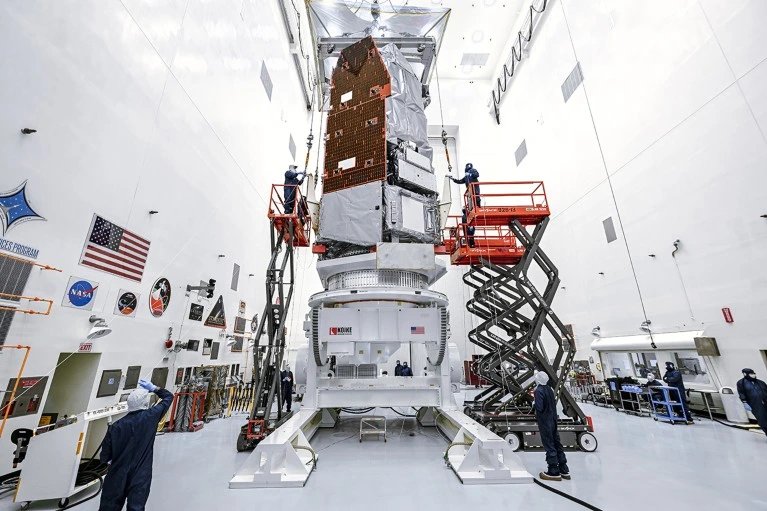
The Nancy Grace Roman Space Telescope launched on 30 August aboard a SpaceX rocket. It will travel approximately 1.5 million kilometres from Earth to begin its observations. The telescope's 2.4-metre primary mirror was originally built for terrestrial surveillance and transferred to NASA in 2012. The mirror was extensively re-engineered into an observatory to study dark matter, dark energy, and distant planets.
Instrument Capabilities
The Wide Field Instrument is a 300-megapixel infrared camera. It can capture a patch of sky roughly 100 times larger than the Hubble Space Telescope in a single exposure. Roman will survey rather than stare, combining exquisite resolution with panoramic reach. This difference changes the kinds of questions that can be asked about the cosmos.
Scientific Goals
Most of the matter in the Universe appears to be dark matter, detectable only through its gravitational effects. Dark energy is the mysterious cause of the accelerating cosmic expansion. The Roman telescope will attempt to map the invisible scaffolding of matter on an unprecedented scale. It stands to fundamentally reshape or upend scientists' current understanding of dark matter and dark energy.
1 source
Time · lag behind first