Voyager 1's plasma instrument failed decades before interstellar crossing
This digest was compiled by AI from multiple sources — links to the originals are below.
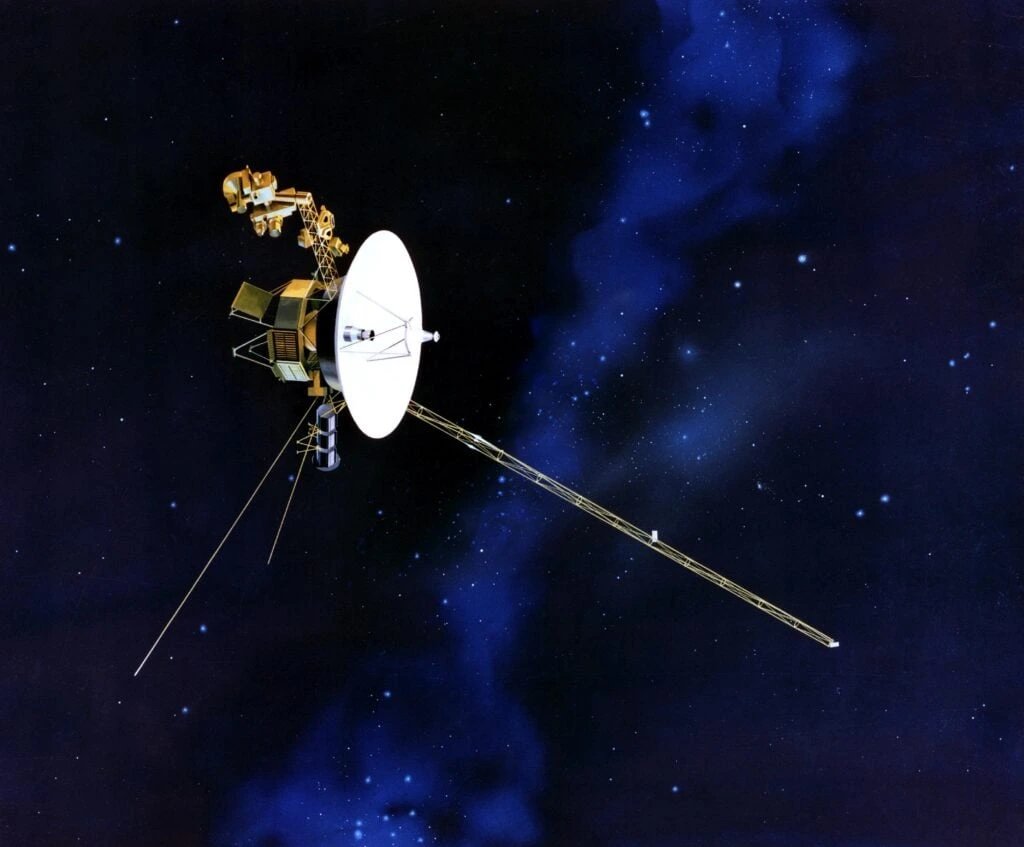
Voyager 1 crossed the heliopause into interstellar space without its dedicated plasma instrument, which failed in 1980 and was powered off in 2007. NASA instead used an improvised method to detect the density change marking the boundary. The crossing itself was unannounced by any direct sensor reading.
Key Facts
- Voyager 1's Plasma Science instrument (PLS), built at MIT under physicist Herbert Bridge, stopped working in 1980 and was turned off in 2007 to save power.
- The heliopause is the outer boundary of the sun's bubble, where the solar wind loses against interstellar gas.
- Interstellar gas is measurably denser than the solar wind inside the heliopause.
- Voyager 1 flew past Jupiter in March 1979 and Saturn in November 1980, with PLS working as intended during both encounters.
- NASA's mission history states PLS 'stopped working in 1980 and was turned off in 2007 to save power.'
The Heliopause Crossing
Voyager 1 crossed the heliopause, the outer skin of the bubble the sun blows around the solar system, without any direct sensor marking the spot. Inside the heliopause, the solar wind pushes back against interstellar gas; at the heliopause, that push finally loses. The only way to know which side a spacecraft is on is to read the density of the surrounding plasma, since interstellar gas is measurably thicker than the solar wind inside the bubble. No wall or membrane marks the boundary, so the crossing was registered only by what the spacecraft felt once it was already inside the interstellar medium.
The Failed Instrument
The Plasma Science instrument (PLS), designed and built at MIT in the 1970s under physicist Herbert Bridge, was meant to measure the density, speed, and temperature of charged particles using four detector cups. PLS worked as intended during Voyager 1's flybys of Jupiter in March 1979 and Saturn in November 1980. NASA's mission history states the instrument 'stopped working in 1980 and was turned off in 2007 to save power.' The failure was quiet and undramatic, leaving the spacecraft without its purpose-built sensor for the one measurement needed to confirm the interstellar crossing.
Improvised Detection
NASA improvised with a piece of hardware nobody had designed for the job to catch a sound nobody expected to exist. The agency built an entire video around the moment of that improvisation, documenting how the density change was detected without PLS. The timing of the instrument's loss was ordinary, with no single dramatic malfunction observed.
1 source
Voyager 1's plasma instrument failed decades before interstellar crossing