
Inouye Telescope Reveals Plasma Whirlpools on Sun's Surface
This digest was compiled by AI from multiple sources — links to the originals are below.
The Daniel K. Inouye Solar Telescope has captured images of plasma whirlpools on the Sun's visible surface, resolving vortices as small as 25 kilometers. The observations, made on April 14, 2025, and published August 5, 2026, confirm the Kelvin–Helmholtz instability in the solar photosphere. The findings were led by David Kuridze of the National Solar Observatory.
Key Facts
- The Inouye Solar Telescope resolved solar vortices as small as 25 kilometers across.
- Observations were made on April 14, 2025, between 21:38 and 21:41 UTC.
- The Nature paper led by David Kuridze was published on August 5, 2026.
- Researchers analyzed 47 vortex-bearing interfaces in the observations.
- The telescope achieved an estimated spatial resolution of 19 kilometers.
Kelvin–Helmholtz Instability
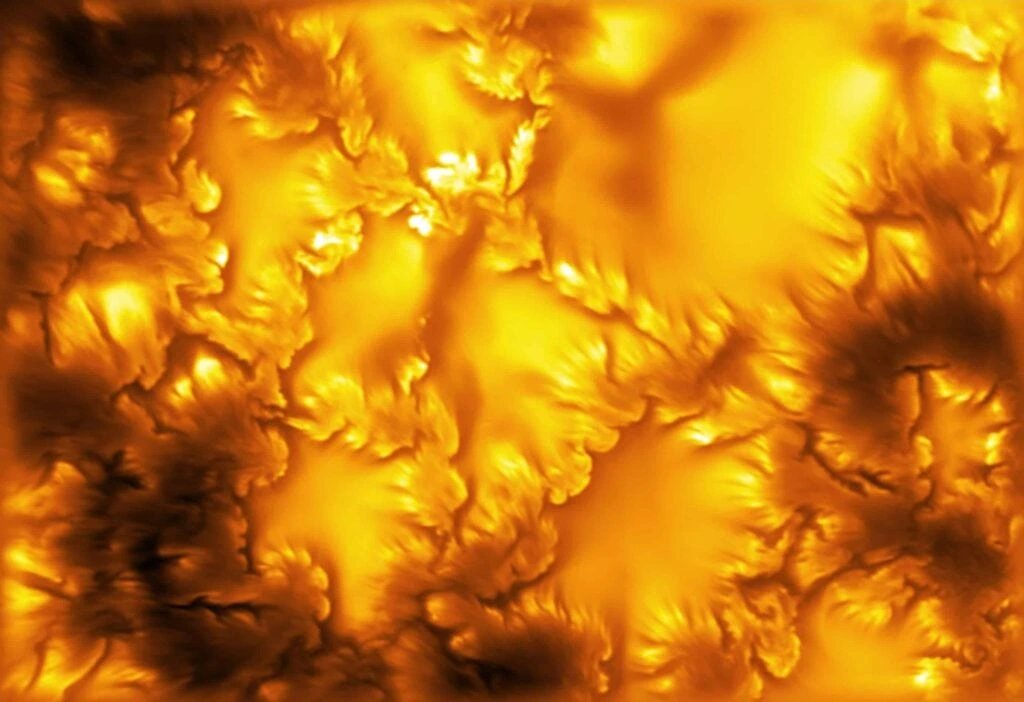
The curls in the new solar image look like waves breaking against a shore, but the scene is hot, magnetised plasma at the visible surface of the Sun. The underlying process is the Kelvin–Helmholtz instability, which appears when velocity shear makes a boundary between two flows unstable. Solar physicists had expected KHI in the photosphere, but earlier telescopes blurred the relevant boundaries into comparatively smooth lines. The Daniel K. Inouye Solar Telescope has now resolved those interfaces finely enough to show repeated waves, stripes and fully formed vortices.
Observation Details
Inouye watched a region containing small dark pores near active region NOAA 14060, close to the centre of the solar disc. A diagnostic FastCam recorded a small field at a wavelength of 416 nanometres, sampling the surface at about six kilometres per pixel. The team used 2,000 calibrated frames to reconstruct each science image, reaching an estimated spatial resolution of 19 kilometres. The final time sequence had a cadence of 2.7 seconds, and the familiar gold palette in the public image is false colour.
Vortex Measurements
Nineteen kilometres is the approximate spatial resolution of the reconstructed sequence, not the diameter of every object in the frame. The researchers analysed 47 vortex-bearing interfaces in the observations. The measured vortex sizes ranged from 25 to 170 kilometres.
1 source
Time · lag behind first