
Inouye Telescope Captures Sharpest-Ever Sun Images, Revealing 20-km Plasma Vortices
This digest was compiled by AI from multiple sources — links to the originals are below.
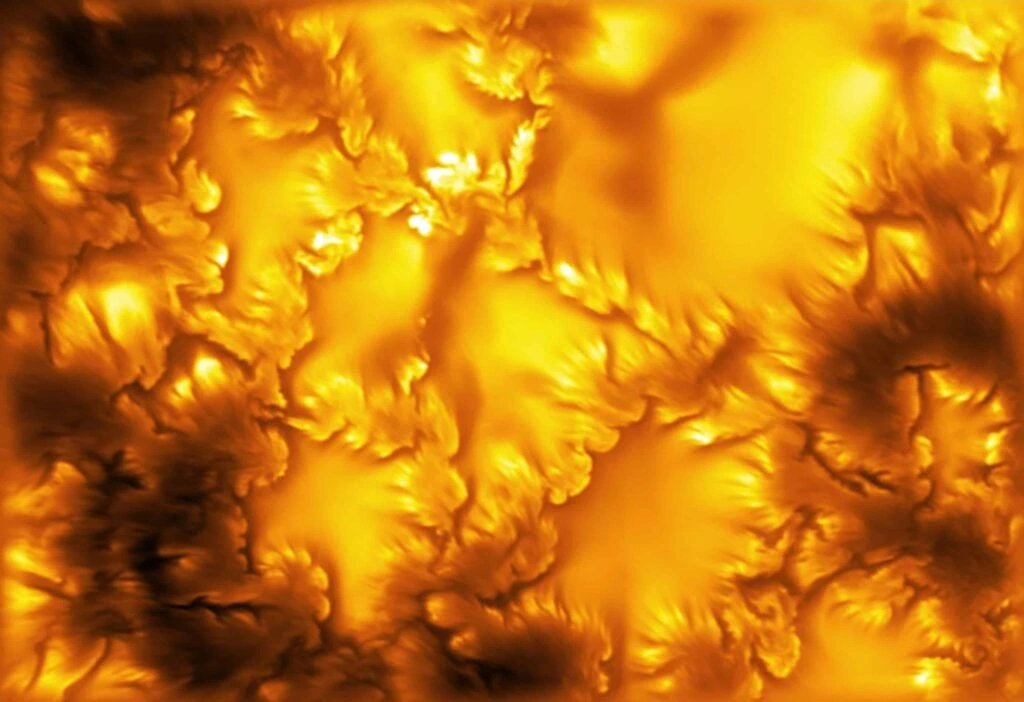
The Daniel K. Inouye Solar Telescope captured the sharpest-ever images of the Sun's visible surface, resolving plasma vortices as small as about 20 kilometres. The images, published on 5 August 2026 in Nature, reveal Kelvin-Helmholtz instability in the solar photosphere for the first time. The observation targeted active region NOAA 14060 near a sunspot on 14 April 2025.
Key Facts
- The Daniel K. Inouye Solar Telescope observed active region NOAA 14060 near a sunspot on 14 April 2025.
- The telescope resolved the solar surface at approximately 19 kilometres, and the smallest detected vortices approached that limit.
- Researchers analysed 47 vortices with sizes ranging from about 25 to 170 kilometres, and a characteristic spacing of about 65 kilometres.
- The images were captured in blue-continuum light at a wavelength of 416 nanometres.
- The findings were published in Nature on 5 August 2026.
The Observation
The Daniel K. Inouye Solar Telescope observed active region NOAA 14060 on 14 April 2025. The target was a magnetically active area near a sunspot, not the entire solar disc. A context image from NASA’s Solar Dynamics Observatory located the patch, and Inouye’s Visible Broadband Imager then narrowed the view. A Max Planck FastCam recorded the finest field at 21:39 UTC, resolving the surface at approximately 19 kilometres. The camera observed blue-continuum light at a wavelength of 416 nanometres.
Kelvin-Helmholtz Instability
An international team identified the observed forms as the first unambiguous detection of Kelvin-Helmholtz instability in the solar photosphere. The phenomenon is well known in clouds, oceans, planetary atmospheres and space plasmas. Along the borders of small magnetic structures, the previously blurred edge breaks into dark stripes and curling forms. In time-lapse sequences, some roll like the crest of an ocean wave, with the smallest approaching the size of a city. The Nature paper published on 5 August 2026 closes the observational gap and opens the question of how much energy these vortices can send into the atmosphere above.
Resolution and Scale
The telescope’s resolution was close to 19 kilometres at 416 nanometres, and the smallest detected vortices approached that theoretical diffraction limit. The Max Planck team also describes fringes a little more than 20 kilometres wide. When the researchers analysed 47 observed vortices, their reported sizes ranged from about 25 to 170 kilometres. The characteristic spatial wavelength, meaning the typical distance from one vortex to the next along an unstable interface, was about 65 kilometres. The Max Planck Institute compares the resolution to recognising a one-euro coin from 180 kilometres away.
1 source
Time · lag behind first