
James Webb Space Telescope finds unresolved red object MoM-BH*-1 660 million years after Big Bang
This digest was compiled by AI from multiple sources — links to the originals are below.
The James Webb Space Telescope has detected an unresolved red object, MoM-BH*-1, whose light left it 660 million years after the Big Bang. A paper published in Nature on August 12 argues that the cleanest explanation is an accreting black hole inside a dense, almost dust-free hydrogen envelope. The finding is one paper and one model, not a directly imaged new class of star.
Key Facts
- MoM-BH*-1 has a redshift of 7.7569, meaning its light left the object when the universe was about 660 million years old.
- The modelled total output is about 80 to 100 billion times the Sun's luminosity.
- Webb measured a Balmer break strength of 7.7, with a plausible range of 6.3 to 10, against about 3 for normal dust-free stellar populations.
- Webb recorded hydrogen-beta emission about 3,000 kilometres per second wide, deep hydrogen absorption and a tentative narrow oxygen signal.
- Webb constrains the source's effective radius only to less than 117 parsecs; the paper places the dense gas at roughly 10 to 100 astronomical units, with a representative calculation using about 40 AU.
The Initial Detection
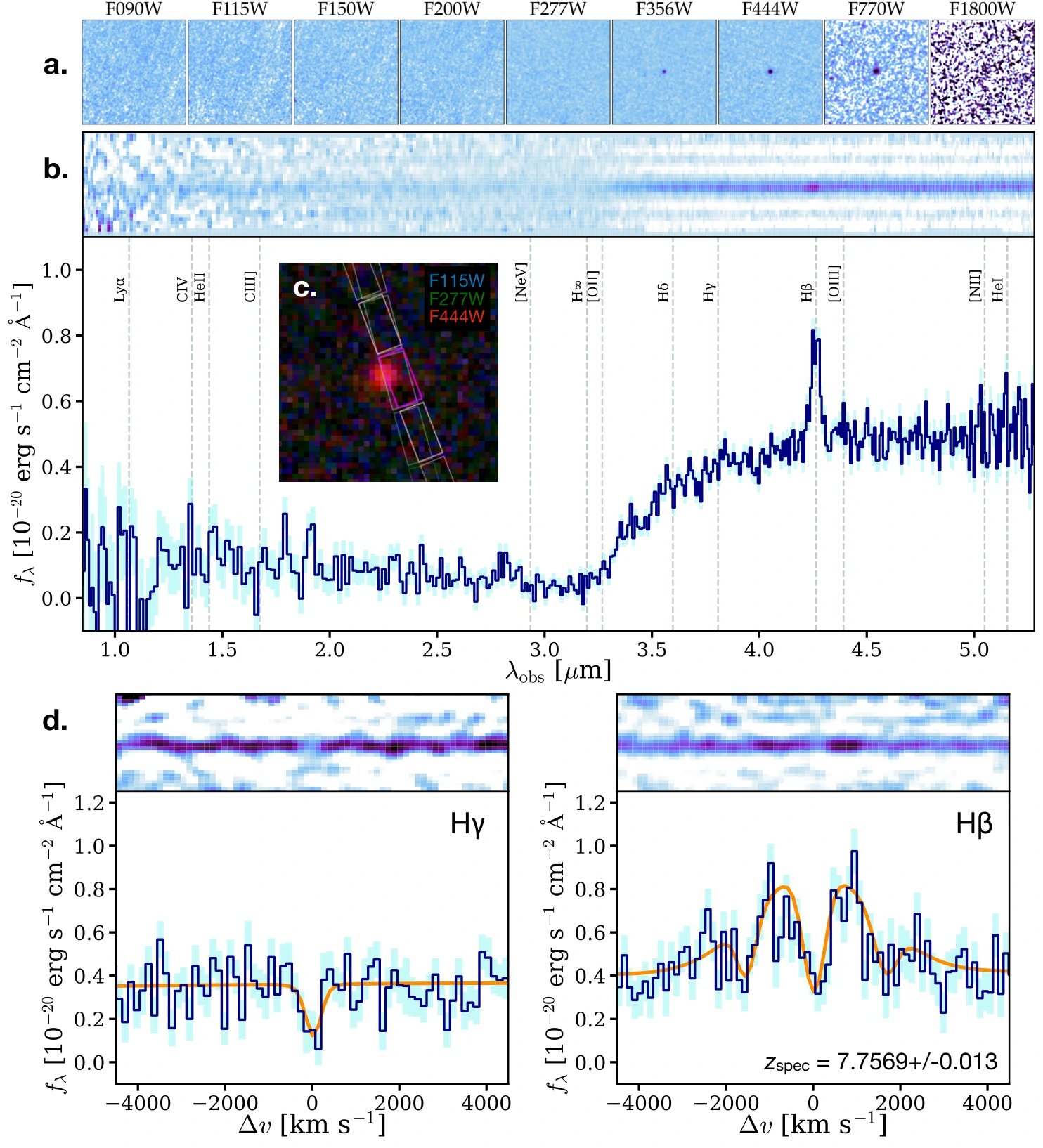
MoM-BH*-1 stood out as the reddest source in a roughly 250-square-arcminute James Webb Space Telescope field. It was bright in the longer-wavelength NIRCam filters, nearly disappeared at shorter wavelengths and remained unresolved. The team combined a 4.5-hour NIRSpec prism observation from December 2024 with an earlier 1.5-hour, higher-resolution spectrum. The object's redshift of 7.7569 means its light left it when the universe was about 660 million years old. The processed spectra are in a public Zenodo archive.
Balmer Break and Interpretation
The decisive feature is an enormous Balmer break, a steep change in brightness shaped by hydrogen. Its measured strength was 7.7, with a plausible range from about 6.3 to 10, while normal dust-free stellar populations should peak around 3. Webb also recorded hydrogen-beta emission roughly 3,000 km/s wide, deep hydrogen absorption and a tentative narrow oxygen signal. "Star-like" describes the escaping light, not the central engine: the source is point-like in Webb's images, while its spectrum combines a blackbody-like continuum with absorption features usually associated with stellar atmospheres. NASA's comparison of the spectrum and model shows the fit, and the paper argues the cleanest explanation is an accreting black hole inside a dense, almost dust-free hydrogen envelope.
Modeled Envelope Scale
Webb constrains the source's effective radius only to less than 117 parsecs, millions of times wider than the Solar System. The far smaller scale comes from the physical model, not from resolving the envelope in an image. The paper places the dense gas roughly 10 to 100 astronomical units from the central source, with a representative calculation using about 40 AU. One AU is the average Earth-Sun distance, and Neptune orbits at roughly 30 AU. The black hole itself remains dark; its accretion flow provides the power, and the surrounding hydrogen reshapes that power before it escapes.
1 source
Time · lag behind first