Uranus's moons point to at least two giant impacts, simulations show
This digest was compiled by AI from multiple sources — links to the originals are below.
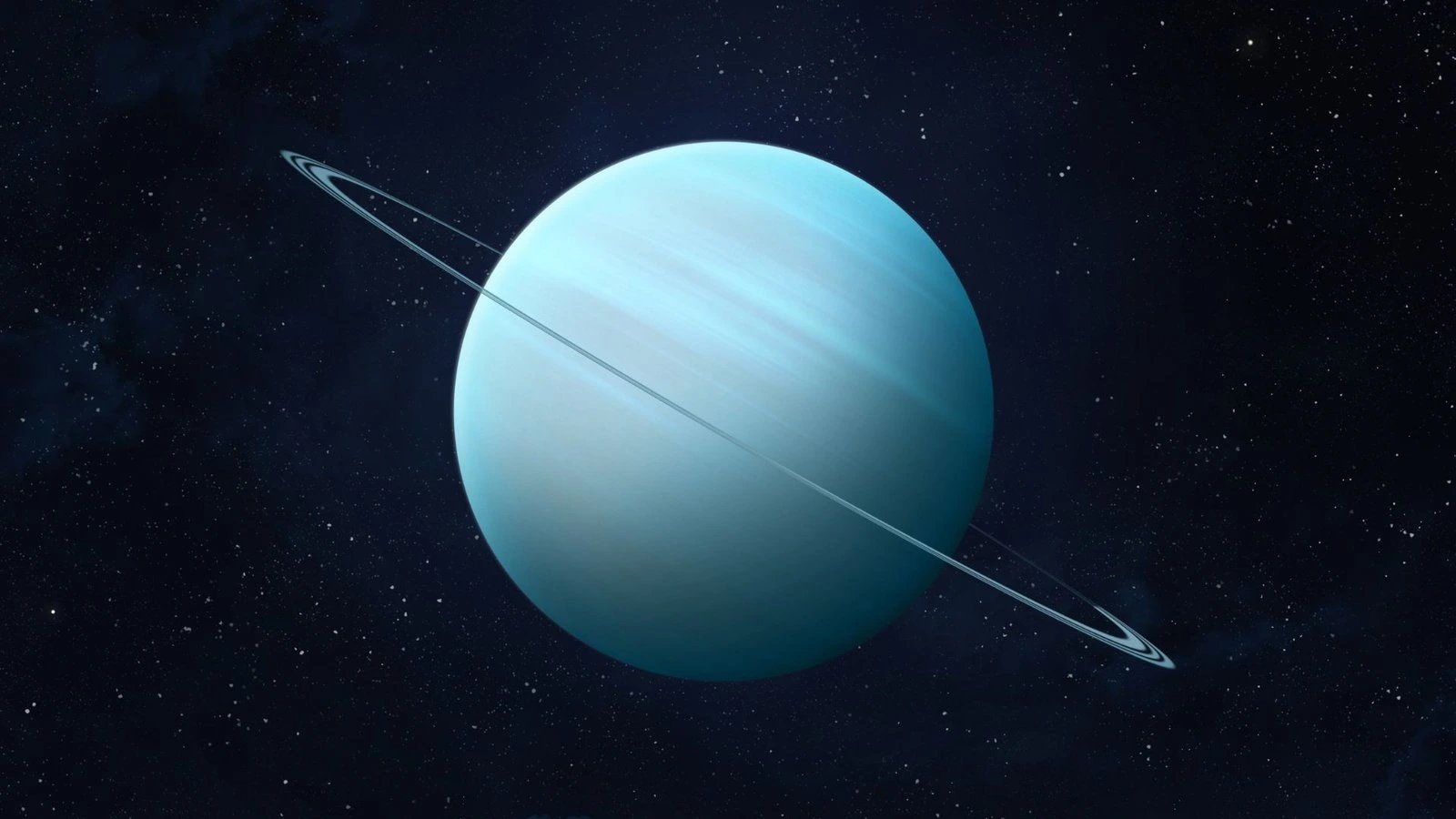
Simulations suggest Uranus's extreme 97.77-degree tilt may have required at least two giant impacts rather than one. The planet's five major moons orbit prograde relative to its spin, a configuration that a single collision struggles to produce if a moon-forming disk already existed. Newer models resolve this by having the moons form after the final impact.
Key Facts
- Uranus's spin axis is tilted 97.77 degrees relative to its orbit, making its rotation formally retrograde.
- The five major moons—Miranda, Ariel, Umbriel, Titania, and Oberon—orbit prograde relative to Uranus's spin.
- A 2012 Icarus paper by Morbidelli, Tsiganis, Batygin, Crida, and Gomes modeled a collision-generated disk inside Uranus's Roche limit.
- One set of calculations concluded that a single abrupt impact could not tilt Uranus from upright if a moon-forming disk already surrounded it.
- Newer simulations show the current moons can assemble on prograde orbits if the decisive collision creates a fresh debris disk.
The Tilt Problem
Uranus's spin axis is inclined by 97.77 degrees relative to its orbit, placing it just 7.77 degrees beyond lying perfectly sideways. This orientation makes the planet's rotation formally retrograde. A giant collision can deliver a large tilt, but the fate of the material that becomes the five major moons remains an awkward question. One influential set of calculations concluded that Uranus could not have gone from upright to its present orientation in a single abrupt blow if a moon-forming disk already surrounded it. Under that model, the final satellites would circle in the wrong direction, implying at least two giant impacts if collisions caused both stages.
Moon Orbits as Evidence
The major moons are nearly circular and nearly coplanar with Uranus's equator, resembling the product of an organized disk rather than five unrelated captures. A disk inherited from before the tilt begins in a very different orientation from the final equator. A model must preserve or recreate the correct direction of the moons' angular momentum, not merely their alignment with the equator. Newer simulations change when the moons form: if the decisive collision tips Uranus and creates a fresh debris disk, the current moons can assemble afterwards on prograde orbits. The disagreement is less about arithmetic than about which disk survived which event.
The 2012 Icarus Model
A 2012 paper in Icarus by Alessandro Morbidelli, Kleomenis Tsiganis, Konstantin Batygin, Aurélien Crida, and Rodney Gomes tried to solve the alignment problem. Their model began with a proto-satellite disk already surrounding young Uranus. A giant impact then changed the planet's spin axis and placed a much more massive, compact disk inside the Roche limit, the region where tides inhibit a large moon from holding itself together. The paper called this inner structure the collision-generated disk, or C-disk.
1 source
Uranus's moons point to at least two giant impacts, simulations show