
Seismic waves from French nuclear tests reveal shifts in Earth's outer core
This digest was compiled by AI from multiple sources — links to the originals are below.
Seismic waves from French nuclear tests at Mururoa reached a Kazakhstan station up to 0.2 seconds late by 1995 compared with 1977. The shifts point to changes in Earth's liquid outer core, a shell of metal roughly 2,200 km thick. The core's volume is about 169 billion cubic kilometres, slightly larger than Mars.
Key Facts
- Seismic signals from French underground nuclear tests at Mururoa in French Polynesia arrived at the BRVK station in Kazakhstan up to 0.2 seconds late by 1995 compared with 1977.
- The study, published in the Journal of Geophysical Research: Solid Earth, was conducted by Virginia Tech geophysicist Ying Zhou.
- Earth's outer core is a liquid metal shell about 2,200 km thick, with a volume of roughly 169 billion cubic kilometres, slightly larger than Mars's 163 billion.
- Zhou analysed 112 pairs of seismic events whose published epicentres lay within 0.05 degrees of one another.
The Mururoa Test Source
Underground nuclear tests at Mururoa in French Polynesia provided unusually repeatable seismic sources for probing Earth's deep interior. Many tests occurred in nearly the same area, allowing waves to travel through approximately the same parts of Earth at different times. Zhou analysed 112 pairs of events with epicentres within 0.05 degrees of each other. The waves were recorded at the BRVK seismic station in Kazakhstan.
Observed Travel-Time Shifts
Seismic signals from Mururoa did not always take the same time to cross the core and reach the Kazakhstan station. Some signals arrived about 0.1 to 0.15 seconds early in the late 1970s. By 1995, comparable signals were roughly 0.15 to 0.2 seconds late. These shifts indicate that the effective seismic travel time along a core-sensitive path changed between 1977 and 1995.
Outer Core Structure
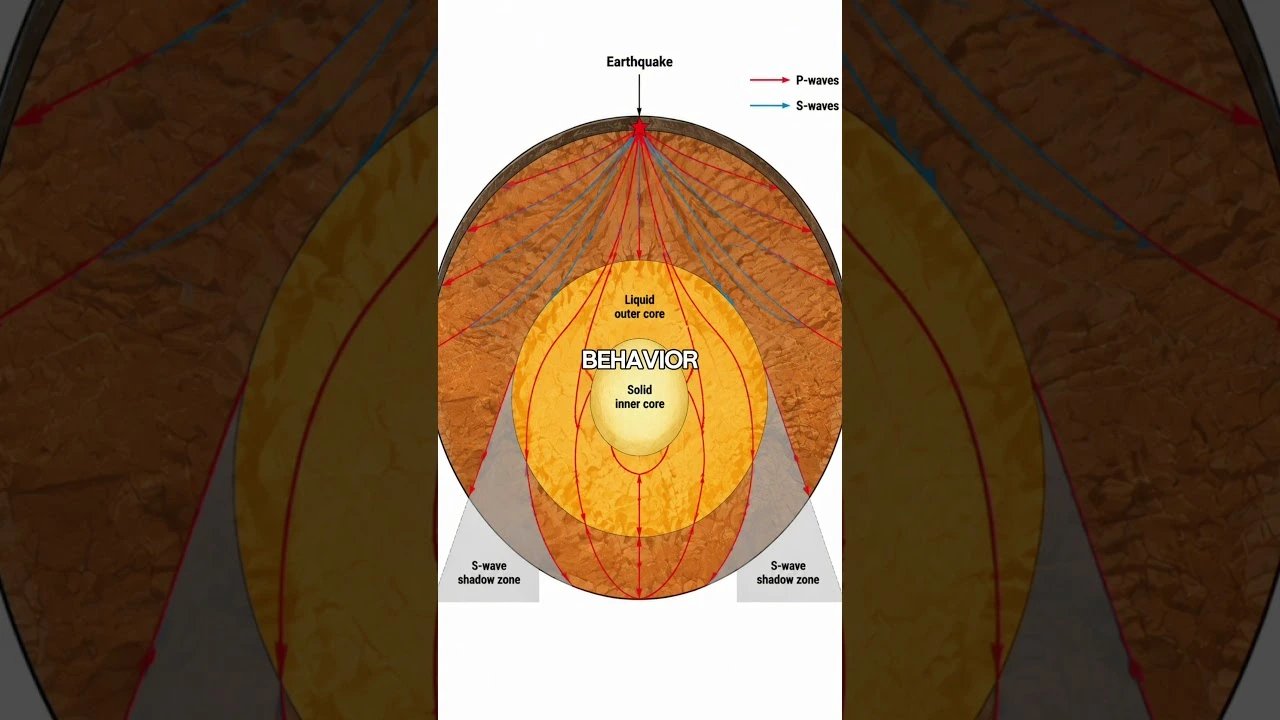
Earth's outer core is a liquid metal shell beginning about 2,900 km below the surface and ending at the solid inner core about 5,150 km down. The outer core's volume is about 169 billion cubic kilometres, slightly larger than Mars's 163 billion cubic kilometres. The core is mostly iron with nickel and lighter elements, held liquid by extreme heat despite immense pressure. Seismic shear waves do not pass through the outer core, while compressional waves slow, bend, and reflect through the fluid.
1 source
Time · lag behind first