
Dark stars may explain early supermassive black holes
This digest was compiled by AI from multiple sources — links to the originals are below.
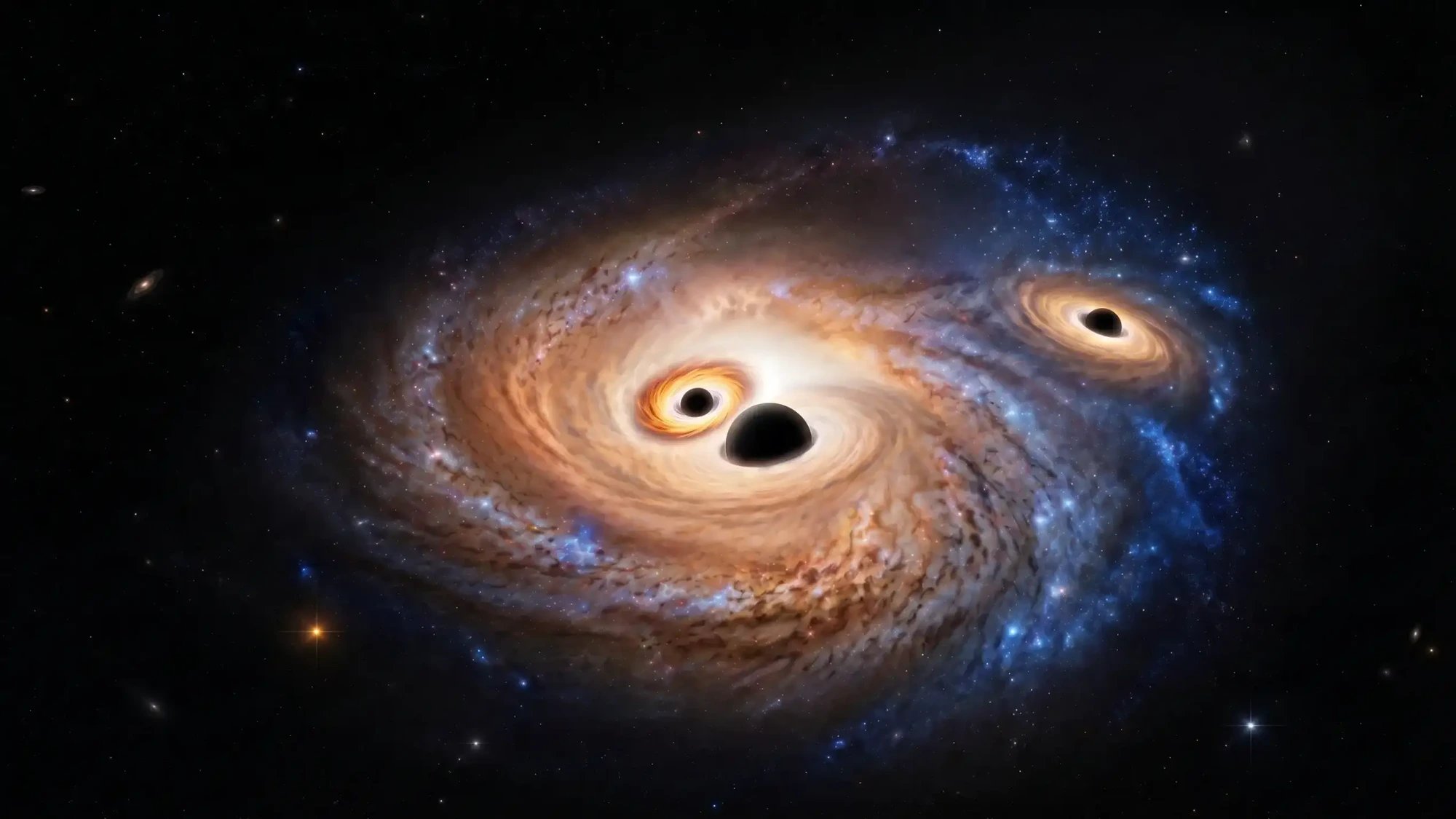
Hypothetical dark stars, powered by annihilating dark matter, could have grown to over one million solar masses in the early universe. Their collapse may have seeded the supermassive black holes that the James Webb Space Telescope is finding unexpectedly early in cosmic history.
Key Facts
- A dark star could reach 100,000 to over one million solar masses, far exceeding ordinary Population III stars.
- The James Webb Space Telescope could observe a supermassive dark star across more than 13 billion years.
- No Population III star has been confirmed to date.
- A 100-solar-mass Population III star could have a surface temperature near 100,000 kelvins and die within a few million years.
Dark Star Mechanism
A dark star would consist almost entirely of primordial hydrogen and helium, with a minute quantity of annihilating dark matter providing the heat that holds it up. Unlike fusion-powered stars, a dark star could remain enormously swollen, with a surface cool enough to avoid flooding its surroundings with ionising radiation. Gas could keep falling in, allowing the star to grow from an ordinary stellar mass towards 100,000 or even more than one million Suns. If such an object finally collapsed, the black hole left behind could be born as an enormous seed, already much closer to the supermassive black holes Webb is finding unexpectedly early in cosmic history.
Population III Comparison
Population III stars formed before earlier stars had enriched the gas with carbon, oxygen, iron and other elements, using raw material overwhelmingly hydrogen and helium with a trace of lithium from the Big Bang. NASA's guide to the first stars notes that a 100-solar-mass example could have a surface temperature near 100,000 kelvins, radiate with the power of a million Suns and die within a few million years. The ultraviolet radiation from these stars ionised the surrounding hydrogen, heated it and drove feedback into the gas cloud, working against the inflow of cold material needed for accretion. This is why 'the first stars were massive' does not automatically mean they could reach a million solar masses.
Theoretical Origins
The dark-star idea grew from work by Douglas Spolyar, Katherine Freese and Paolo Gondolo, who asked what dark matter would do inside the first collapsing star-forming haloes.
1 source
Time · lag behind first