
Webb telescope maps dark matter across COSMOS field at twice Hubble's resolution
This digest was compiled by AI from multiple sources — links to the originals are below.
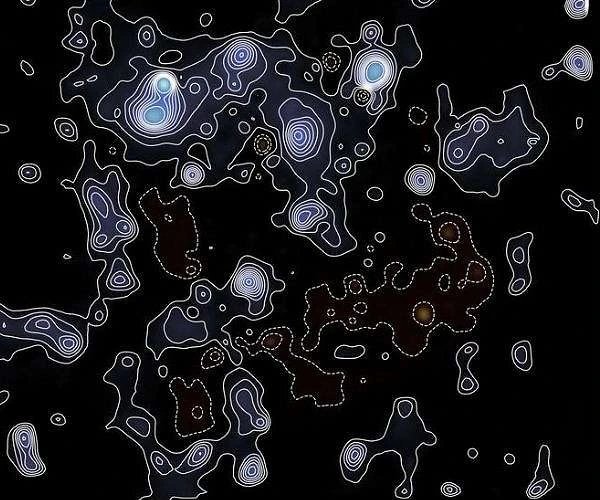
The James Webb Space Telescope has produced the highest-resolution wide-area dark matter map to date, resolving 129 galaxies per square arcminute across the COSMOS-Web field. The map, published in Nature Astronomy, achieves an angular resolution of 1.00 arcminutes, more than twice as sharp as Hubble's reconstruction of the same area. Webb's data reveal new clumps and thin connections between galaxy concentrations that earlier surveys could not distinguish.
Key Facts
- Webb resolved usable galaxy shapes at a density of 129 galaxies per square arcminute across the COSMOS-Web footprint.
- The resulting dark matter map has an angular resolution of 1.00 ± 0.01 arcminutes, more than twice as sharp as Hubble's earlier reconstruction.
- The survey recorded almost 800,000 galaxies, whose shapes were used to reconstruct the dark matter distribution.
- The findings were published in Nature Astronomy.
The COSMOS-Web Survey
The James Webb Space Telescope recorded almost 800,000 galaxies across the COSMOS-Web field. From these galaxies, researchers reconstructed a dark matter map using weak gravitational lensing. The map achieves an angular resolution of 1.00 ± 0.01 arcminutes, more than twice as sharp as the earlier Hubble reconstruction of the same field. Clusters that had blurred together became better confined, and new clumps appeared.
Dark Matter and Gravitational Lensing
Dark matter does not emit, reflect, or absorb light, making it invisible to ordinary telescopes. Its gravity bends spacetime, causing light from distant galaxies to be slightly stretched or rotated—an effect known as weak gravitational lensing. Ordinary matter accounts for only about five percent of the universe's total energy budget, while dark matter makes up roughly 27 percent. The survey's weak lensing signal is usually subtle, with no giant arcs around every mass concentration.
1 source
Time · lag behind first