
Nuclear test waves reveal shifts in Earth's outer core
This digest was compiled by AI from multiple sources — links to the originals are below.
Seismic waves from French nuclear tests recorded in Kazakhstan show that travel times through Earth's outer core changed between 1977 and 1995. The differences, up to 0.2 seconds, suggest the outer core is not a uniform molten layer but a dynamic region with moving material. The findings point to a possible anomalous zone under the South Pacific.
Key Facts
- Seismic waves from French underground nuclear tests at Mururoa Atoll in French Polynesia were recorded at a station in Kazakhstan after traveling thousands of kilometers through Earth's interior.
- Compared with 1977 data, waves in 1982 and 1983 traveled about 0.1 seconds faster, and in 1988-1990 about 0.15 seconds faster.
- By 1995, the trend reversed, with waves traveling about 0.15 to 0.2 seconds slower.
- Researchers estimate an unusual zone more than 700 kilometers long and about 100 kilometers thick may exist under the South Pacific at low latitudes.
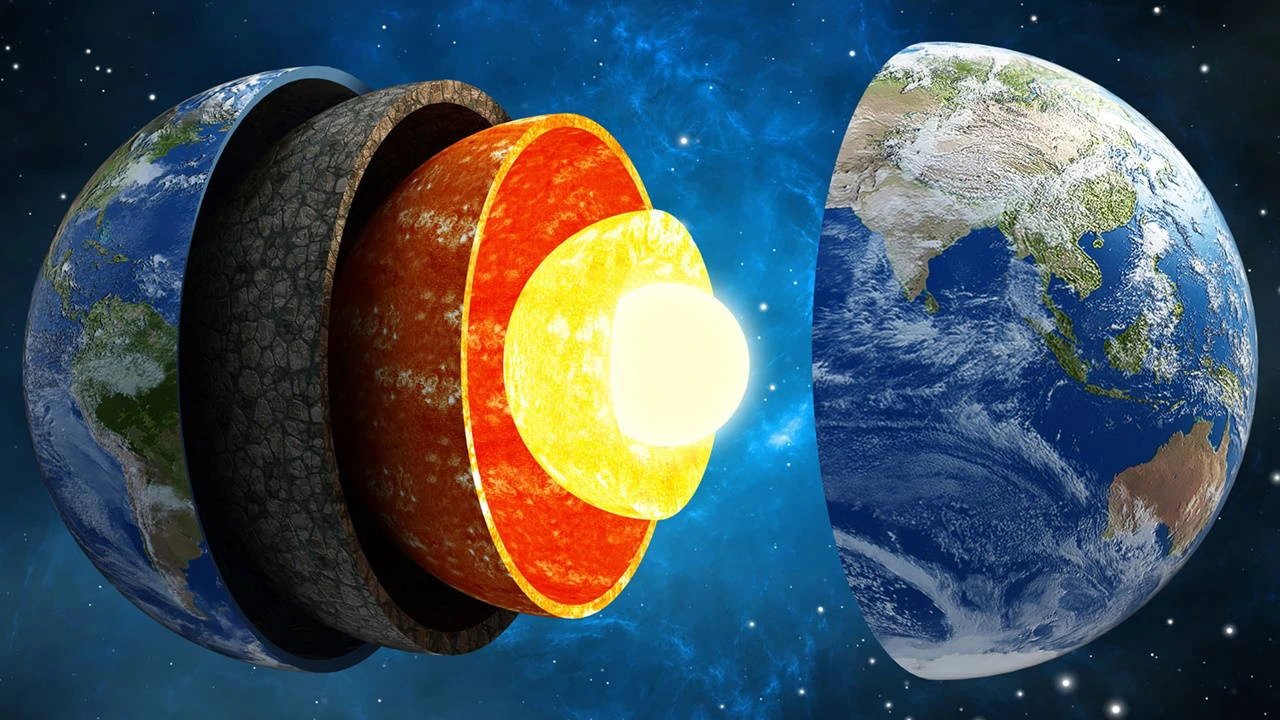
- The outer core consists largely of liquid iron and other metals, and its motion drives Earth's magnetic field.
Nuclear Test Data
Geophysicist Ying Zhou of Virginia Tech analyzed seismic waves from French underground nuclear tests conducted at Mururoa Atoll in French Polynesia between 1977 and 1995. The waves traveled thousands of kilometers through Earth's interior and were recorded by a seismic observation station in Kazakhstan. Because the tests occurred at nearly identical locations, researchers could compare travel times of seismic waves following almost the same path in different years.
Travel Time Changes
Analysis showed that waves passing through the outer core did not always reach the station in the same time. Compared with 1977 data, waves in 1982 and 1983 moved about 0.1 seconds faster, and in 1988-1990 about 0.15 seconds faster. By 1995, the trend reversed, with waves traveling about 0.15 to 0.2 seconds slower. These small differences are considered significant for seismic waves that travel thousands of kilometers, indicating that materials along the wave paths changed over time.
Outer Core Structure
The changes may be driven by active mixing and displacement of material in the outer core. Scientists estimate an unusual zone more than 700 kilometers long and about 100 kilometers thick may exist under the South Pacific at low latitudes. Movement or temporal change of this structure could explain the observed variations in seismic wave speeds across different years. The outer core consists largely of liquid iron and other metals, and the motion of these liquids underlies the processes that generate Earth's magnetic field. Understanding how outer core material moves could provide important insights into how Earth's magnetic field forms and why it changes over time.
1 source
Time · lag behind first