
James Webb finds two sources of CO2 on Uranus moons, solving 40-year mystery
This digest was compiled by AI from multiple sources — links to the originals are below.
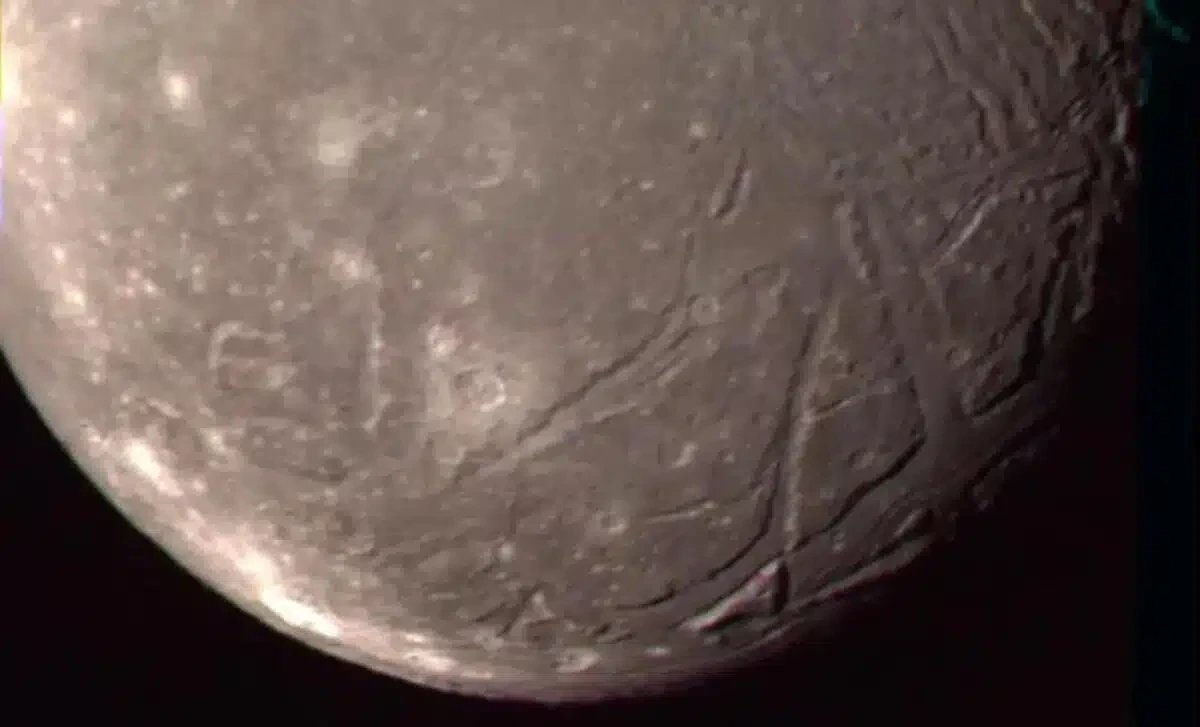
The James Webb Space Telescope has identified two distinct sources of carbon dioxide on Uranus's four largest moons. Observations from September 2023 show CO2 concentrated on trailing hemispheres from magnetospheric radiation, while carbonates and clathrates on leading hemispheres indicate internal origin. The findings resolve a 40-year-old puzzle dating to Voyager 2's 1986 flyby.
Key Facts
- JWST observations in September 2023 covered the leading and trailing hemispheres of Ariel, Umbriel, Titania, and Oberon.
- CO2 is concentrated on the trailing hemispheres, which receive the main flux of charged particles from Uranus's magnetosphere.
- The inner moons Ariel and Umbriel are significantly richer in CO2 than the outer moons Titania and Oberon.
- Carbonate minerals and CO2 clathrates detected on Ariel and Umbriel require liquid water and high pressure, indicating an internal source.
Observations and Method
A team from Johns Hopkins University analyzed JWST observations taken in September 2023 separately for the leading and trailing hemispheres of each moon. The telescope's spectrograph accessed the 4.27-micrometer CO2 band that Earth's atmosphere blocks for ground-based observatories. Voyager 2's 1986 flyby provided images of canyons, smooth plains, and possible cryovolcanic features but could not determine surface chemistry.
Radiolytic Surface Production
CO2 concentrates on trailing hemispheres, where electrons, protons, and heavy ions from Uranus's magnetosphere bombard water ice and carbon-bearing regolith. This radiolytic synthesis produces a thin crust of fine-grained CO2 frost over a thicker layer of coarse-grained CO2 ice mixed with clathrates. Some CO2 migrates seasonally and accumulates in cold traps at equatorial latitudes.
Internal Origin Evidence
On leading hemispheres, where radiolytic production is weaker, JWST detected the 4.27-micrometer band on all four moons. Spectra of Ariel and Umbriel show crystalline CO2 ice lines and a broad 4.02-micrometer band matching carbonate minerals found on Ceres and Jupiter's moon Callisto. Carbonates form when CO2 interacts with silicate rocks in the presence of liquid water, and clathrates typically form under high pressure in deep interiors. The spatial distribution of carbonates and clathrates, not confined to trailing hemispheres, requires a second mechanism: CO2 outgassing from the moons' interiors.
1 source
Time · lag behind first