
Blood-lime binder likely preserved Huashan rock art for 2,000 years
This digest was compiled by AI from multiple sources — links to the originals are below.
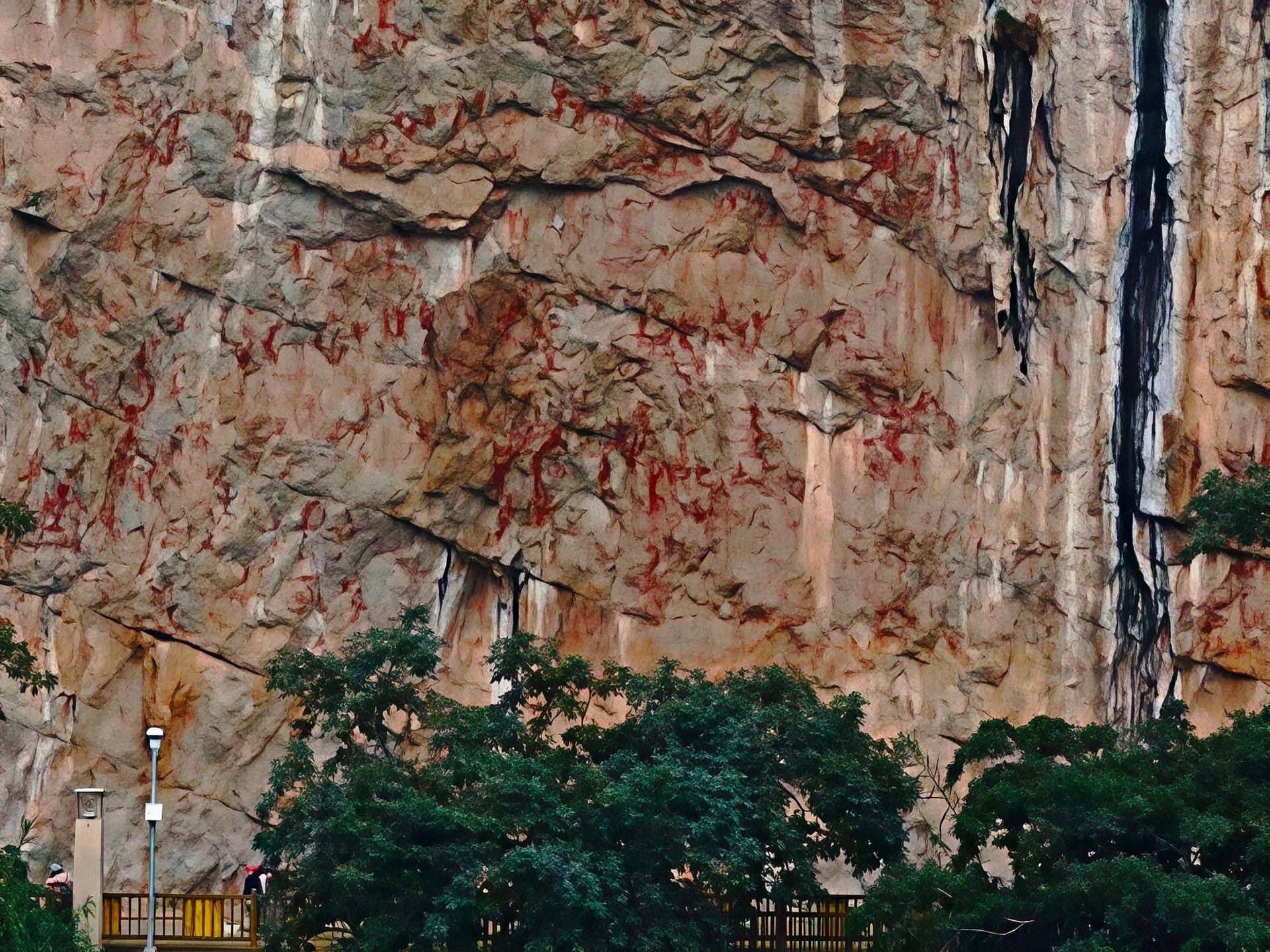
A study published in the Journal of Archaeological Science concludes that a lime-and-blood binder was the key to preserving the Huashan rock art in southern China for at least 2,000 years. The pigment, made from local red clay with nano-hematite, was encapsulated in the outer mortar layer, locking it to the cliff like concrete.
Paint Composition
The red pigment in the Huashan paintings came from local red clay containing microscopic iron oxide particles known as nano-hematite. The team collected fallen rock fragments from three sites and used scanning electron microscopy and spectroscopy to identify paint layers and chemical makeup. The pigment particles were found inside an outer layer of man-made mortar that included lime and blood. The study, published in the Journal of Archaeological Science, dates the paintings to at least 2,000 years and places them across more than 80 locations spanning 260 kilometers.
Blood as Binder
Blood proteins mixed with lime trigger a reaction that forms calcium carbonate around the pigment particles, according to the authors. This process may have locked the pigment directly to the cliff, functioning like concrete. The researchers describe the result as a stable organic-inorganic composite bonding system. The composite held pigment to cliff surfaces for at least 2,000 years. Tests detected human serum proteins, suggesting the blood may have come from females who had given birth.
Luoyue Ritual Context
The artists belonged to the Luoyue people, a matriarchal society near the Vietnam border. Because tests identified human serum proteins, the authors suggest the blood came from women who had given birth, linking it to female fertility worship and symbols of life and renewal. The Huashan rock art landscape is a UNESCO World Heritage site with thousands of images across more than 80 locations. The authors argue the production was technically intensive, involving complex binders, rather than merely labor-intensive.
1 source
Time · lag behind first