
Scientists find 3.7-billion-year-old strontium match between Australian rocks and Moon
This digest was compiled by AI from multiple sources — links to the originals are below.
Researchers at the University of Western Australia measured a strontium isotope ratio of 0.700050 in 3.73-billion-year-old anorthosites from the Manfred Complex. The value matches the initial ratio of Apollo 16 lunar sample 60025 when both are corrected to 4.515 billion years ago. The finding supports the giant-impact origin of the Moon.
Key Facts
- The Manfred Complex anorthosites in Western Australia are 3.73 billion years old, making them the oldest rocks on the Australian continent.
- The measured initial strontium-87/strontium-86 ratio in the Manfred plagioclase is 0.700050, the least radiogenic value ever precisely measured in a terrestrial sample.
- Apollo 16 sample 60025, a 1.8-kilogram ferroan anorthosite collected by John Young and Charles Duke, yields an initial strontium ratio of 0.699062 and is dated at 4.51 billion years.
- After correcting for rubidium content, Earth and Moon converge on a strontium ratio of 0.699061 at 4.515 billion years ago.
- The study was led by PhD student Matilda Boyce and published in Nature Communications.
The Strontium Match
A team led by Matilda Boyce at the University of Western Australia measured strontium isotope ratios in plagioclase feldspar from the Manfred Complex in the Murchison region. The initial ratio of 0.700050 is the least radiogenic strontium ever precisely measured in any terrestrial sample. Apollo 16 astronauts John Young and Charles Duke collected sample 60025 in the Descartes highlands, a 1.8-kilogram lump of ferroan anorthosite. Its plagioclase yields an initial strontium ratio of 0.699062, dated at 4.51 billion years old. Wind both bodies back to about 4.515 billion years ago, correcting for how much rubidium each actually carries, and Earth and Moon converge on 0.699061.
Giant Impact Evidence
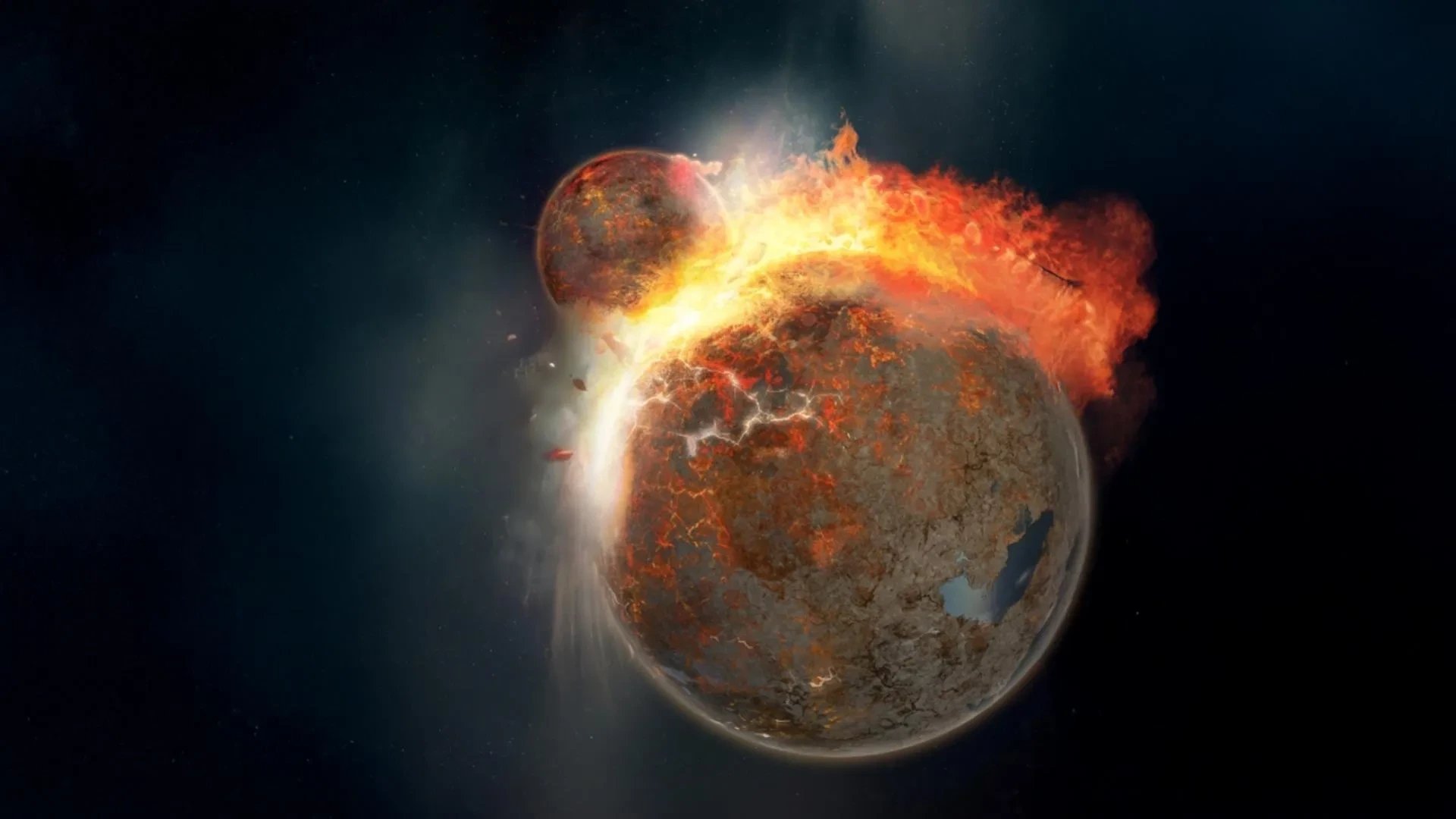
Rubidium is moderately volatile and strontium is not, which matters enormously in a collision hot enough to melt two planets. The standard account holds that a Mars-size body slammed into the young Earth, flinging off the debris that became the Moon. Rubidium boils off in such an event, while strontium stays put, leaving the Moon much poorer in rubidium than Earth. The measured ratios match what the giant-impact model predicts, supporting a common origin for Earth and Moon.
Analytical Method
Boyce and her co-authors used fine-scale analytical methods to isolate fresh areas of plagioclase feldspar crystals. Plagioclase admits almost no rubidium, so the strontium ratio sealed in at crystallisation barely drifts afterwards. The findings are reported in Nature Communications.
1 source
Time · lag behind first