
Tokyo University of Science researchers demonstrate nonreciprocal collective dynamics in over 10,000 particles
This digest was compiled by AI from multiple sources — links to the originals are below.
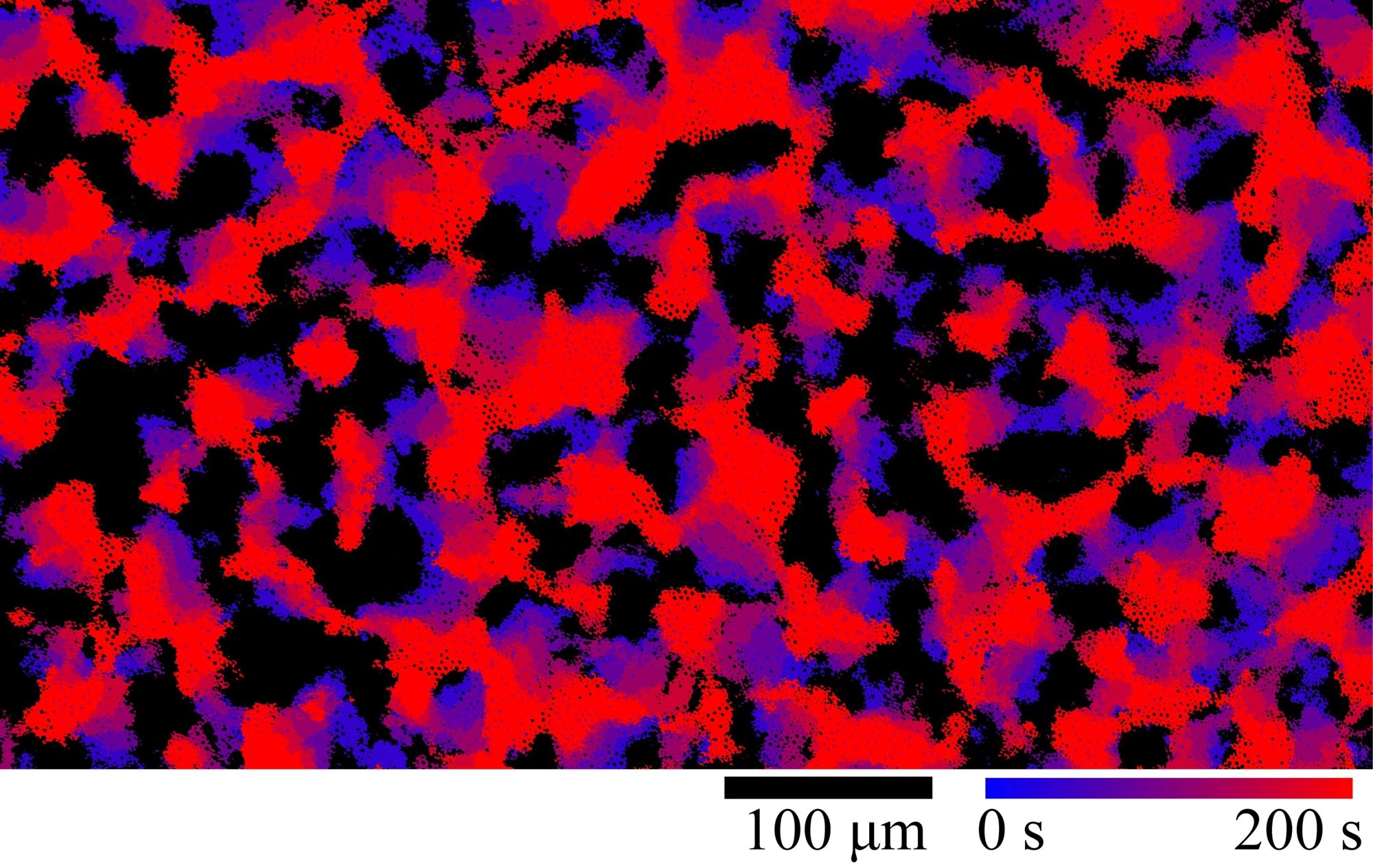
Tokyo University of Science researchers demonstrate that over 10,000 colloidal particles can move collectively by breaking action-reaction symmetry. The particles, which lack self-propulsion, formed asymmetric pairs and sustained motion for over an hour when exposed to an alternating electric field, according to a study published Aug. 6 in Physical Review Letters.
Experimental Design
The team suspended polystyrene colloidal particles of two sizes — 1 and 1.5 micrometers in radius — in water between transparent indium-tin-oxide electrodes. An alternating electric field generated electrohydrodynamic (EHD) flows whose strength increased sharply with particle size. The system contained over 10,000 particles and maintained dynamics for more than one hour. The study was led by professor Yutaka Sumino and assistant professor Kiwamu Yoshii at Tokyo University of Science, along with graduate students Shoma Hara, Keisuke Kittaka, Hiroaki Ishikawa, and Masazumi Okada.
Nonreciprocal Interactions
Because EHD flow strength grows with particle size, larger 1.5 µm particles generated stronger flows and attracted smaller 1 µm particles more strongly than vice versa. This imbalance broke the action-reaction symmetry of Newton’s third law, which holds only for passive systems. The result was a nonreciprocal effective interaction where smaller particles effectively "chased" larger ones, leading to spontaneous pairing and asymmetric structures with distinct front-back orientation.
Collective Motion and Significance
The observed dynamics persisted over large scales and long times, establishing the system as an experimentally controllable test bed for nonreciprocal many-body physics. Sumino noted that the platform allows exploration of how broken symmetry gives rise to collective phenomena. The research, published in Physical Review Letters, suggests that active-matter behaviors like swarming and clustering can emerge without individual self-propulsion when interparticle forces are asymmetric.
1 source
Time · lag behind first