
Rochester team's flying focus laser doubles electron energy in plasma accelerators, study finds
This digest was compiled by AI from multiple sources — links to the originals are below.
Researchers led by the University of Rochester’s Laboratory for Laser Energetics have accelerated electrons to more than double the energy predicted by the traditional dephasing limit in laser-plasma accelerators, according to a study published today in Nature Physics. The breakthrough overcomes a fundamental barrier that causes electrons to outrun their accelerating wave, using a flying focus laser pulse that keeps pace with the particles. The result demonstrates a path to compact, high-energy particle sources.
The Dephasing Limit
In laser-plasma accelerators, an intense laser pulse drives a plasma wake with electric fields exceeding 1 GV/cm—orders of magnitude stronger than conventional accelerators. But the electrons, moving at near light speed, outpace the slower-moving wake, causing a process called dephasing that stops energy gain, as explained by Dr. Charlie Arrowsmith, lead author from the University of Rochester’s Laboratory for Laser Energetics. This dephasing limit has restricted the energy reach of compact plasma accelerators for decades.
Flying Focus Solution
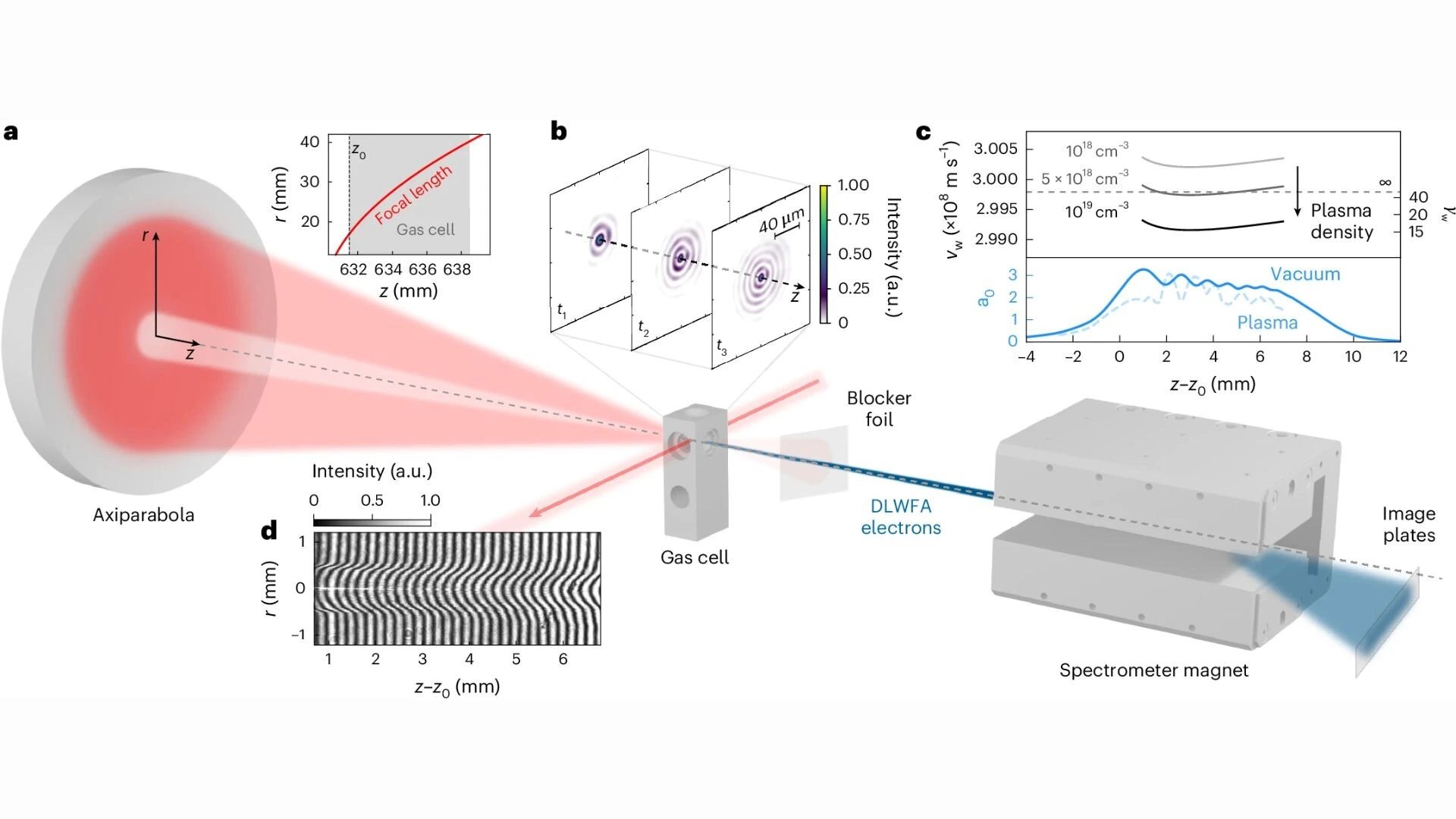
The Rochester team engineered a laser pulse with a ‘flying focus,’ where the beam’s focal point moves independently of its group velocity. By precisely controlling the timing of different radial sections of the pulse, they created a focus that travels at a speed matching the accelerated electrons, effectively counteracting dephasing. This technique, described in Nature Physics, allows the electrons to remain in the accelerating phase of the wakefield for a longer distance.
Record Energy Gain
In experimental tests, the flying focus pulse boosted electron energies to more than twice the traditional dephasing limit for the same acceleration length. The result validates a theoretical prediction from 2022 and marks the first experimental demonstration of dephasing-less laser-plasma acceleration. The achieved energy level, while still in the MeV range, demonstrates proof-of-principle for future high-energy compact sources.
1 source
Time · lag behind first