
Fudan simulations reveal extreme acceleration at quark-gluon plasma edge
This digest was compiled by AI from multiple sources — links to the originals are below.
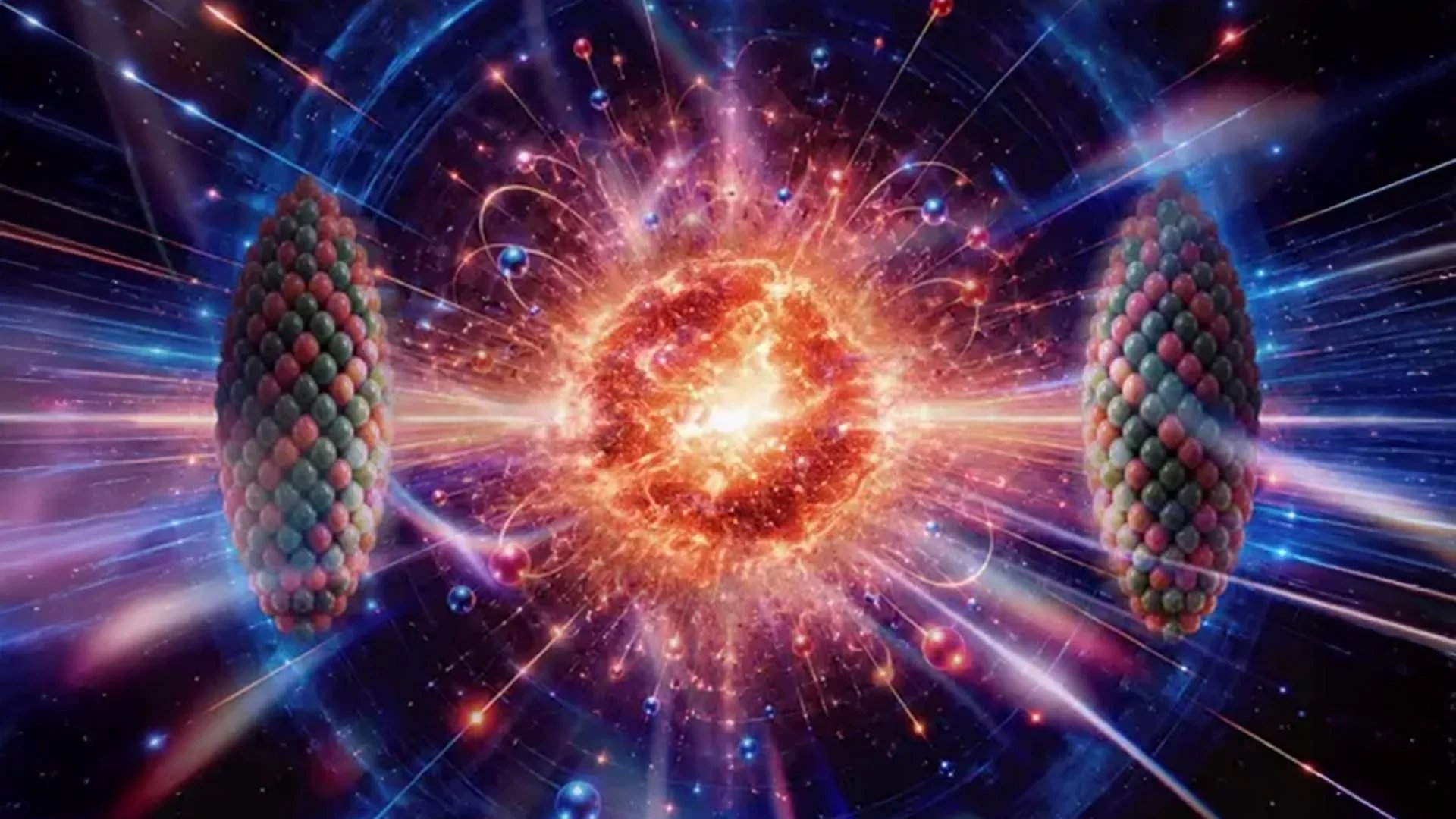
Fudan University physicists have mapped the extreme acceleration that builds up along the edges of quark-gluon plasma, according to new simulations published in Nuclear Science and Techniques on August 3. The acceleration, which reaches several hundred MeV, drives the plasma's explosive expansion and may act as a thermodynamic control parameter. The findings suggest that acceleration has been an overlooked force in the hottest matter ever created.
Acceleration Across Collision Energies
The team combined AMPT and UrQMD particle transport models with a Gaussian smearing method to map how acceleration forms and changes inside quark-gluon plasma. They tracked acceleration across collision energies from 3.5 GeV, typical of the STAR experiment at RHIC, up to 2.76 TeV at the LHC. The simulations showed that peak proper acceleration can reach several hundred MeV, with the strongest transverse acceleration pointing outward near the fireball’s outer boundary. This outward acceleration arises because pressure drops steeply at the edge while enthalpy density decreases, amplifying the effect via the relativistic Euler equation.
Thermodynamic Control Potential
The researchers suggest that acceleration is not merely a kinematic detail but may act as a thermodynamic control parameter of QCD matter. At low collision energies, the acceleration region is more localized, while at higher energies it spreads, indicating a potential influence on the plasma’s state transitions. Professor Xu-Guang Huang notes that this could reshape understanding of how matter behaves under extreme conditions, placing acceleration on equal footing with vorticity and electromagnetic fields. Future studies will need to explore its effects on particle spin and energy dissipation.
1 source
Time · lag behind first