
Europa's hidden ocean may hold twice Earth's water, but its magnetic signal stays faint
This digest was compiled by AI from multiple sources — links to the originals are below.
A 2025 numerical study finds that the magnetic field generated by Europa's convecting saltwater ocean would remain below one nanotesla at the moon's surface, far below the precision of NASA's Europa Clipper magnetic experiment. The finding does not undermine Galileo's earlier magnetic evidence for a subsurface ocean, which came from a larger periodic response to Jupiter's field. Europa's ocean may still hold more than twice the liquid water of all Earth's oceans combined.
Key Facts
- The 2025 study by Libor Šachl, Jakub Kvorka, Ondřej Čadek and Jakub Velímský calculated that Europa's ocean-generated magnetic field would stay below one nanotesla at the surface.
- NASA's Europa Clipper magnetic experiment requires precision far above the modelled signal, making direct detection of ocean currents unlikely.
- Galileo's magnetic evidence for Europa's ocean came from a larger periodic response to Jupiter's field, not from the small signal caused by moving water.
- Europa's probable ocean depth of 60 to 150 kilometres could contain more than twice the liquid water of all Earth's oceans combined.
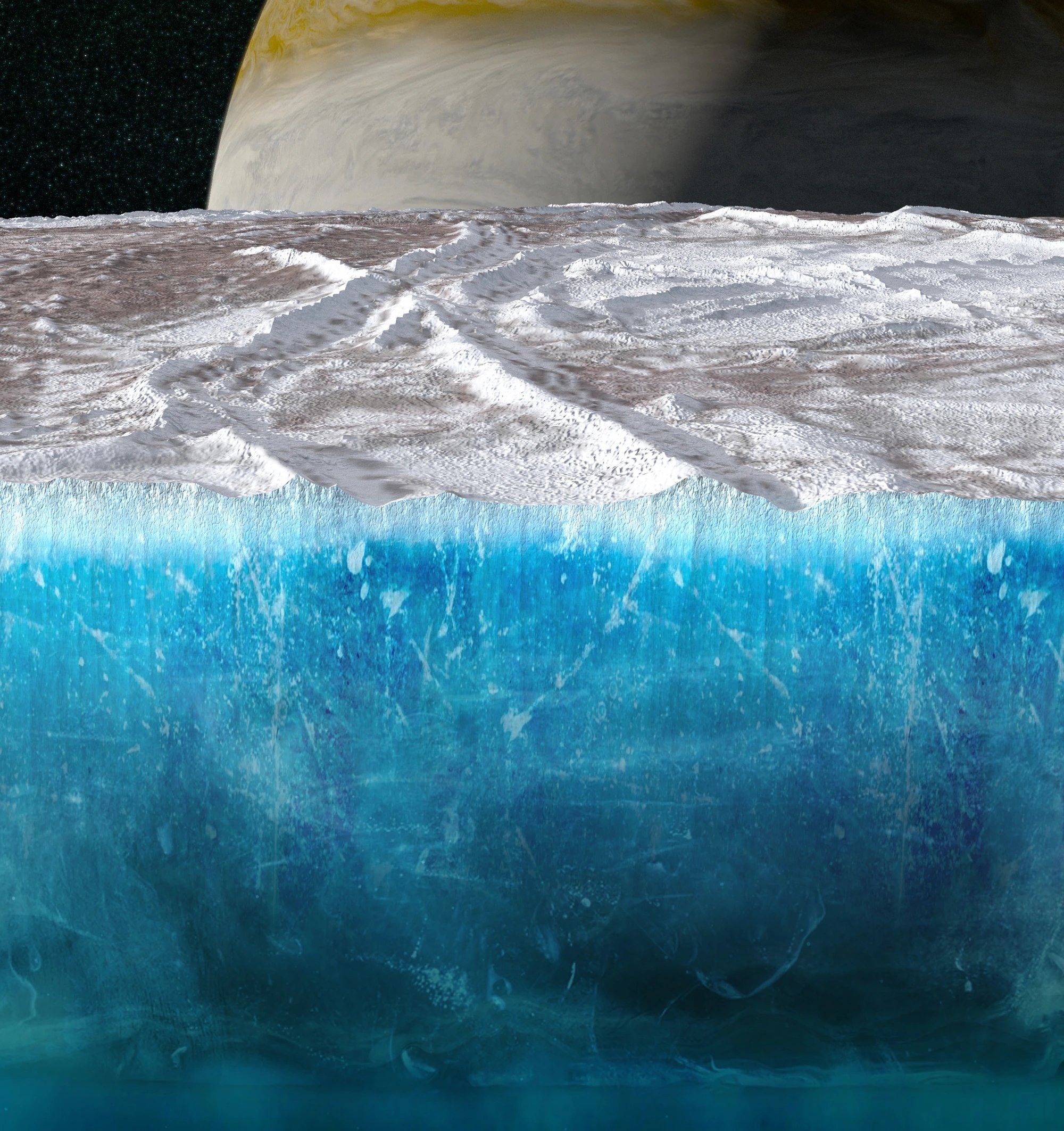
- Europa is about 3,120 kilometres wide, with an ice shell estimated at roughly 29 kilometres thick above the ocean.
Magnetic Signal Limits
The 2025 numerical study by Šachl, Kvorka, Čadek and Velímský found that the magnetic field generated by Europa's convecting saltwater would remain below one nanotesla at the moon's surface. Even their most favourable model barely approached the precision required of NASA's Europa Clipper magnetic experiment. The finding distinguishes between Galileo's magnetic evidence for the ocean, which came from a larger periodic response to Jupiter's field, and the much smaller signal caused by physically moving water. This is one modelling study, not a detection or a settled limit on every possible Europan current.
Ocean Scale
Europa is about 3,120 kilometres wide, with an exterior of water ice marked by bands, ridges, fractures and chaos terrain. NASA's current description places the probable ocean at roughly 60 to 150 kilometres deep, which could contain more than twice the liquid water held by all of Earth's oceans. SpaceDaily previously examined an estimate that puts about 29 kilometres of solid ice above the ocean. Earth's seas average only about four kilometres deep, while Europa's liquid shell tens of kilometres deep wrapped around the entire moon adds up quickly.
Ocean Dynamics
Heat enters from the rocky interior and leaves through the ice, while Jupiter's tides continually deform the moon. Europa rotates once per orbit, and density changes as water warms, cools, freezes and becomes more or less salty. Together these processes can organise fluid motion across enormous distances, with models describing convection, eddies, broad circulation cells and east-west currents beneath the ice.
1 source
Time · lag behind first