Chinese physicists create Bose-Einstein condensate from ultracold polar molecules
This digest was compiled by AI from multiple sources — links to the originals are below.
Researchers from The Chinese University of Hong Kong and the Chinese Academy of Sciences have created a Bose-Einstein condensate using sodium-rubidium molecules, a milestone in ultracold physics. The achievement, reported in Nature Physics, overcomes long-standing challenges of molecular loss during cooling by employing a microwave shielding technique. The condensate opens avenues for studying strongly interacting quantum systems with long-range dipolar interactions.
The Breakthrough
Researchers from The Chinese University of Hong Kong and the Institute of Theoretical Physics, Chinese Academy of Sciences, successfully created a Bose-Einstein condensate (BEC) from sodium-rubidium (NaRb) molecules. The team cooled the polar molecules to temperatures near absolute zero, where they collectively occupy the same quantum state. The result, published in Nature Physics, marks the first realization of a molecular BEC with ultracold polar molecules, extending a line of research that began with atomic BECs in 1995.
Loss Suppression Technique
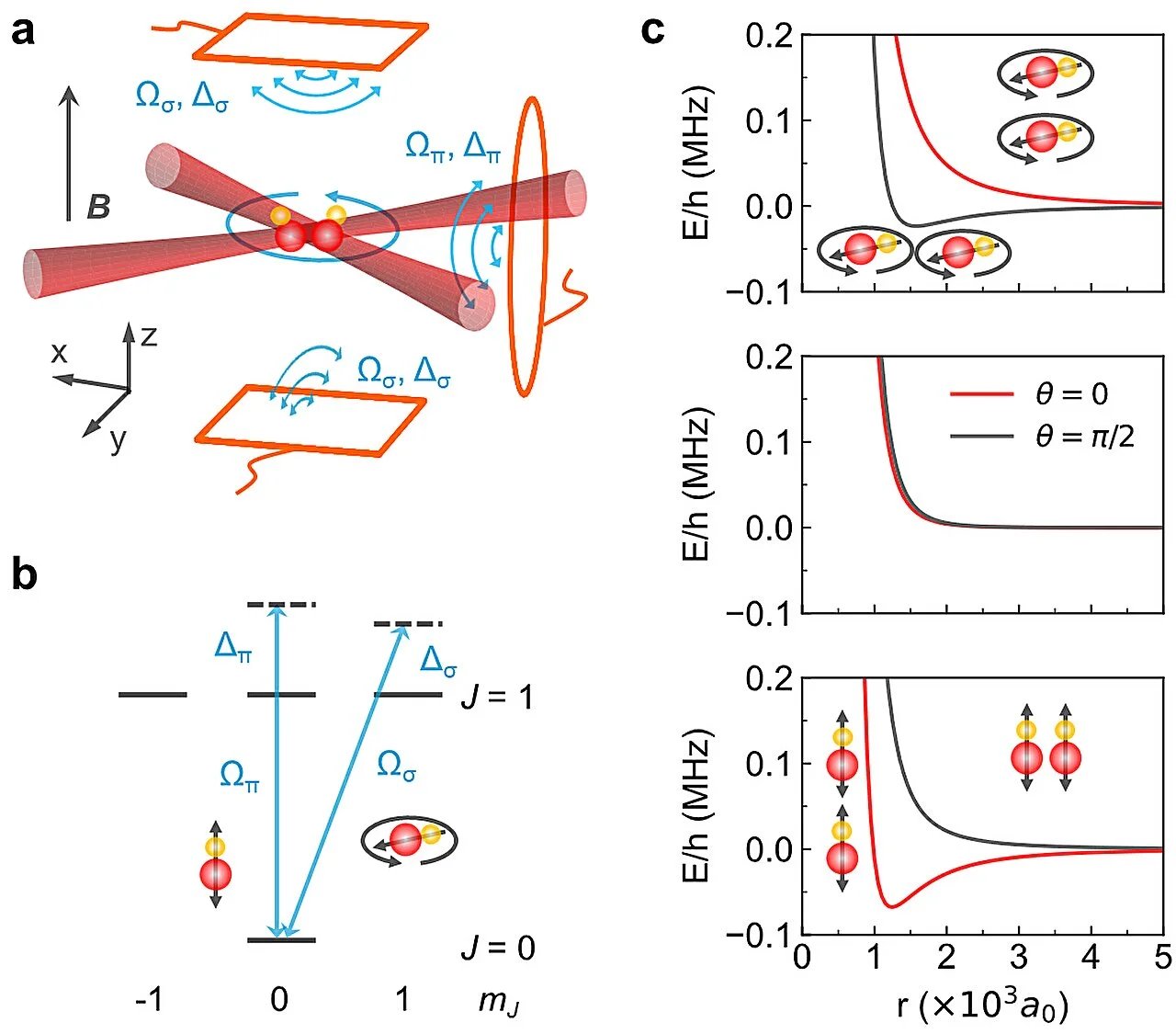
Creating a BEC from polar molecules has been hindered by two-body collisional losses that occur during cooling. The researchers employed a dual-microwave loss suppression method, previously demonstrated with NaCs molecules, to protect the NaRb molecules. This technique shields the molecules from chemical reactions that would otherwise prevent cooling to quantum degeneracy. The approach allowed efficient evaporative cooling without significant molecule loss, achieving condensation.
Scientific Implications
Polar molecules possess permanent electric dipole moments and rich internal structure, enabling new types of quantum simulation. The molecular BEC opens the door to studying strongly interacting many-body phenomena and long-range dipolar physics. It may lead to advances in quantum computing, precision measurement, and understanding of exotic quantum phases. The work builds on decades of effort in ultracold physics, following the first polar molecule creation in 2008 at JILA.
What's Next
The team plans to explore novel quantum phases and dynamics in the dipolar condensate. It remains unclear how scalable the technique is for other polar molecule species.
1 source
Chinese physicists create Bose-Einstein condensate from ultracold polar molecules