Berkeley Lab team creates exciton condensate in semiconductor, switchable by magnetic field
This digest was compiled by AI from multiple sources — links to the originals are below.
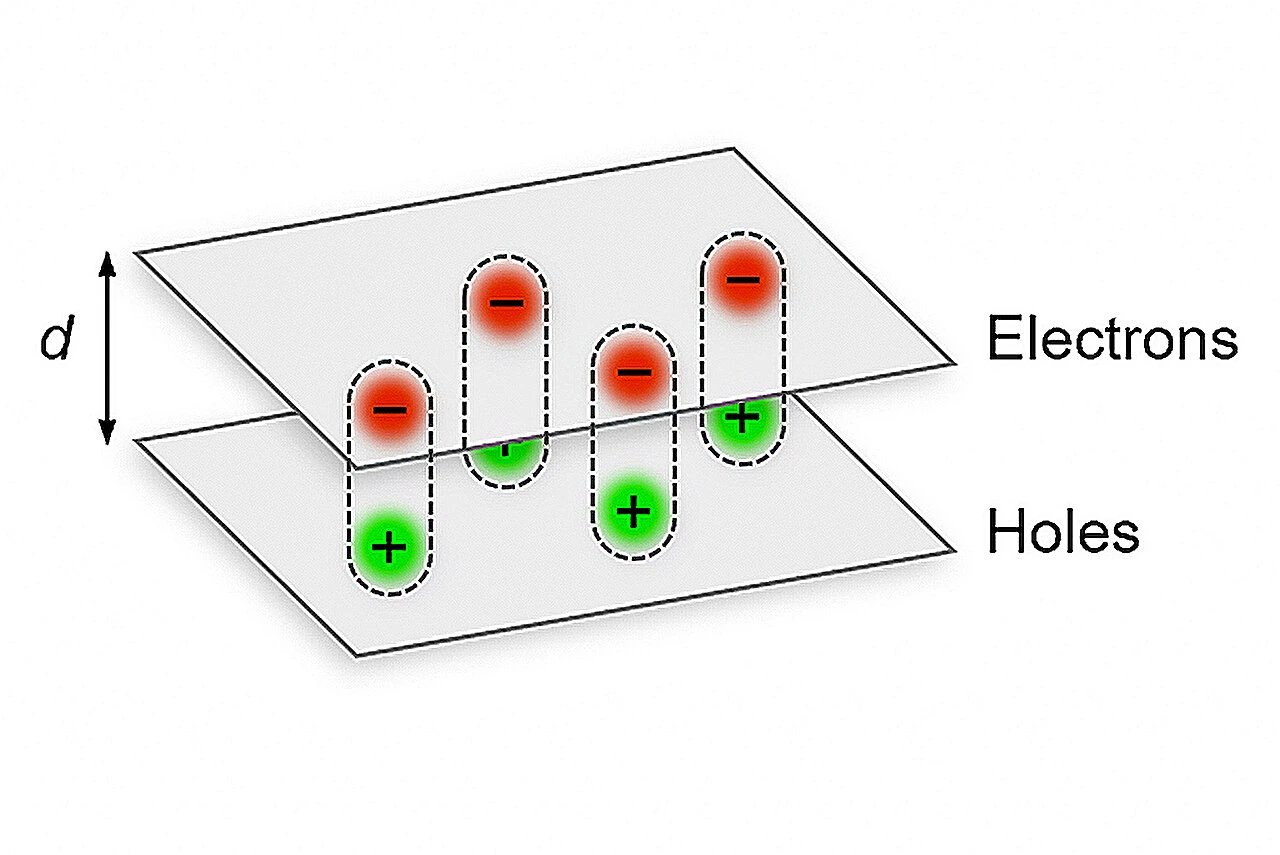
Researchers led by Lawrence Berkeley National Laboratory have created a Bose-Einstein condensate of excitons in an atomically thin semiconductor at temperatures up to 2 kelvins, as reported in Nature. The condensate exhibits internal states that can be switched with a magnetic field, opening a new platform for quantum fluids in solid materials. The persistence of the condensate at relatively high temperatures—millions of times warmer than previous demonstrations in ultracold gases—surprised the team.
Device Engineering
Feng Wang’s team at Berkeley Lab built a 2D semiconducting device that hosts excitons in their ground state rather than excited states. Using electrical gates, they tuned exciton density, and magneto-optical spectroscopy at cryogenic temperatures confirmed that the excitons formed a Bose-Einstein condensate. Unlike optically generated excitons that decay within a billionth of a second, these ground-state excitons reached equilibrium and persisted.
Magnetic Switching and Stability
The condensate showed internal structure switchable by magnetic fields, revealing hidden quantum order. The signatures remained up to 2 kelvins—still frigid but far warmer than ultracold gas BECs. This stability, combined with tunability, makes the platform promising for quantum simulations and coherent optoelectronics.
What's Next
The team plans to explore whether the condensate can be manipulated at even higher temperatures and integrated with other quantum devices. It remains unclear how the internal order can be harnessed for practical quantum information processing, but the platform could enable new types of exciton-based electronics.
1 source
Berkeley Lab team creates exciton condensate in semiconductor, switchable by magnetic field