
Boston College physicists create electrostatic trap for charged excitons enabling quantum light control
This digest was compiled by AI from multiple sources — links to the originals are below.
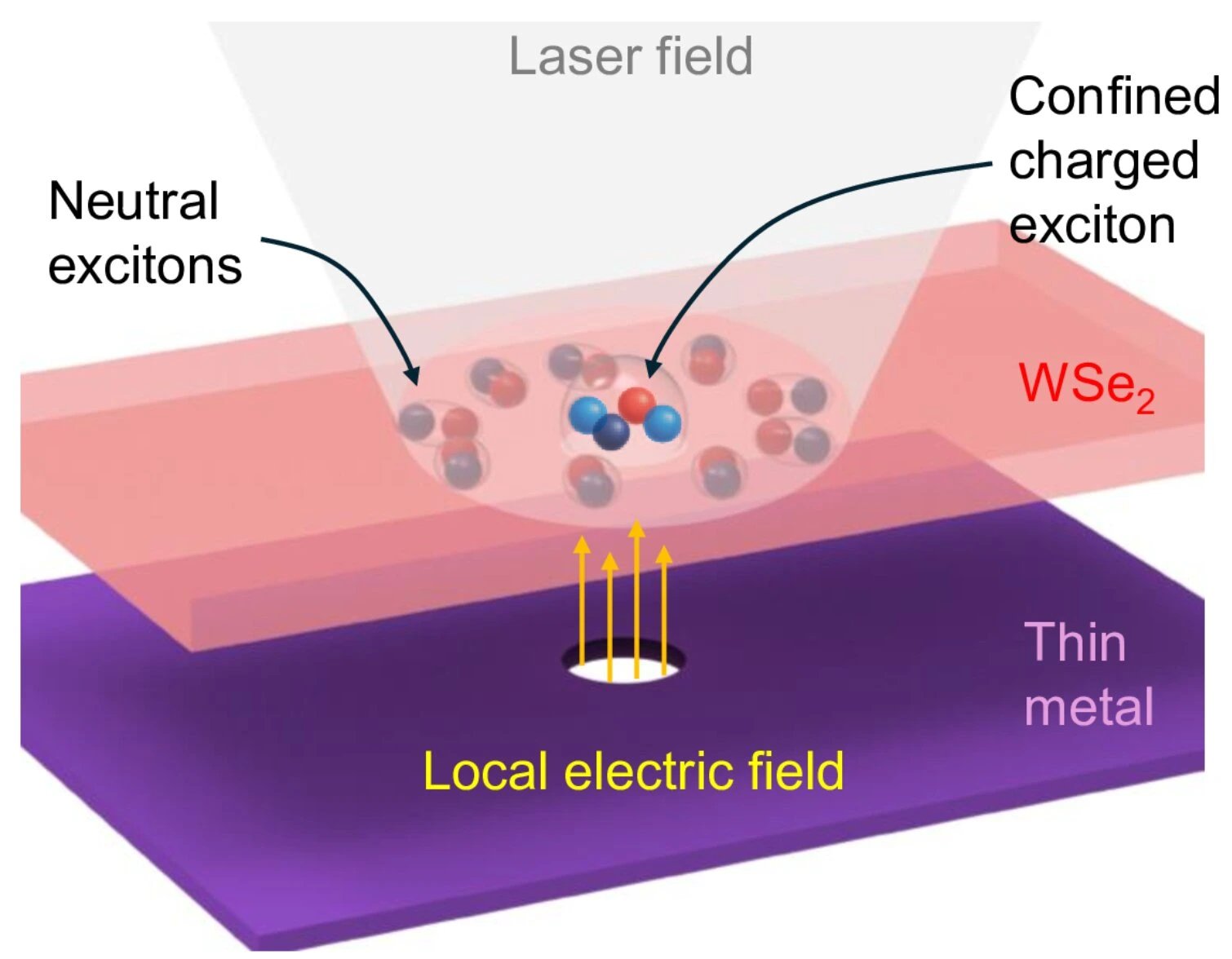
Researchers led by Boston College physicists Qiong Ma and Kenneth Burch create an electrically tunable quantum nanoscale corral that traps charged excitons. The device enables precise electrical control of tiny light sources, including their brightness, color and quantum states, the team reports today in Nature Nanotechnology. The finding was unexpected, emerging from an experiment originally designed to study a different effect.
The Electrostatic Nanocorral
The trap consists of an extremely thin, porous metal layer that generates highly focused electric fields, allowing charged excitons to be held in place by surrounding neutral particles. The device, made from tungsten diselenide (WSe₂), can be switched on and off electrically, transitioning between tightly confined and freely moving excitons. The team, led by Ma and Burch, included postdoctoral researcher Zumeng Huang, former postdocs Zhe Sun and Jian Tang, and six graduate students.
Quantum Light Control
The electrostatic nanocorral enables precise electrical control of the brightness, color and quantum states of light emitted from trapped excitons. This capability addresses a key challenge in quantum technologies: efficiently connecting matter-based quantum states with light. Excitons, which interact strongly with light, are prime candidates for quantum communication and photonic devices, but confining charged excitons at the nanoscale had been difficult. The new method provides a reliable way to trap and manipulate them, advancing tunable quantum light sources.
1 source
Time · lag behind first