
Global telescopes capture supernova shock breakout for only second time in 20 years
This digest was compiled by AI from multiple sources — links to the originals are below.
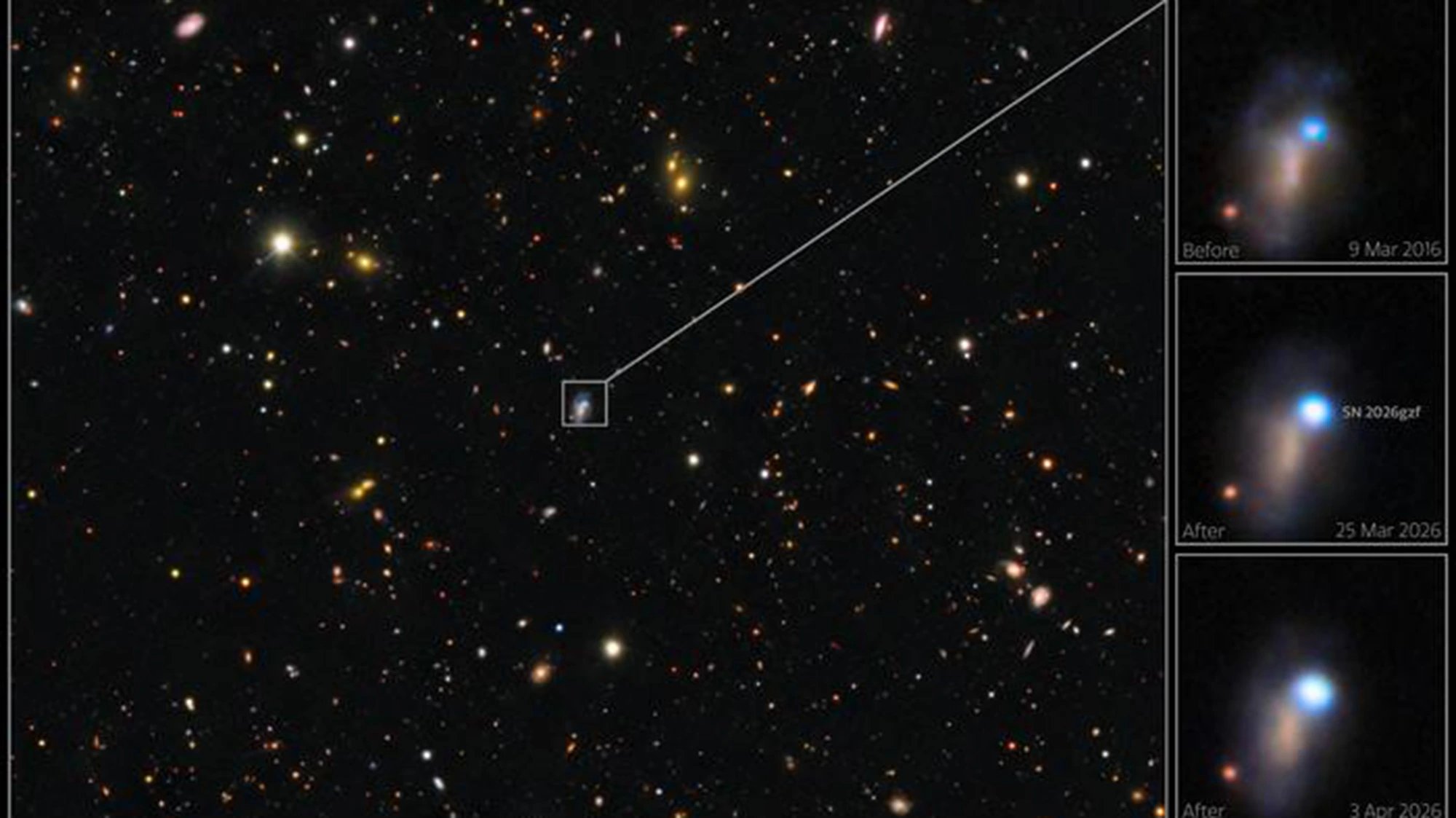
A global fleet of telescopes captured the shock breakout of a supernova 500 million light-years away, marking only the second such observation in two decades. The explosive death of a star 20 times the sun's mass was first spotted in March by China's Einstein Probe X-ray telescope. The observations revealed the faintest shock breakout for a Type Ic-BL supernova and no associated gamma-ray bursts, surprising astronomers.
The Detection
China's Einstein Probe X-ray telescope first detected the explosion in March. Within an hour, ground-based telescopes identified it as a supernova. The Vera C. Rubin Observatory, which began its 10-year Legacy Survey of Space and Time in June, was already observing the COSMOS Deep Drilling Field where the supernova appeared. The Dark Energy Spectroscopic Instrument and other facilities also joined rapid follow-up observations.
The Surprising Findings
Astronomers classified the event as a Type Ic broad-lined (Ic-BL) supernova, a type that usually produces gamma-ray bursts. The shock breakout—the first flash of light as the star collapses—was captured in unprecedented detail, only the second such observation in two decades. However, no gamma-ray bursts were detected, and the shock breakout was the faintest recorded for this supernova type. Researchers suggest the jet may have been choked by stellar material. The results were published July 14 in The Astrophysical Journal Letters.
1 source
Time · lag behind first