
Astronomers link 10-minute X-ray burst to neutron star merger 6 billion light-years away
This digest was compiled by AI from multiple sources — links to the originals are below.
Astronomers have obtained the first convincing evidence that fast X-ray bursts can arise from neutron star collisions. The Einstein Probe telescope detected a nearly 10-minute X-ray burst, EP250704a/GRB 250704B, at redshift z=0.6610. Follow-up observations with ESO's Very Large Telescope revealed absorption lines of iron and magnesium, ruling out a supernova.
Key Facts
- The X-ray burst EP250704a/GRB 250704B lasted nearly 10 minutes and was detected by the Einstein Probe telescope.
- Spectroscopic observations with ESO's Very Large Telescope measured the burst's redshift at z=0.6610, corresponding to a distance of over 6 billion light-years.
- Absorption lines of iron and magnesium were detected in the burst's spectrum, and no supernova was found at the location.
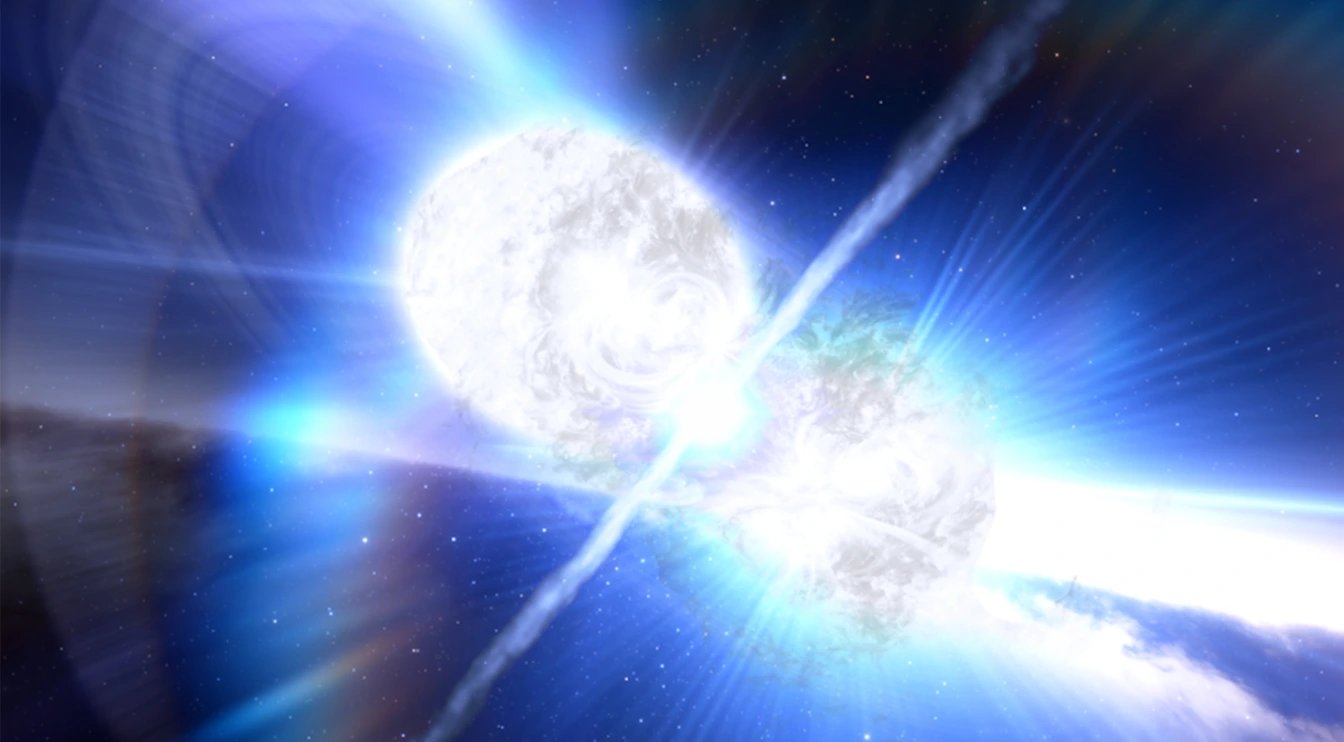
- The event is interpreted as the merger of two neutron stars, possibly leaving behind a magnetar that powered the prolonged X-ray emission.
Detection and Follow-up
The Einstein Probe, a European-Chinese X-ray telescope, detected the burst EP250704a/GRB 250704B. Within minutes, astronomers began observations with ESO's Very Large Telescope in Chile and other observatories. The X-shooter spectrograph on the VLT dispersed the burst's light and revealed absorption lines of iron and magnesium. The measured redshift of z=0.6610 places the source at a distance of more than six billion light-years.
Interpretation as Neutron Star Merger
A search for a supernova at the burst location found none, ruling out that alternative explanation. The nearly 10-minute duration and the measured distance point instead to a merger of two neutron stars. Neutron stars are ultra-dense remnants of massive stars, and their collisions release enormous energy and gravitational waves. Researchers suggest the merger may have produced a magnetar, a rapidly spinning neutron star with an extremely strong magnetic field. Such a magnetar could power the unusually prolonged X-ray emission observed in EP250704a.
Implications for Future Observations
Previously, short gamma-ray bursts lasting less than two seconds were considered the main electromagnetic signature of neutron star mergers. EP250704a shows that such events can produce significantly longer X-ray emission. Future gravitational-wave astronomy could help link neutron star mergers to X-ray signals and precisely localize these events.
1 source
Time · lag behind first