Japan scientists discover human norovirus GII.3 capsid adopts two conformations
This digest was compiled by AI from multiple sources — links to the originals are below.
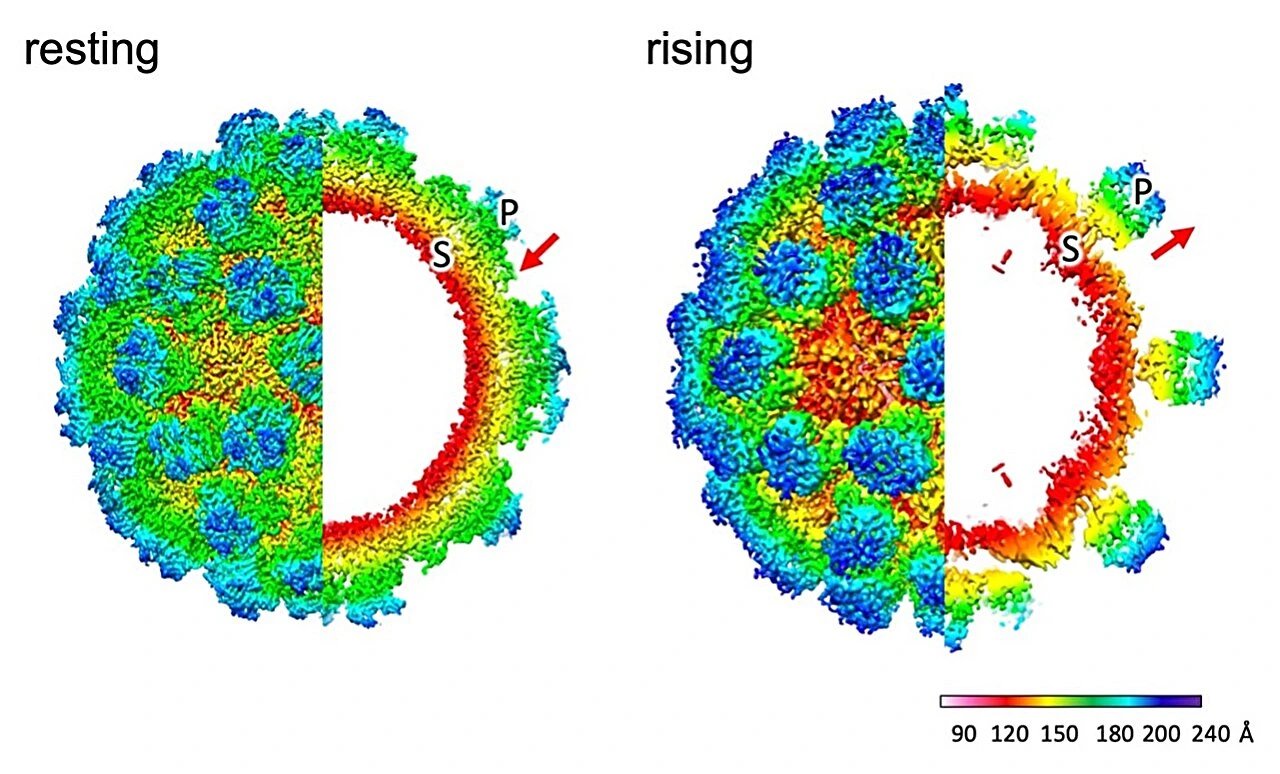
A team led by Kazuyoshi Murata used cryo-electron microscopy to reveal that virus-like particles of human norovirus GII.3 exist in two distinct conformations: a resting state and a rising state. The findings, published July 24 in the International Journal of Molecular Sciences, show the protruding P domain shifts position by 1 nm and rotates ~55° between states. The structural dynamics offer new targets for antiviral development, even as no effective drugs are currently available.
The Two Conformations
Using cryo-EM at near-atomic resolution, the Murata team imaged VLPs of the GII.3 strain, which has caused multiple regional outbreaks. A single sample contained capsids in both resting and rising conformations. In the resting state, the P domain sits adjacent to the shell domain; in the rising state, it lifts approximately 1 nm and rotates 55°, exposing new surfaces. The P domain in the rising state is significantly more flexible than in the resting state.
Interaction Network Reorganization
The structural shift is mediated by a reorganization of protein–protein contacts. In the resting state, the P domain’s P2 subdomain forms an extensive interaction network with neighboring capsid proteins. Upon elevation, the network shifts to the P1 subdomain. This pattern mirrors conformational changes previously observed in murine norovirus using cell-culture models, suggesting a conserved mechanism.
Public Health Impact
Human norovirus infects 600–700 million people annually and is the leading cause of acute gastroenteritis globally. Research has been hampered because the virus cannot be efficiently grown in cultured cells. The new structural data may guide the design of antiviral compounds that lock the capsid in one conformation, potentially preventing infection. The GII.3 genotype has been linked to repeated epidemics in East Asia.
What's Next
The research group plans to investigate how the conformational dynamics influence host-cell attachment and immune evasion. It remains unclear whether small molecules that stabilize the resting state could serve as effective antivirals.
1 source
Japan scientists discover human norovirus GII.3 capsid adopts two conformations