NTU team develops reusable molecular helper for pure chiral rotaxanes
This digest was compiled by AI from multiple sources — links to the originals are below.
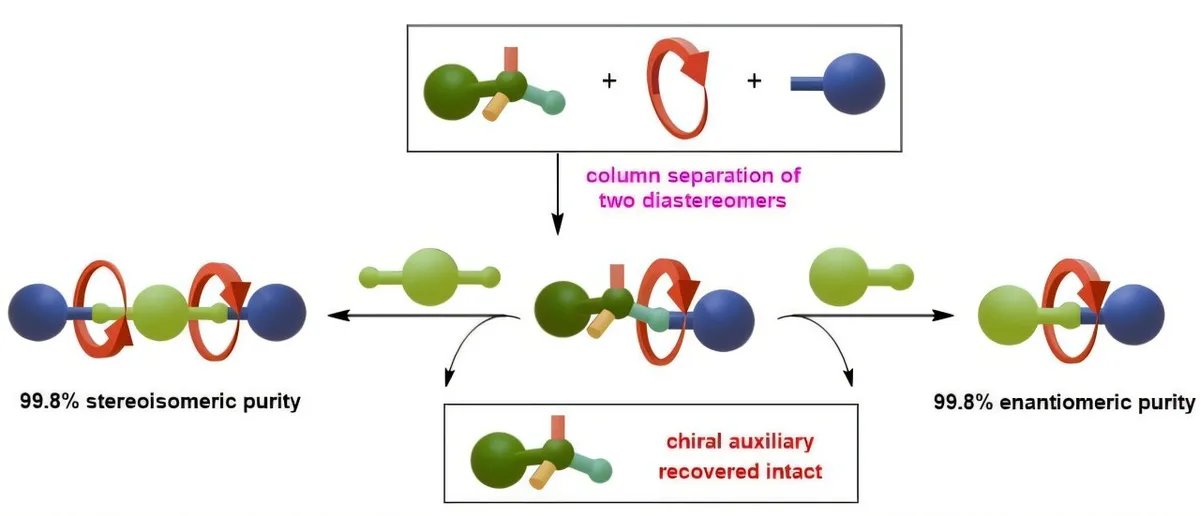
Researchers at National Taiwan University have developed a practical method using a recoverable chiral auxiliary to synthesize mechanically planar chiral rotaxanes with enantiomeric purity up to 99.6% ee. The approach enables scalable production of these interlocked molecules, which are promising for molecular switches, catalysts, and sensors.
The Synthetic Challenge
Chiral rotaxanes, where chirality arises from the fixed orientation of achiral components in a mechanically interlocked structure, are difficult to prepare in pure single-enantiomer forms. Traditional methods often yield low quantities and require complex separation. The new strategy addresses this by using a removable chiral auxiliary that guides the formation of the desired interlocked structure.
The Reusable Auxiliary
The chiral auxiliary forms diastereomeric intermediates that can be separated by column chromatography. After conversion to the target rotaxanes, the auxiliary is recovered intact for reuse, making the process more economical. The team achieved enantiomeric purities up to 99.6% ee for simple rotaxanes and 99.8% stereoisomeric purity for a complex rotaxane with two rings on one axle.
Broader Implications
The method provides a reliable platform for exploring mechanically chiral molecules in catalysis, molecular recognition, sensing, and chiroptical materials. Corresponding author Sheng-Hsien Chiu noted that the difficulty of preparing pure chiral interlocked molecules has long hampered applications, and this work opens the door to new chiral materials.
What's Next
The team plans to apply the strategy to other mechanically interlocked structures and explore their use in functional materials. It remains unclear whether the method can be scaled to industrial production or adapted for other chiral architectures.
1 source
NTU team develops reusable molecular helper for pure chiral rotaxanes