
Amsterdam scientists use cling film to transfer large 2D material sheets
This digest was compiled by AI from multiple sources — links to the originals are below.
An Amsterdam-based research team has developed a method to transfer centimeter-scale sheets of atom-thin materials onto patterned surfaces without cracking, using ordinary kitchen cling film. The technique, reported in ACS Nano, overcomes the 22‑year limitation of adhesive tape exfoliation that only produced microscopic flakes. The breakthrough could accelerate the fabrication of ultrathin electronic and optical devices.
The Transfer Challenge
Since the discovery of two‑dimensional materials like graphene, scientists have faced the problem of isolating large, usable sheets. The standard approach—pressing adhesive tape onto a crystal and peeling—yields flakes smaller than a human hair. In 2018, gold‑assisted exfoliation enabled centimeter‑scale sheets, but only on flat substrates. Transferring these fragile layers onto patterned surfaces, such as those with electrical contacts, caused tears and cracks, rendering them useless for most practical devices.
Cling Film Solution
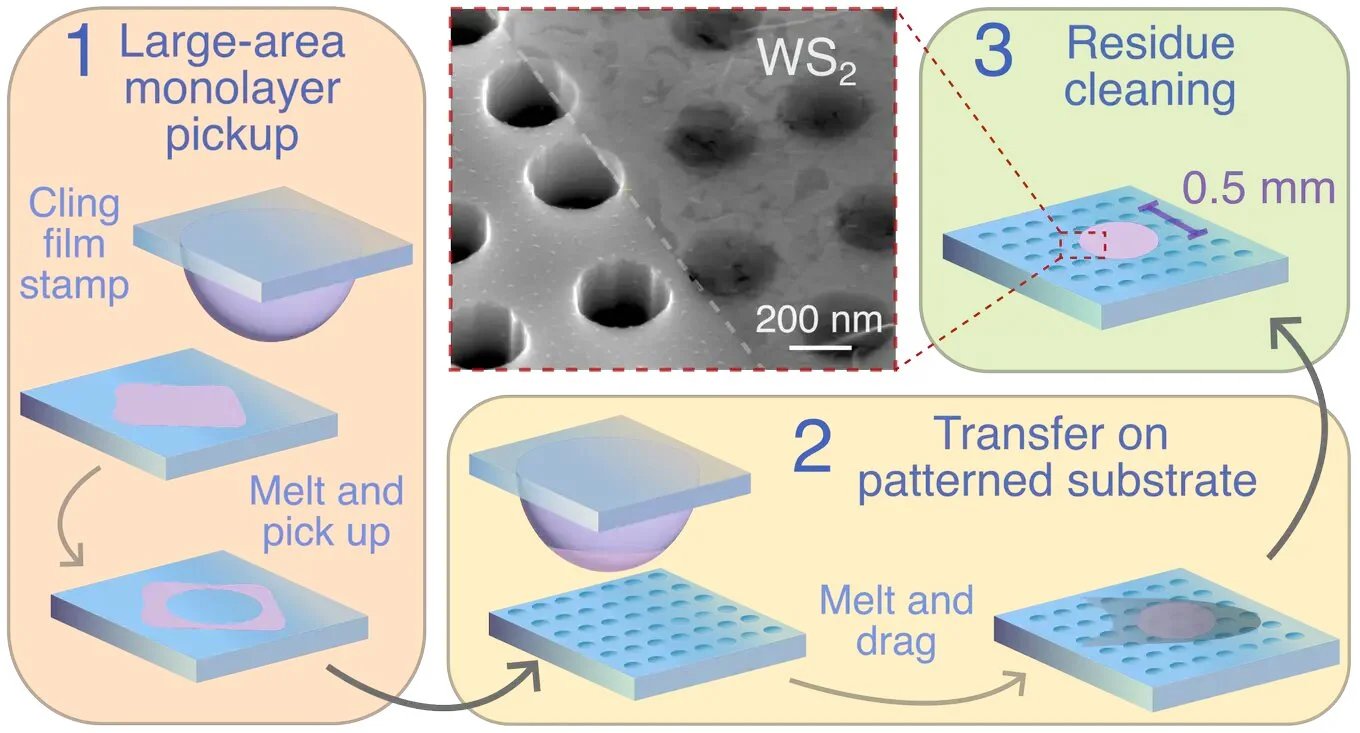
The Amsterdam team, led by PhD student Bernardo Dias, found that kitchen cling film can act as a flexible, temporary support during transfer. After peeling a 2D material sheet off a gold film, the researchers laminated it with cling film and floated it in water to remove the gold, then applied it to a patterned surface. The cling film stretched and conformed to the textures without breaking the sheet. The method successfully transferred sheets several centimeters across, published in ACS Nano.
Device Applications
The technique opens the door to integrating 2D materials into real‑world electronics and optics. Because of their unique electrical and optical properties, these ultrathin layers can improve transistors, sensors, and light‑emitting devices. The cling film process is compatible with standard semiconductor fabrication steps and uses a material that leaves minimal residue. Researchers are now exploring its use with a variety of 2D materials, including transition metal dichalcogenides.
1 source
Time · lag behind first