
KAIST coating boosts condensation heat transfer 5.5 times
This digest was compiled by AI from multiple sources — links to the originals are below.
KAIST researchers developed a polymer coating that increases condensation heat transfer up to 5.5 times compared with copper surfaces. The coating promotes droplet formation and rapid detachment, improving efficiency in power plants, desalination, and electronics cooling.
Key Facts
- The coating increases condensation heat transfer performance by up to 5.5 times compared with conventional copper surfaces.
- KAIST announced the development on August 23.
- The joint team was led by Professor Youngsuk Nam from Mechanical Engineering and Professor Sung Gap Im from Chemical and Biomolecular Engineering.
- The coating was produced using initiated chemical vapor deposition (iCVD).
The Coating Technology
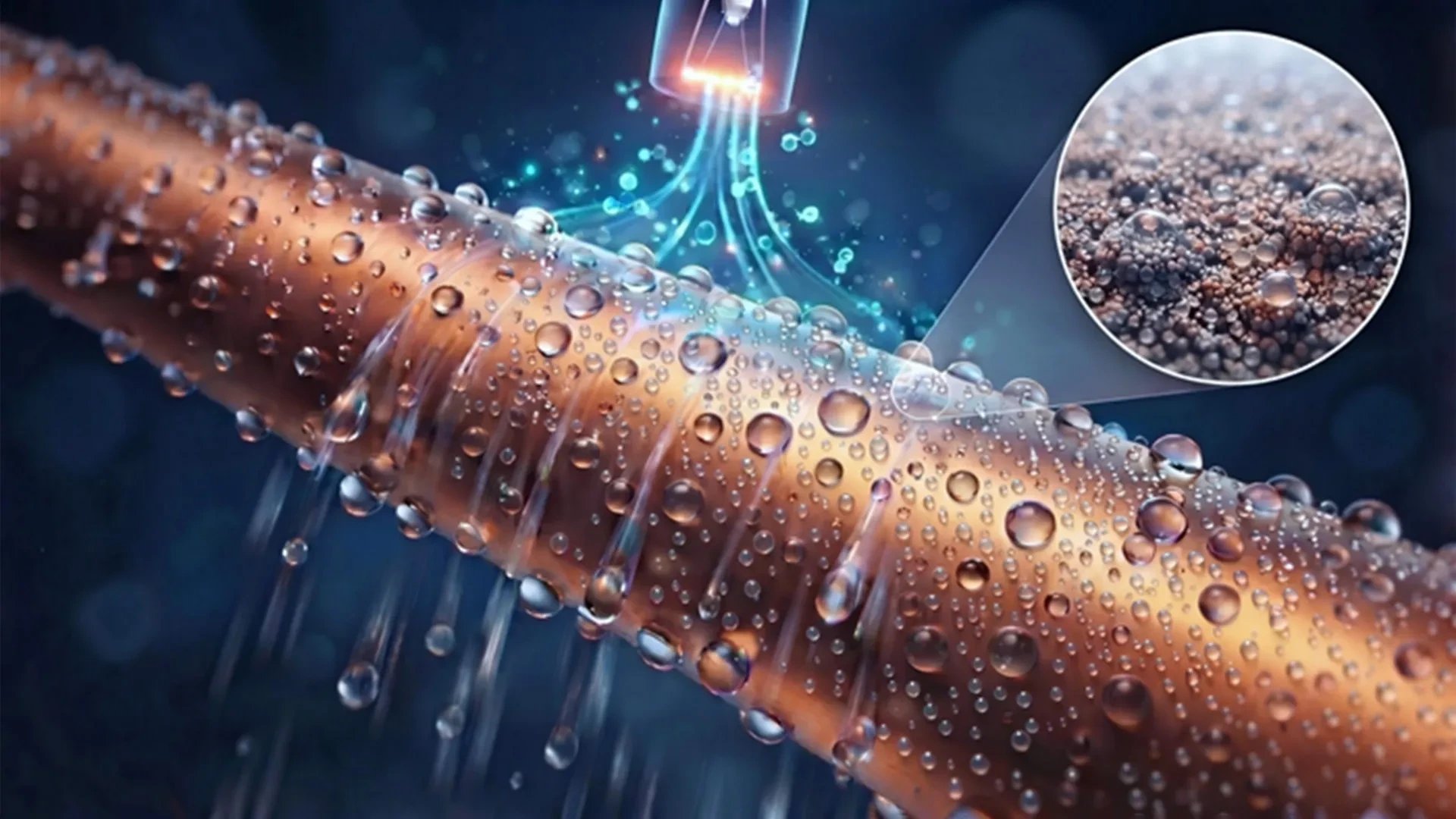
The coating works by helping water droplets form more easily and detach more quickly. The researchers carefully controlled the thickness and structure of an ultrathin polymer coating. The coating encourages more droplets to appear as water vapor condenses while making it easier for those droplets to leave the surface. The coating was produced using initiated chemical vapor deposition (iCVD), which deposits gas-phase precursors onto a surface to form an extremely thin polymer layer. When the researchers made the polymer film thinner, many small polymer aggregates appeared across the surface.
Condensation Heat Transfer
Condensation occurs when water vapor changes into liquid water. In industry, condensation plays an important role in converting steam back into water at power plants, producing fresh water from seawater, and carrying heat away from electronic equipment. On ordinary metal surfaces, small droplets often merge into a continuous film of water that acts as an additional barrier to heat flow. Dropwise condensation, where water remains in individual droplets that repeatedly form and detach, allows heat to move through the surface more effectively.
Droplet Formation and Removal
Previous surface designs faced a trade-off between nucleation and droplet mobility. Rough surfaces provide more places for droplets to begin forming but can trap the droplets and make them difficult to remove. Smoother surfaces allow droplets to slide or detach more easily but provide fewer sites where new droplets can form. The researchers addressed this problem by taking advantage of nanoscale polymer aggregates that had previously been treated as unwanted defects in polymer coatings.
1 source
Time · lag behind first