
Kazakhstan critical raw material exports hit $16.9 bln in 2025
This digest was compiled by AI from multiple sources — links to the originals are below.
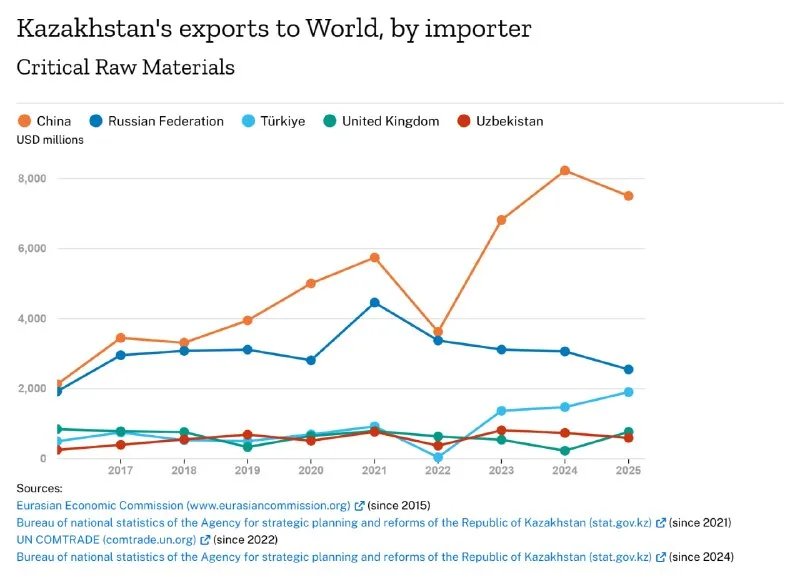
Kazakhstan exported $16.9 billion worth of critical raw materials (CRM) in 2025, accounting for 21.4% of total exports, according to the International Trade Centre (ITC). China was the largest buyer, purchasing $7.5 billion, or 44% of CRM exports. The country's CRM exports remain dominated by copper cathodes, ores, and ferrochrome, with limited domestic processing.
Export Structure
Copper cathodes and sections led CRM exports at $3.58 billion, followed by copper ores and concentrates ($2.85 billion) and ferrochrome ($1.65 billion), according to ITC data cited by Tengenomika. Silver exports reached $740 million, unwrought zinc $619 million, and refined copper $518 million. Unwrought aluminum and aluminum oxide added $517 million and $427 million respectively, while flat-rolled iron and steel products and iron ores contributed $364 million and $360 million.
Market Position
Kazakhstan accounted for an estimated 0.7–0.8% of global CRM trade in 2025, with total CRM exports of $16.9 billion representing 21.4% of the country's total export revenue, Tengenomika reported. Beyond China, major buyers included Russia ($2.6 billion), Turkey ($1.9 billion), the UK ($768 million), Uzbekistan ($597 million), Kyrgyzstan ($464 million), and Japan ($432 million). The CRM category encompasses not only rare earths but also copper, aluminum, chromium, zinc, lithium, and cobalt.
Processing Gap
The export structure remains heavily weighted toward raw ores, concentrates, and primary metallurgy products, with limited domestic value addition, according to Tengenomika. Expanding deep processing — such as cathode copper, battery materials, and specialty alloys — could boost export revenue and create jobs. Inbusiness.kz noted that Kazakhstan has strengthened its position in the CRM market but still relies on China as the dominant buyer.
2 sources
Time · lag behind first