
Argonne supercomputer maps pion internal structure in new detail
This digest was compiled by AI from multiple sources — links to the originals are below.
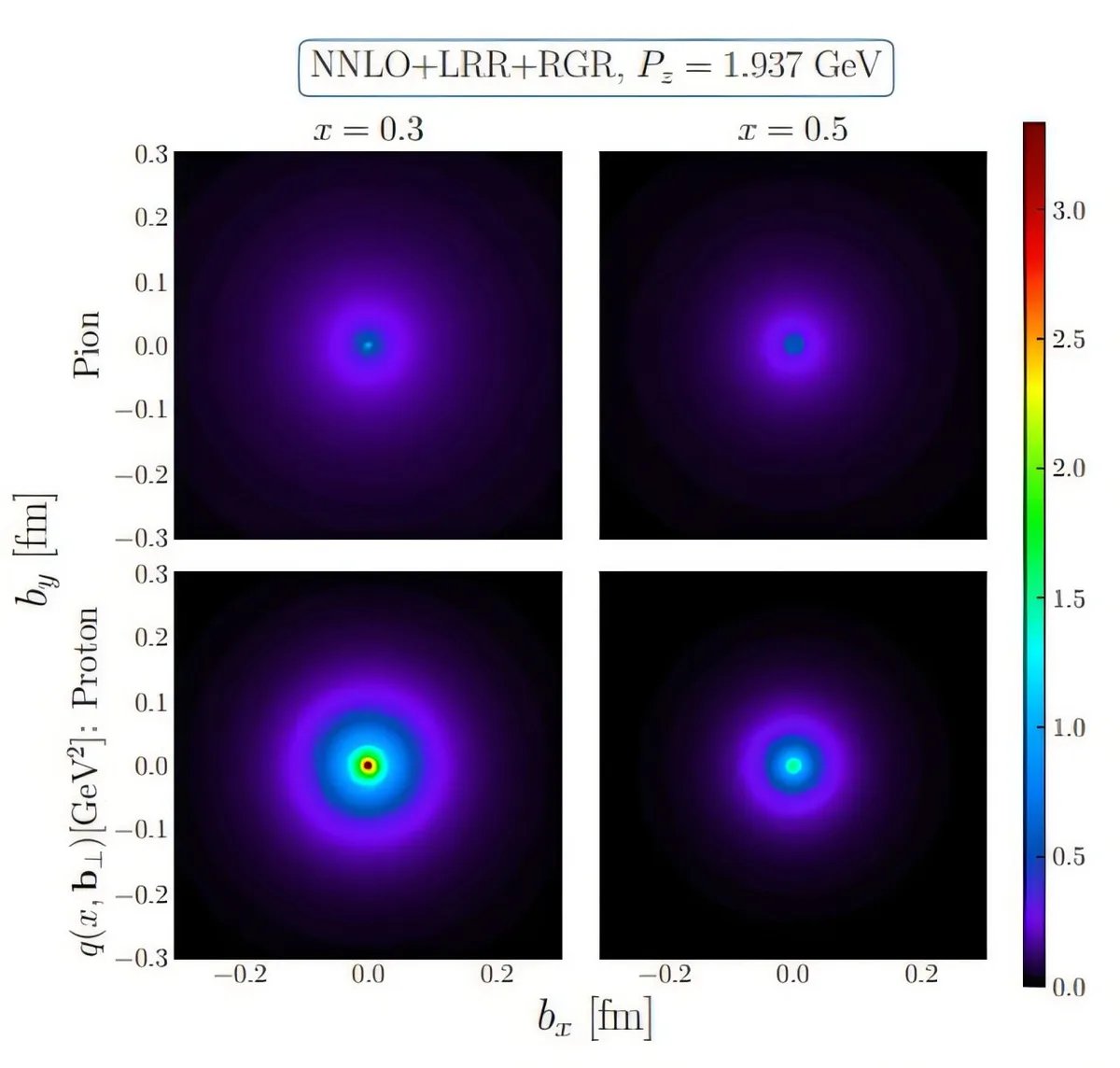
Researchers used the Frontier supercomputer at the U.S. Department of Energy's Argonne National Laboratory to map the internal structure of a pion with unprecedented precision. The findings, published in the Journal of High Energy Physics, reveal how quarks and gluons are distributed within the subatomic particle that helps bind matter together.
The Simulation
The team employed lattice quantum chromodynamics (QCD) calculations on the Frontier supercomputer, the world's first exascale system. The simulation modeled the strong force interactions binding quarks inside the pion, a particle composed of one quark and one antiquark. The computation required over 10 million core-hours on Frontier's AMD MI250X GPUs.
Key Findings
The results provided the first high-resolution view of the pion's parton distribution functions (PDFs), showing how quarks and gluons carry momentum within the particle. The data matched experimental measurements from particle colliders within 1% accuracy. This level of detail could improve predictions for experiments at facilities like the Electron-Ion Collider.
Argonne's Dual Transformation
The U.S. Department of Energy’s Argonne National Laboratory is undergoing a transformation with the introduction of the Aurora supercomputer and the upcoming upgrade of the Advanced Photon Source. These new research tools will enable scientists to uncover the secrets of new materials.
2 sources
Time · lag behind first