
Scientists decipher burnt scrolls using lead detection without unrolling
This digest was compiled by AI from multiple sources — links to the originals are below.
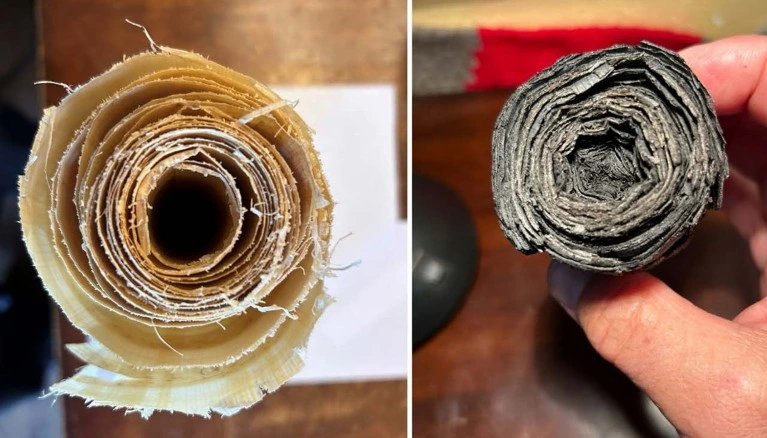
Researchers recreated carbonized papyrus scrolls and deciphered their text by detecting lead in the ink, according to a study published Wednesday in PLoS ONE. The method could help read the only known complete library from antiquity, the Herculaneum scrolls buried by the eruption of Vesuvius in AD 79. The team used traditional materials from Egypt and Japan to simulate the ancient scrolls.
Key Facts
- The study was published last Wednesday in PLoS ONE.
- The eruption of Vesuvius in AD 79 carbonized more than 1,000 papyrus scrolls in Herculaneum.
- Douglas Seiler, a retired inventor and affiliate of the University of California, Berkeley, led the research.
- The team sourced papyrus and reed pens from Egypt and traditional lampblack ink from Japan.
The Experiment
Douglas Seiler and his colleagues attempted to recreate carbonized scrolls by sourcing papyrus and reed pens from Egypt and traditional lampblack ink from Japan. They used ink with various concentrations of lead to inscribe the papyrus. The papyri were rolled up and placed in a high-temperature furnace to replicate the roasting that the ancient scrolls underwent at Herculaneum. The team then showed that they could decipher the text by detecting the element lead in the ink.
Herculaneum Scrolls
In AD 79, the Roman town of Herculaneum was destroyed by a cataclysmic eruption of Vesuvius, with a cloud of hot gas, ashes and pumice burning people and objects. Waves of volcanic mud then buried the town, carbonizing more than 1,000 brittle papyrus scrolls and preserving them in that state. It is the only known complete library from antiquity. A few scrolls were physically unrolled after their discovery in 1752, but many crumbled into ash, quickly halting these efforts.
Digital Unrolling
In the past few years, X-ray computed tomography combined with machine learning has allowed researchers to digitally unroll some scrolls and decipher the writing inside. Last year, a team won a US$60,000 prize in the Vesuvius Challenge by using an algorithm to identify a Greek work. Earlier this year, a whole scroll was deciphered without being opened. Standard CT scanning techniques struggle to spot letters because both the ink and papyrus contain carbon, but detecting lead instead may overcome this problem.
1 source
Time · lag behind first