
Aral Sea Drying Exposes Carbon Emissions and Restoration Dilemma
This digest was compiled by AI from multiple sources — links to the originals are below.
The drying Aral Sea has become a source of carbon emissions as its exposed lakebed transforms into the Aralkum desert. Kazakhstan and Uzbekistan face a strategic choice between reflooding the former seabed or greening it into a stable terrestrial landscape. The decision will shape the region's environmental and economic future for decades.
Key Facts
- The Kokaral Dam, completed in 2005, raised the North Aral Sea's water volume to over 27 cubic kilometers by 2025.
- Water salinity in the Small Aral Sea dropped almost fourfold to 8-15 g/L after the Kokaral project, enabling recovery of more than 20 fish species.
- By 2025, the water level in the Small Aral exceeded 42 meters on the Baltic System, compared to 20 meters in the Western Aral Sea.
- The Aralkum desert has formed on the former lakebed where fishing vessels sailed just decades ago.
The Aral Sea's Fragmentation
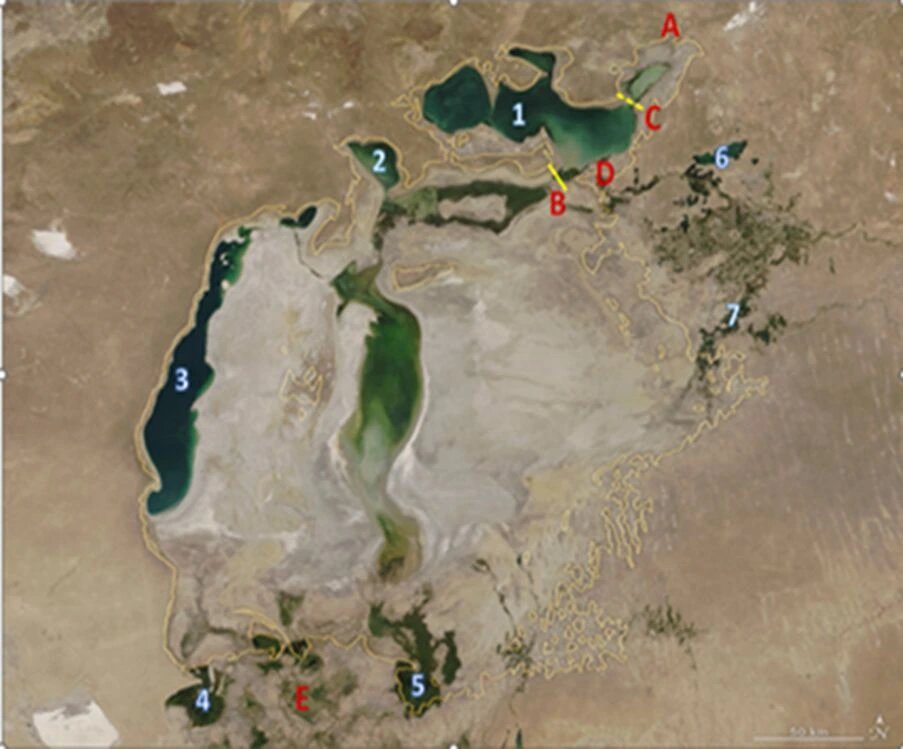
Today's Aral Sea is no longer a single body of water but several separate water systems and vast dried-up lakebed areas. The Aralkum desert has emerged on the former seabed, replacing areas once navigated by fishing vessels. The Small Aral Sea in Kazakhstan demonstrates that ecological damage can be partially reversed under the right conditions. The Kokaral Dam, built in 2005, separated the northern Small Aral from the southern Great Aral Sea.
Restoration and Economic Revival
The Kokaral Dam stopped Syr Darya water from draining south, allowing accumulation in the Small Aral Sea. By 2025, the North Aral Sea's water volume exceeded 27 cubic kilometers and its surface area reached 3,400 square kilometers, according to the Ministry of Water Resources. Water salinity dropped almost fourfold to 8-15 g/L, supporting the recovery of more than 20 fish species. The ecological restoration of the Small Aral is closely tied to its economic impact on local communities.
1 source
Time · lag behind first