
NIST physicist opens sealed envelope after 10-year gravitational constant experiment
This digest was compiled by AI from multiple sources — links to the originals are below.
Physicist Stephan Schlamminger of the National Institute of Standards and Technology opened a sealed envelope containing the result of his team's decade-long measurement of the universal gravitational constant. The experiment aimed to resolve persistent discrepancies among measurements of big G, which remains less precisely known than other fundamental constants. The envelope's contents reveal whether the team's data align with or diverge from previous results.
Key Facts
- Stephan Schlamminger, a physicist at the National Institute of Standards and Technology, spent a decade measuring the universal gravitational constant, known as big G.
- Scientists have been attempting to measure big G for more than 225 years, beginning roughly a century after Isaac Newton introduced his law of universal gravitation.
- Measurements of big G disagree by roughly one part in 10,000, a discrepancy larger than expected from ordinary experimental uncertainty.
- The experimental masses used in laboratory measurements of gravity are about 500 billion trillion times smaller than Earth.
The Sealed Envelope
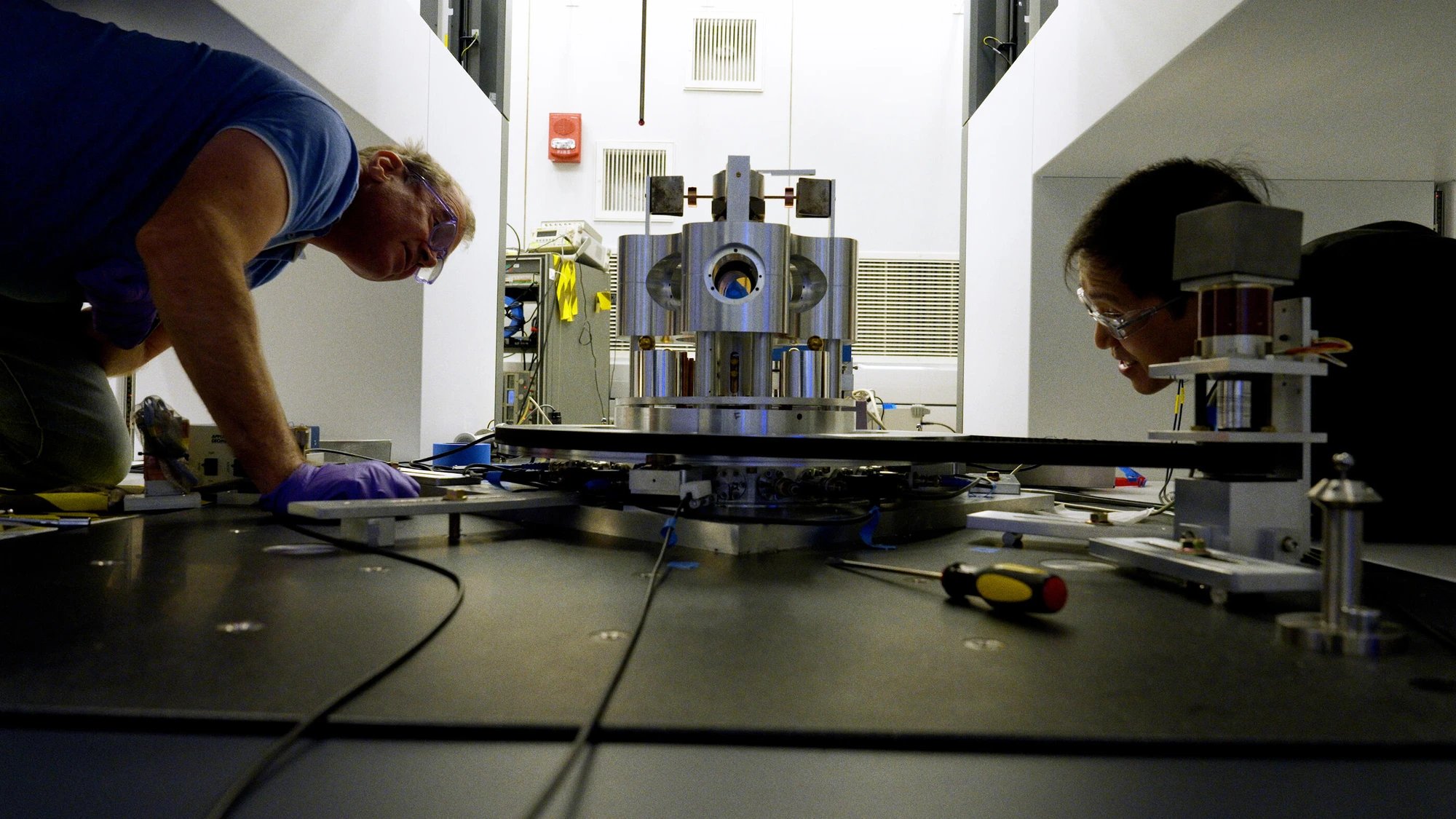
Stephan Schlamminger, a physicist at the National Institute of Standards and Technology, spent much of the previous decade trying to measure the universal gravitational constant. After 10 years of experiments, corrections, and analysis, the answer was sitting inside a sealed envelope. The number hidden in the envelope was the key that would finally unscramble his experimental data and reveal what his team had measured.
Gravity's Elusive Number
Gravity keeps people anchored to Earth, guides planets around the Sun, and helps gather stars into galaxies. Yet scientists still do not know its fundamental strength with the precision they have achieved for other basic forces of nature. The gravitational constant remains less precisely known than comparable constants associated with electromagnetism and the strong and weak nuclear forces. A magnet roughly the size of a pinhead can lift a paper clip against the gravitational pull of the entire Earth, demonstrating gravity's extraordinary weakness.
Measurements That Refuse to Agree
Modern instruments have become extraordinarily sensitive, but measurements of big G continue to produce slightly different answers. The disagreements are small, roughly one part in 10,000, yet still larger than researchers would expect from ordinary experimental uncertainty. The most likely explanation is that some subtle experimental effect has been overlooked. But there is also a far more intriguing possibility: perhaps scientists are missing something about gravity itself.
3 sources
Time · lag behind first