
Scientists observe Einstein's gravity in quantum world for first time
This digest was compiled by AI from multiple sources — links to the originals are below.
An international team including Nobel laureate Sir Roger Penrose directly observed a gravitational effect in a falling quantum object for the first time. The experiment confirmed that Einstein's equivalence principle holds for quantum particles under the conditions tested. The research was published September 2 in Science Advances.
Key Facts
- The experiment directly observed a gravitational effect in a falling quantum object for the first time.
- The research was led by Ben-Gurion University of the Negev, the University of Ulm, and the University of Oxford.
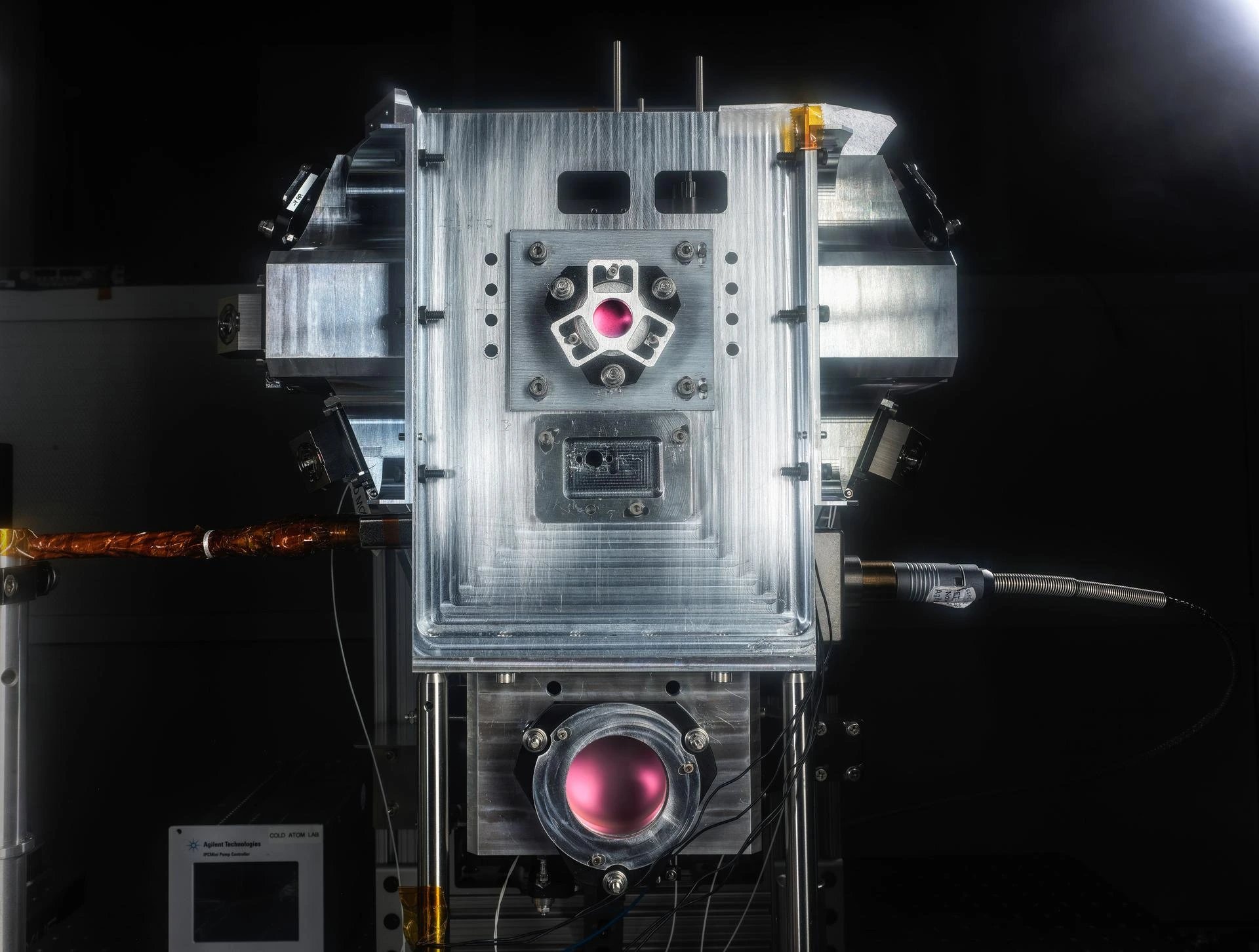
- The team used an instrument called the Quantum Galileo Interferometer to split the quantum wave of an atom into two paths.
- The experiment was carried out using clouds of rubidium atoms cooled to temperatures just above absolute zero.
Testing Einstein's Equivalence Principle
The equivalence principle states that gravity should effectively vanish locally for an observer in free fall. The principle has been confirmed with extraordinary precision using ordinary matter, but testing it directly with quantum objects has been much more difficult. Quantum objects can behave like waves and can effectively follow more than one path at the same time. The team built an instrument called the Quantum Galileo Interferometer to make such a test possible.
Splitting an Atom Into Two Quantum Paths
The experimental team, including PhD student Or Dobkowski, used microwave pulses to place ultracold atoms into a quantum superposition. This effectively allowed each atom to follow two paths at once. Tiny electrical wires built into the chip generated carefully controlled magnetic fields. One part of the atomic wave interacted with the magnetic field, creating an upward force that precisely balanced the downward pull of gravity. As a result, that portion of the wave remained stationary relative to the laboratory and the Earth.
1 source
Time · lag behind first