
10-year Treasury yield tops 5%, highest since 2007, surpassing CBO forecasts
This digest was compiled by AI from multiple sources — links to the originals are below.
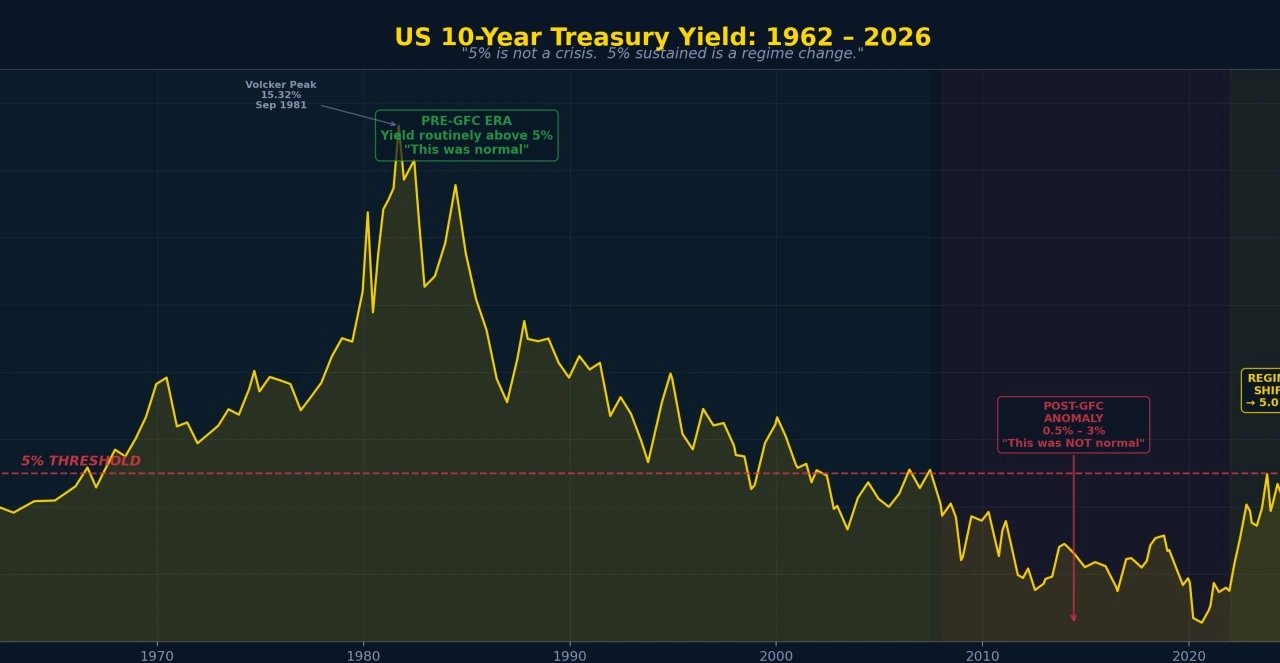
The 10-year U.S. Treasury yield topped 5% this week, the highest since 2007, exceeding the Congressional Budget Office's February forecast of 4.1% for this year. The surge raises U.S. borrowing costs and could push annual interest payments to $2.7 trillion by 2030 if yields stay elevated. The jump comes even as the economy runs hot and geopolitical shocks become more frequent.
Key Facts
- The 10-year Treasury yield topped 5% this week, the highest since 2007.
- The CBO's February outlook projected the 10-year yield at 4.1% for 2026 and 4.2% for 2027.
- The Committee for a Responsible Federal Budget estimates annual interest payments could reach $2.7 trillion by 2030 if yields remain more than 80 basis points above baseline.
- The 10-year yield has jumped a full percentage point since late February, when the Iran war began.
- Market veteran Ed Yardeni, who coined the term 'bond vigilantes', now says a debt crisis is possible if the bond market starts to worry.
Yield Surge
The 10-year Treasury yield topped 5% this past week, the highest level since 2007. The CBO's February long-term outlook had projected the yield at 4.1% for 2026 and 4.2% for 2027. The yield was expected to hover around 4.3% from 2028 to 2031, then tick up to 4.4% from 2032 to 2036. The 10-year yield has jumped a full percentage point since right before the Iran war started in late February and a half point in the past two months alone.
Debt Burden
Yields determine how much the Treasury Department must pay in interest on the U.S. debt, which can accelerate as rates go up. The U.S. has accumulated $40 trillion in debt and runs $2 trillion in annual budget deficits that show no sign of improving. The Committee for a Responsible Federal Budget estimated that if yields remain more than 80 basis points over baseline projections, the U.S. will spend $2.7 trillion on annual interest payments by the end of the decade. That amount would exceed Medicare or Social Security retirement benefits.
Market Reaction
Maya MacGuineas, president of the Committee for a Responsible Federal Budget, said on Monday that a fiscal crisis, once unthinkable, is now a distinct possibility. Market veteran Ed Yardeni, who coined the term 'bond vigilantes', had maintained that yields of 4% to 5% are a normal range for a robust U.S. economy. As yields surged over the summer, Yardeni was unfazed, saying there was still no sign that the bond vigilantes were revolting. In a note on Tuesday, Yardeni wrote: 'We will worry about a debt crisis when the bond market worries about a debt crisis.'
1 source
Time · lag behind first