
Atlantic currents act as global heat valve, study finds
This digest was compiled by AI from multiple sources — links to the originals are below.
An international team led by Kristo Beyert analyzed Atlantic meridional overturning circulation using three climate models and ice-core data from Greenland and Antarctica. The study, published in Nature Geoscience, finds the circulation acts as a heat valve that releases ocean heat to the atmosphere when strong and traps it when weak. The mechanism explains past abrupt climate shifts during the Pleistocene.
Key Facts
- The study was published in Nature Geoscience.
- Researchers used three climate models and ice-core data from Greenland and Antarctica.
- The team was led by Kristo Beyert and included David Bonan of the University of Washington.
- The analysis focused on Dansgaard–Oeschger cycles, abrupt climate oscillations of the Pleistocene.
The Heat Valve Mechanism
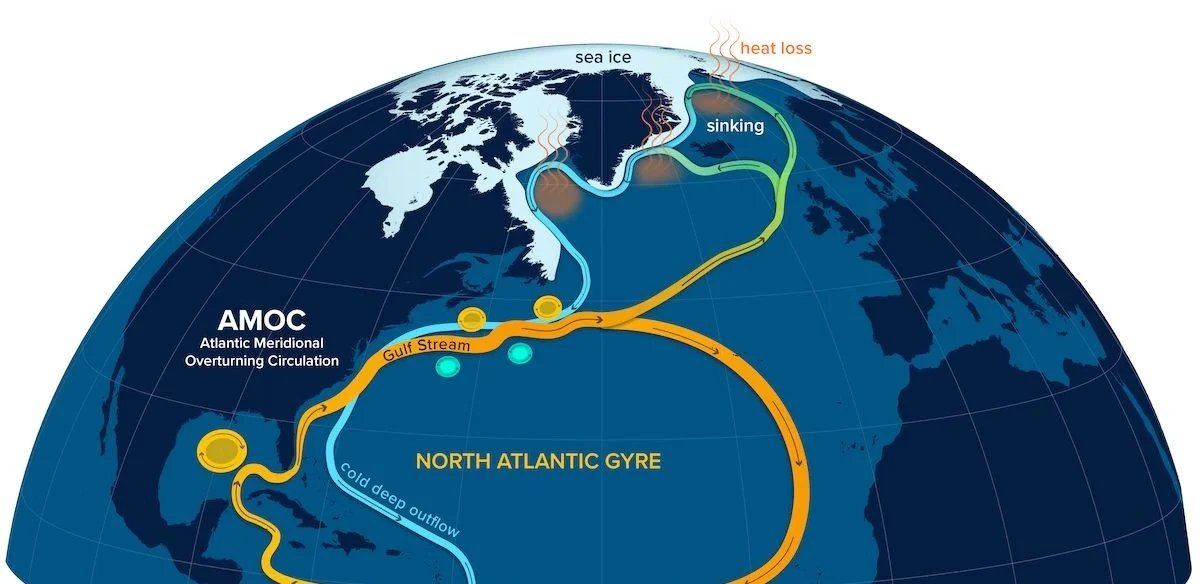
The Atlantic meridional overturning circulation (AMOC), which includes the Gulf Stream, functions as a global heat valve rather than a simple heat conveyor. When the circulation strengthens, active mixing in the North Atlantic releases heat from the ocean into the atmosphere and onward to space. When it weakens, mixing declines and heat accumulates inside the ocean. This mechanism explains why past abrupt warmings in Greenland were accompanied by slower changes in Antarctica.
Implications for Future Climate
The authors caution against directly extrapolating the findings to the future because ice-age conditions with extensive sea ice differ greatly from today's warming ocean. The work changes the understanding of the Atlantic's role in the climate system: its weakening threatens not only cooling in Europe but also additional global heating. The Atlantic circulation is already weakening amid glacier melt and freshwater influx, so scientists are closely monitoring its state. The circulation affects the climate of Europe and the entire Northern Hemisphere, including precipitation and temperature patterns.
1 source
Time · lag behind first